POLITE
If you’d like to… · If you would… · If I may…
If you’d like to follow me…
would = willingness ENGLISHCUE
Until 30 November: try EnglishCue PRO for US$0.99 your first week, then US$19.90/month, cancel anytime. Try PRO · US$0.99 →
C2 English grammar lesson · Conditionals · PRO · 60 min
If you’d like to follow me… If I may say so… If you’re hungry, there’s soup. If anything, it’s got worse.
A receptionist says: “If you’d like to follow me, I’ll show you to your room. If you’re hungry, the restaurant is open until eleven. If you would sign here, please.” Later, a guest complains: “The new chef? If he’s a chef, I’m a pilot! The food hasn’t improved — if anything, it’s got worse.” None of these are real conditions: they are polite, practical or rhetorical. By the end of this lesson you can use conditionals for politeness, irony and emphasis.
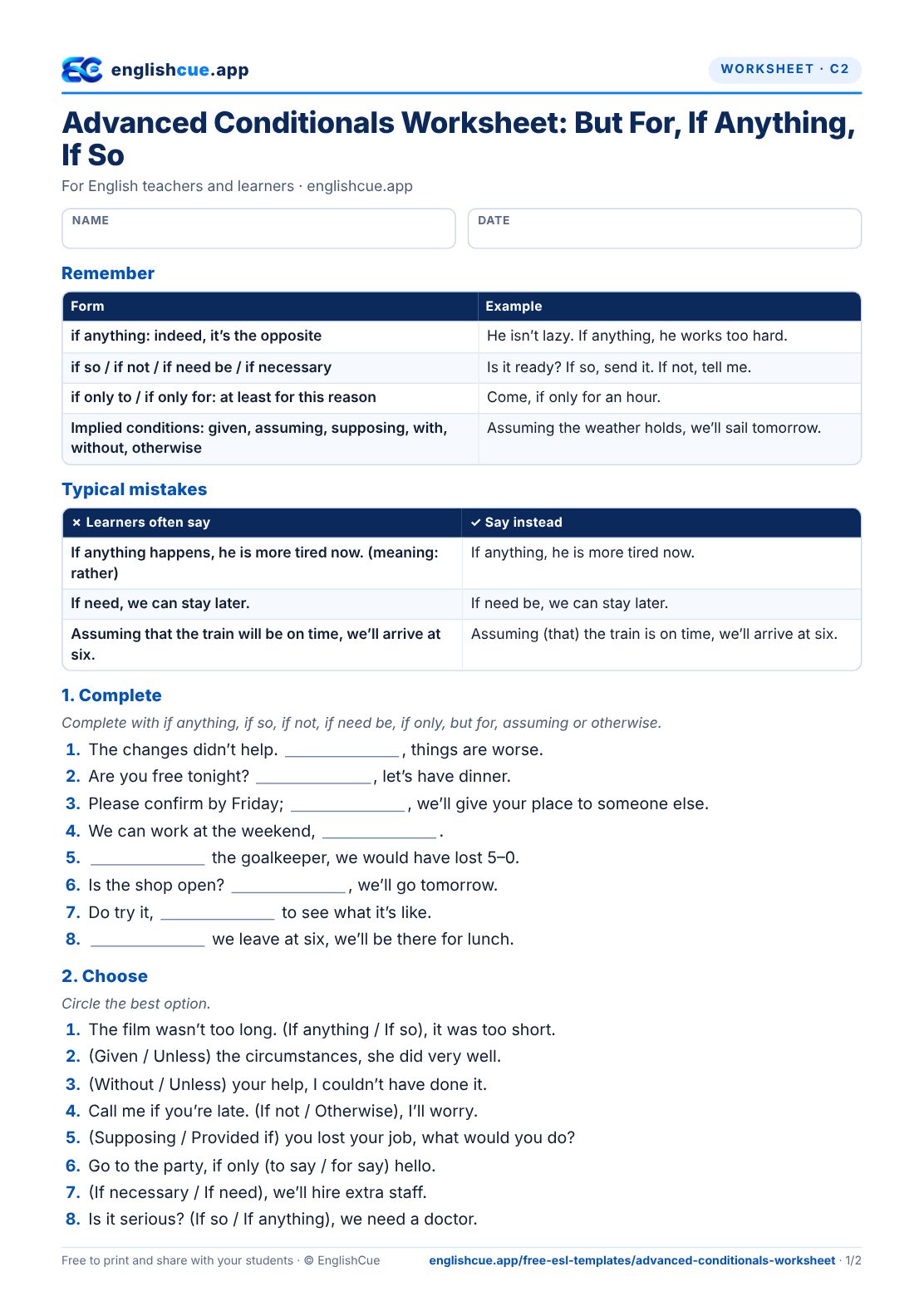 Worksheet · C2 · PDF with answersAdvanced Conditionals Worksheet: But For, If Anything, If So
The forms your learner will use by the end of the lesson.
If you’d like to… · If you would… · If I may…
If you’d like to follow me…
would = willingnessIf you need X, Y is there (anyway)
If you’re cold, there’s a blanket.
offersIf X, I’m Y (absurd)
If that’s cheap, I’m a millionaire.
disbeliefif anything · if so / not · if ever · if any · if at all
Rarely, if ever.
precise| Type | Meaning | Example |
|---|---|---|
| polite requests | softening an instruction | If you’d like to take a seat… · If you would sign here… |
| polite introductions | asking permission to say something | If I may say so, … · If you don’t mind my asking, … |
| speech-act conditionals | the main clause is true anyway | If you need anything, I’m in the office. |
| rhetorical (absurd) | strong disbelief | If that’s a bargain, I’m the Queen of England. |
| if anything | if there is a change, it’s the opposite | It’s not cheaper. If anything, it’s more expensive. |
| if so / if not | referring back | Are you free? If so, call me. |
| if at all / if ever | rarely, hardly | She seldom, if ever, complains. |
Will / would can appear in polite if-clauses (If you’ll wait here… / If you’d follow me…) because they mean willingness, not future.
The errors students make most often with this structure, and how to explain them.
Voice and agency: who is responsible in the sentence? (Mistakes were made… / We made mistakes.)
Use them as a warm-up or an exit ticket. Answers are below.
Share your screen and teach: everything from the warm-up to the writing task is ready.