HAVE
I have · she has
She has a car.
everywhere; normal in American English ENGLISHCUE
Until 30 November: try EnglishCue PRO for US$0.99 your first week, then US$19.90/month, cancel anytime. Try PRO · US$0.99 →
A1 English grammar lesson · The verb be and there is · PRO · 60 min
Say what you have and ask other people: I have a tent, she’s got a car, do you have a map?
Zoe and Ben plan a camping weekend. Zoe says: “I have a tent, and my brother has a big car.” Ben, who is from London, says: “Great. I’ve got two sleeping bags, but I haven’t got a torch.” They say the same kind of thing in two ways. By the end of this lesson you can use have and have got to talk about your things, your family and how you look.
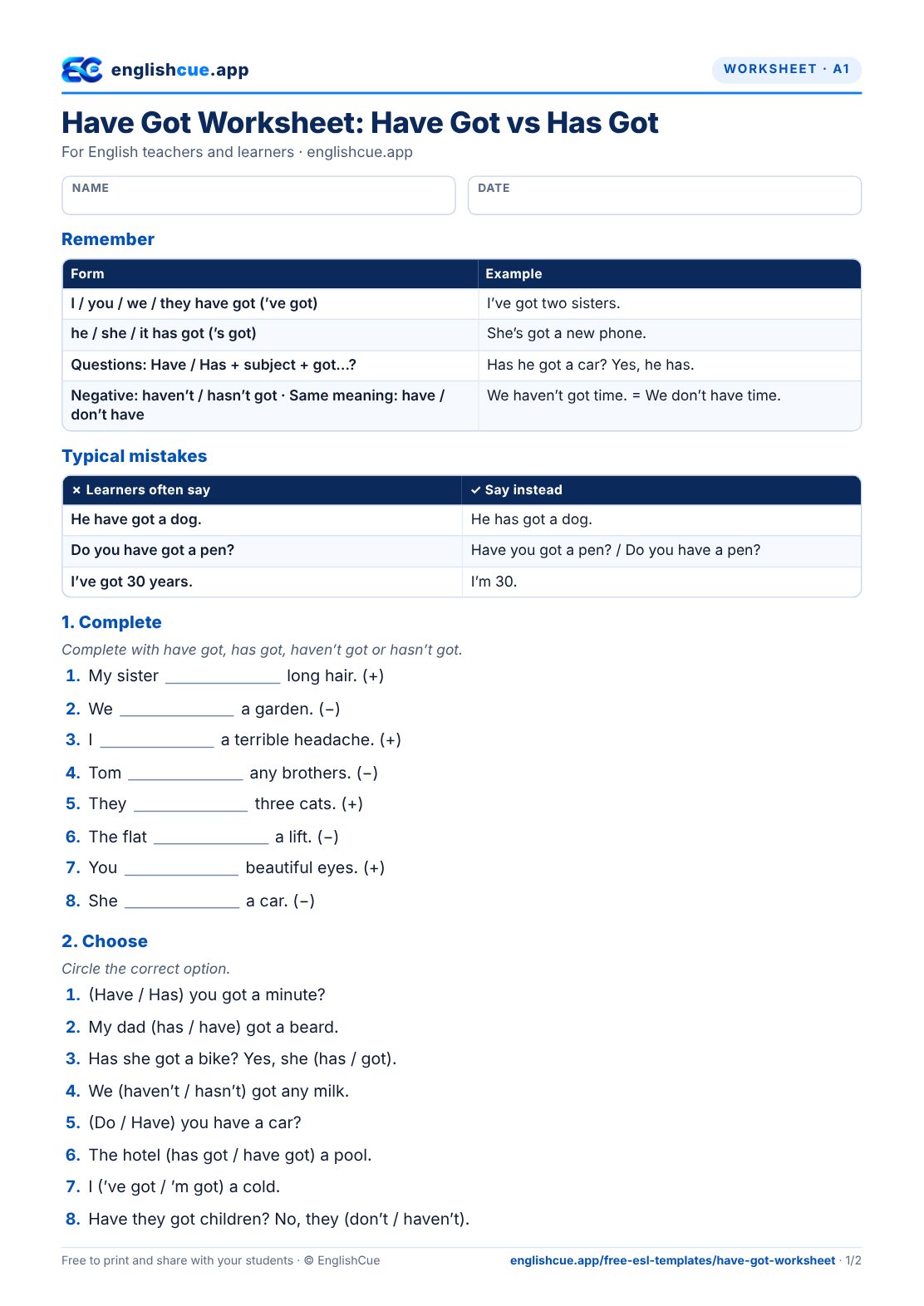 Worksheet · A1 · PDF with answersHave Got Worksheet: Have Got vs Has Got
The forms your learner will use by the end of the lesson.
I have · she has
She has a car.
everywhere; normal in American EnglishI’ve got · she’s got
She’s got a car.
common in British conversationdon’t / doesn’t have · haven’t / hasn’t got
He doesn’t have a map.
after doesn’t: haveDo you have…? · Have you got…?
Yes, I do. · Yes, I have.
answer in the same system| Subject | + | − | ? |
|---|---|---|---|
| I · you · we · they | have | don’t have | Do … have? |
| he · she · it | has | doesn’t have | Does … have? |
After doesn’t and does, the verb is have, not has: She doesn’t have a car.
The errors students make most often with this structure, and how to explain them.
Use have or have got for things (a car), family (two sisters), appearance (blue eyes), and illness (a cold). For age, use be: I am 30.
Never mix them: not “Do you have got”. And age is with be: She is 30.
Use them as a warm-up or an exit ticket. Answers are below.
All the verb be and there is lessons → All A1 grammar lessons →
Share your screen and teach: everything from the warm-up to the writing task is ready.