ENGLISHCUE

Until 30 November: try EnglishCue PRO for US$0.99 your first week, then US$19.90/month, cancel anytime. Try PRO · US$0.99 →

C1 English grammar lesson · Reported speech · PRO · 60 min

Academic hedging: the data suggest, it could be argued that

The results suggest that… This may be due to… It could be argued that… To some extent, the hypothesis is supported.

The situation

Two versions of a research conclusion. A: “Social media causes anxiety in teenagers. Schools must ban phones.” B: “The results suggest that heavy social media use may contribute to anxiety in teenagers. It could be argued that schools should limit phone use, although further research would appear necessary.” Version B is hedged: it is cautious, precise and more credible. By the end of this lesson you can hedge claims in essays, reports and presentations.

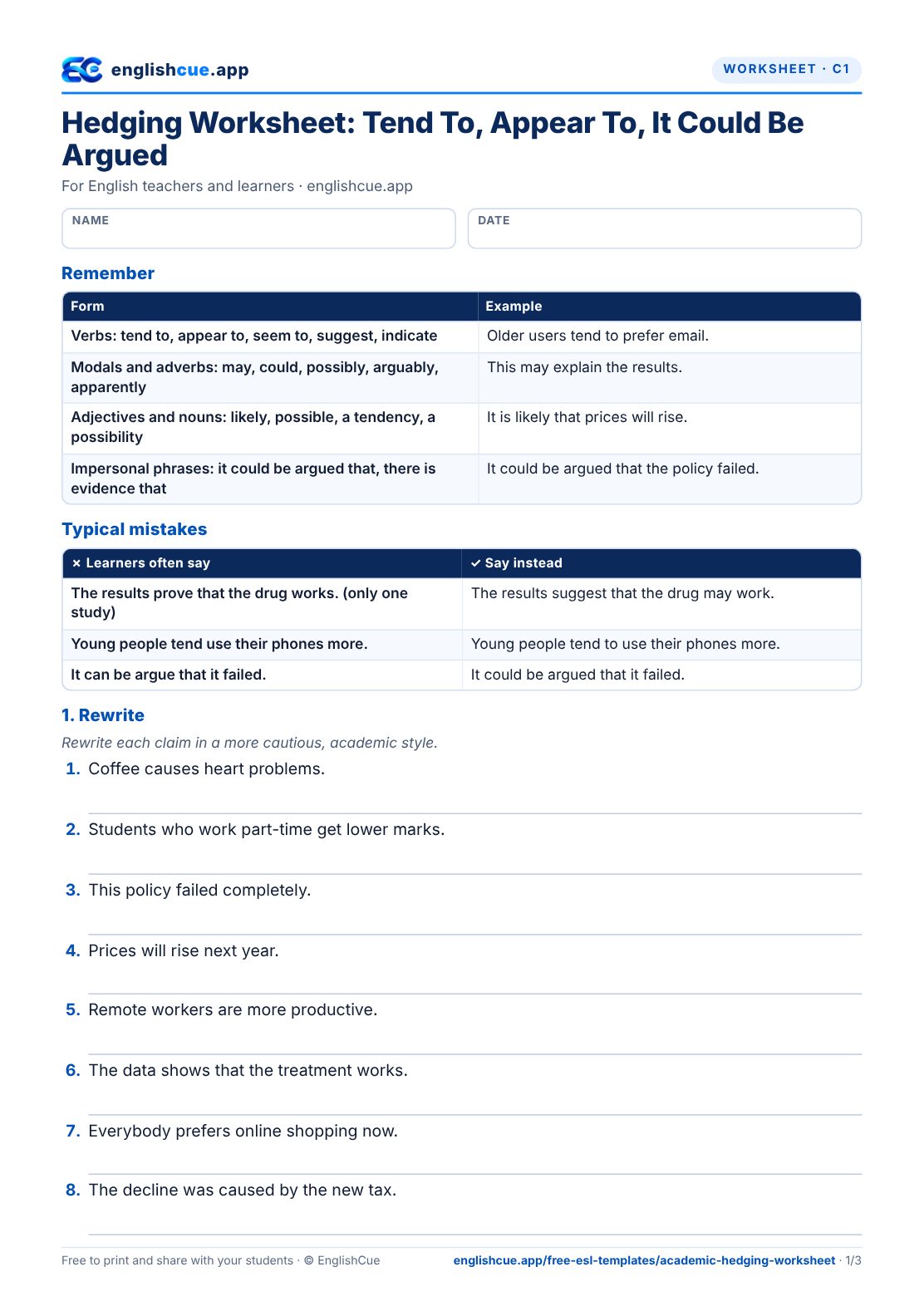
Free practice worksheet

Hedging Worksheet: Tend To, Appear To, It Could Be Argued previewWorksheet · C1 · PDF with answersHedging Worksheet: Tend To, Appear To, It Could Be Argued

The grammar at a glance

The forms your learner will use by the end of the lesson.

LEXICAL VERBS

suggest · indicate · appear · tend to

The data suggest that…

not prove

MODALS

may · might · could · would appear

This may be due to…

possibility

ADVERBS / LIMITS

arguably · largely · to some extent · in this study

To some extent, …

partial claims

IMPERSONAL

It could be argued that · There is evidence that

It is widely believed that…

no I think

Hedging tools

ToolExamplesSentence
lexical verbssuggest, indicate, appear, seem, tendThe data suggest that sleep improves memory.
modal verbsmay, might, could, would (appear)This may be due to stress.
adverbspossibly, arguably, relatively, largely, partlyThis is arguably the main cause.
adverbial phrasesto some extent, in part, in most cases, to a certain degreeTo some extent, the results support this.
adjectives / nounsit is possible / likely that, there is evidence thatThere is some evidence that diet matters.
impersonal passiveIt could be argued / It is widely believed thatIt could be argued that the sample was small.
limiting the claimin this study, among young adults, under certain conditionsThe effect was strong among young adults.

Don’t over-hedge: “It might possibly perhaps suggest…” sounds weak. Use one or two hedges per claim. Boosters (clearly, undoubtedly) are for well-established facts.

Common mistakes to watch for

The errors students make most often with this structure, and how to explain them.

  • This study proves that coffee causes insomnia. (20 participants) → This study suggests that coffee may contribute to insomnia.Too strong for the evidence.
  • It could argue that the sample was small. → It could be argued that the sample was small.Passive.
  • The results might possibly perhaps indicate a link. → The results may indicate a link.Over-hedging.
  • The data suggests that… (academic BrE) → The data suggest that…Data is often plural in academic English (both accepted, but be consistent).
  • In my opinion I think that it is maybe true. → It would appear that this is the case.Impersonal and concise.
  • There is an evidence that diet matters. → There is evidence that diet matters.Evidence is uncountable.

Teaching tips

Next lesson

Determiners and reference: the former, the latter, such, said, the aforementioned.

Quick check: three sample questions

Use them as a warm-up or an exit ticket. Answers are below.

  1. Hedged: The results ___ that exercise improves mood.
    • indicate
    • prove
    • show definitely
  2. Hedged: This difference ___ be explained by age.
    • may
    • must
    • will
  3. Impersonal: ___ that the method has limitations.
    • It could be argued
    • It could argue
    • I argue strongly
Show answers
  1. indicate. Indicate = hedge.
  2. may. Modal hedge.
  3. It could be argued. Passive.

What the full lesson includes

  • A scene that shows the structure in use, with guided discovery questions.
  • Forms and examples on screen, with colour-coded contrasts.
  • Self-correcting practice: choose, fix, build and rewrite, with an explanation for every answer.
  • A recorded listening with transcript, a speaking task with follow-up questions and a short writing task with a model answer.
  • Teacher mode and self-study mode, so students can review after class.

Where this lesson fits in the course

More reported speech lessons

  1. B2Reporting verbs: admit, deny, suggest, warn, insistHe admitted making a mistake. She refused to apologise. I suggested postponing the launch.
  2. C1Reporting with stance: claim, allege, concede, disputeThe CEO claimed that profits had risen. Critics disputed the figures. She conceded that mistakes were made.
  3. C2Free indirect speech: inside a character’s mind“I can’t go,” she thought. → She thought she couldn’t go. → She couldn’t go. Not now. What would her mother say?
  4. C2Evidentiality: apparently, reportedly, so-called, rumour has itAccording to the police… The minister reportedly knew. Rumour has it she’s leaving. The so-called experts…

All reported speech lessons → All C1 grammar lessons →

Teach it and practise it

Teach this lesson with EnglishCue PRO.

Share your screen and teach: everything from the warm-up to the writing task is ready.