Compare. A: “A 12-year-old girl from a small village near Leeds won the national science prize. A robot that sorts recycling was her invention. That someone so young could design it surprised the judges.” B: “The national science prize went to a 12-year-old girl from a small village near Leeds. Her invention was a robot that sorts recycling. It surprised the judges that someone so young could design it.” Version B flows: each sentence starts with known information and ends with new, heavy information. By the end of this lesson you can organise information like a professional writer.
The forms your learner will use by the end of the lesson.
GIVEN → NEW
start with known, end with new
We met a chef. She owns…
bridge
END-FOCUS
key information last
The prize went to a 12-year-old.
surprise
END-WEIGHT
long phrases last
Turn off all the lights upstairs.
easy to read
TOOLS
it-extraposition · there · passive · converse verbs
It’s clear that…
reorganise
Principles and tools
Principle / tool
What it does
Example
given → new
start with what the reader knows
We met a scientist. She works on robots.
end-focus
the key / new point goes last
The prize went to a 12-year-old girl.
end-weight
long phrases go last
I gave the library all the books I had collected over twenty years.
it-extraposition
move a long subject to the end
It surprised everyone that she won.
there + be
introduce new things
There is a growing demand for electric bikes.
passive / verb choice
keep the topic as subject
The prize was won by … · The prize went to …
particle position
short object between, long object after
switch it off · switch off all the lights downstairs
Think of each sentence as a bridge: the start connects back, the end carries the reader forward.
Common mistakes to watch for
The errors students make most often with this structure, and how to explain them.
That the government would cancel the project after spending millions surprised nobody. → It surprised nobody that the government cancelled the project after spending millions.Heavy subject → extraposition.
I explained the new rules that the manager had sent us on Monday to them. → I explained to them the new rules that the manager had sent us on Monday.Heavy object last.
A farmer found the treasure. The treasure was in a field. A field near York. → The treasure was found by a farmer in a field near York.One flowing sentence.
Please switch the lights in the kitchen and the bathroom off. → Please switch off the lights in the kitchen and the bathroom.Long object after particle.
Our new product is popular. Young people mostly buy our new product. → Our new product is popular, especially with young people.Avoid repeating; new info at end.
A new café opened. Delicious cakes the café sells. → A new café has opened. It sells delicious cakes.Given (it) → new.
Teaching tips
Next lesson
Clefts and pseudo-clefts across registers: What we need is…, It was then that…, The thing is…
Quick check: three sample questions
Use them as a warm-up or an exit ticket. Answers are below.
Better flow: “We visited an old castle. ___”
It was built by a Norman knight in 1080.
A Norman knight built it in 1080.
In 1080 a Norman knight did build it.
End-weight: ___
It is clear that we need more time.
That we need more time is clear.
Clear is that we need more time.
“Have you seen my bike?” “Yes, ___”
I lent it to Tom.
Tom borrowed it from me, your bike.
To Tom I lent it.
Show answers
It was built by a Norman knight in 1080.. Given (it) → new.
It is clear that we need more time.. It-extraposition.
I lent it to Tom.. Given (it) → new (Tom).
What the full lesson includes
A scene that shows the structure in use, with guided discovery questions.
Forms and examples on screen, with colour-coded contrasts.
Self-correcting practice: choose, fix, build and rewrite, with an explanation for every answer.
A recorded listening with transcript, a speaking task with follow-up questions and a short writing task with a model answer.
Teacher mode and self-study mode, so students can review after class.
 ENGLISHCUE
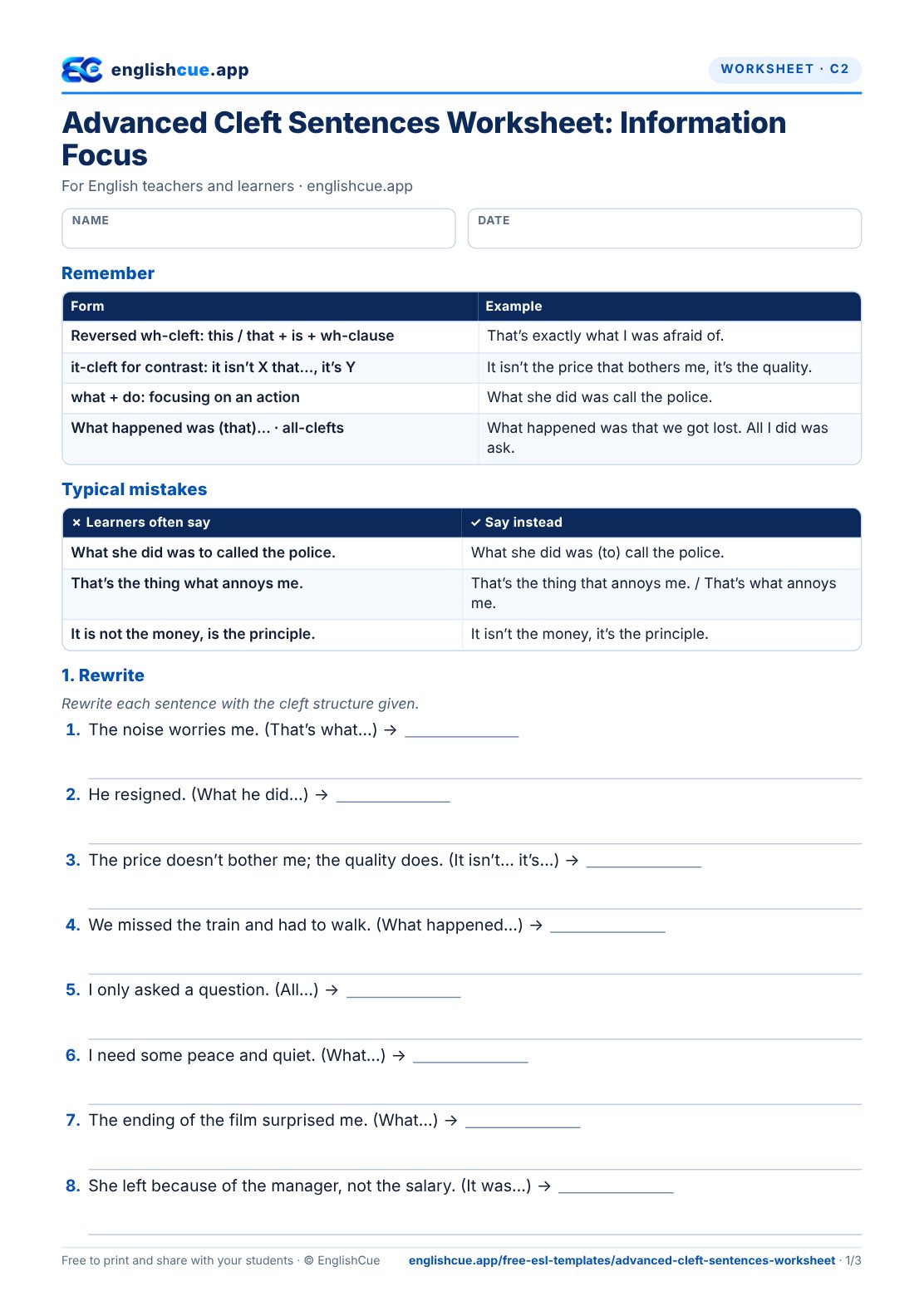 Worksheet · C2 · PDF with answersAdvanced Cleft Sentences Worksheet: Information Focus