+ S
noun + s
chairs · keys · photos
the normal plural ENGLISHCUE
Until 30 November: try EnglishCue PRO for US$0.99 your first week, then US$19.90/month, cancel anytime. Try PRO · US$0.99 →
A1 English grammar lesson · Nouns and agreement · PRO · 60 min
Talk about more than one: two boxes, three knives, five people.
Nina and Carl move to a new house. They count their things: “Twelve boxes, four chairs, two shelves, six knives… and three children!” By the end of this lesson you can make the plural of almost any noun, and you know the small group of irregular ones.
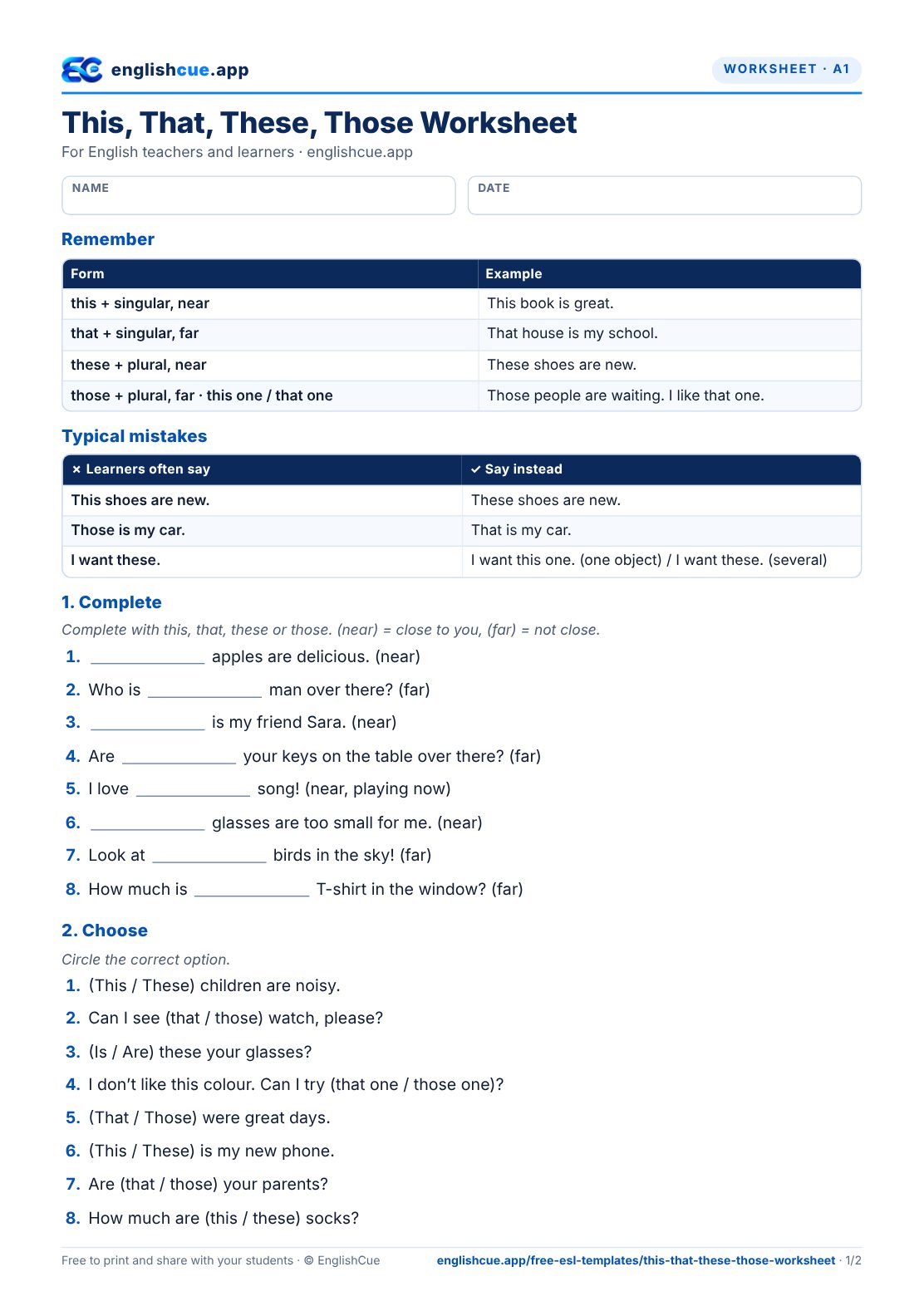 Worksheet · A1 · PDF with answersThis, That, These, Those Worksheet
The forms your learner will use by the end of the lesson.
noun + s
chairs · keys · photos
the normal plurals, x, ch, sh + es
boxes · glasses · dishes
an extra syllabley → ies · f → ves
babies · knives
consonant + y; some -f / -femen · women · children · people
five people · three children
never with -s| The noun ends in… | Plural | Examples |
|---|---|---|
| most letters | + s | chairs, lamps, keys, days |
| s, ss, x, ch, sh | + es | buses, glasses, boxes, watches, dishes |
| consonant + y | y → ies | babies, cities, families, parties |
| f / fe (some) | f → ves | knives, wives, shelves, leaves |
The errors students make most often with this structure, and how to explain them.
In English the adjective has no plural: one big box, two big boxes. Never “bigs boxes”. And the is the same: the box, the boxes.
The adjective does not change (two big boxes), and nouns like jeans, glasses and scissors are always plural: My glasses are here.
Use them as a warm-up or an exit ticket. Answers are below.
Share your screen and teach: everything from the warm-up to the writing task is ready.