COUNTABLE
a / an + singular · plural with -s
an apple · some apples
you can count them ENGLISHCUE
Until 30 November: try EnglishCue PRO for US$0.99 your first week, then US$19.90/month, cancel anytime. Try PRO · US$0.99 →
A1 English grammar lesson · Comparison and quantity · PRO · 60 min
Talk about food and quantities: some bread, some apples, any milk? There isn’t any rice.
Ravi and Lea plan a picnic. Lea looks in the kitchen: “We have some bread and some apples. But there isn’t any cheese, and we don’t have any juice. Is there any water?” By the end of this lesson you can talk about food and quantities with some and any.
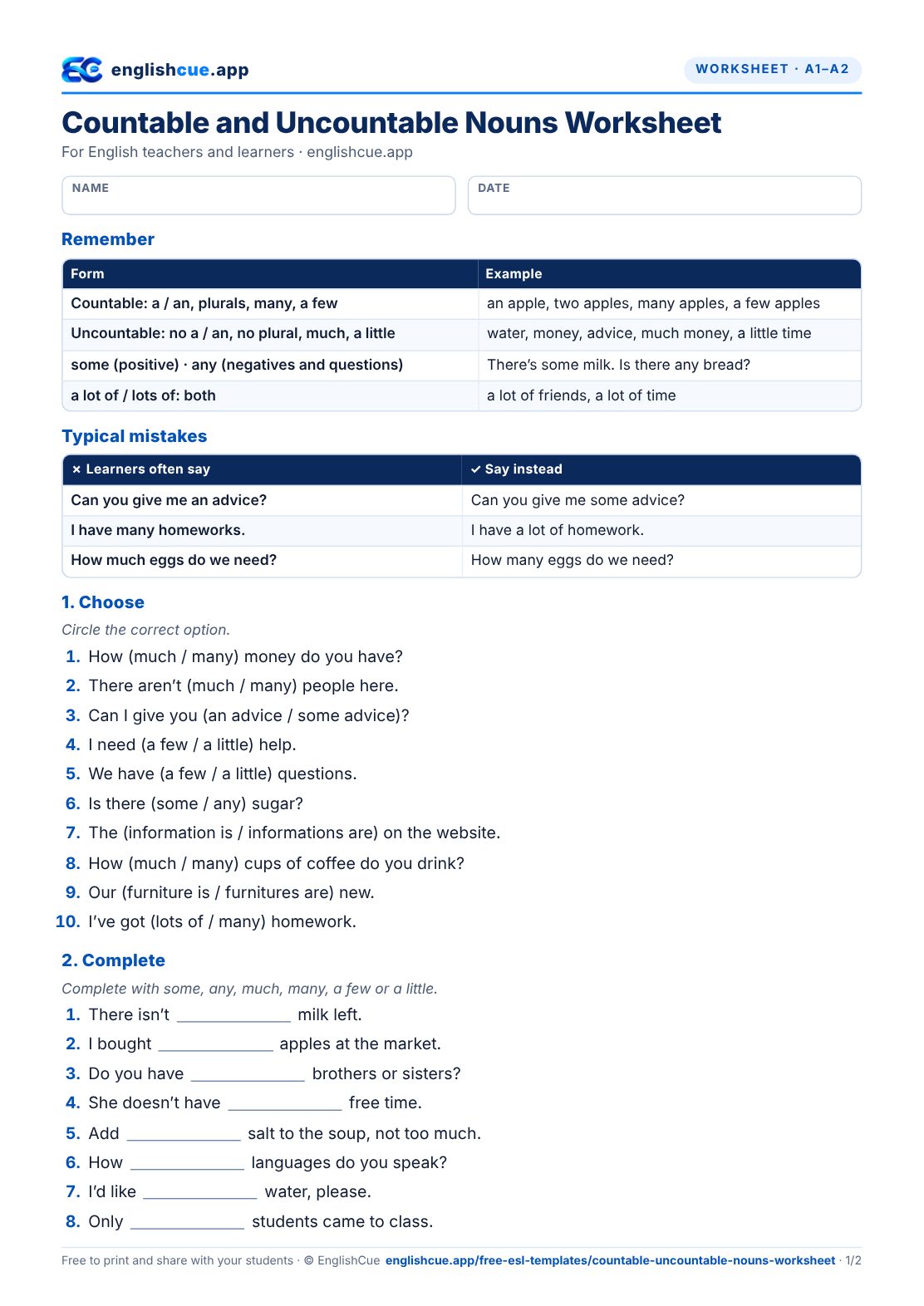 Worksheet · A1–A2 · PDF with answersCountable and Uncountable Nouns Worksheet
The forms your learner will use by the end of the lesson.
a / an + singular · plural with -s
an apple · some apples
you can count themno a / an · no plural
some bread · a loaf of bread
liquids, masses, ideasaffirmative · offers · requests
Would you like some tea?
we have some…negatives · real questions
Is there any milk? · There isn’t any.
not … any| Countable (plural) | Uncountable | |
|---|---|---|
| + | We have some apples. | We have some bread. |
| − | We don’t have any apples. | There isn’t any bread. |
| ? | Do we have any apples? | Is there any bread? |
With some and any, countable nouns are plural: some apples, any eggs. Uncountable nouns stay singular: some milk, any juice.
The errors students make most often with this structure, and how to explain them.
Most uncountable nouns are liquids (water, milk, juice), masses (rice, sugar, bread, cheese) or ideas (money, time, information). To count them, use a container: a bottle of water, a loaf of bread, a piece of cheese.
To ask for a quantity: How much milk? (uncountable) · How many eggs? (countable).
Use them as a warm-up or an exit ticket. Answers are below.
All comparison and quantity lessons → All A1 grammar lessons →
Share your screen and teach: everything from the warm-up to the writing task is ready.