ATTITUDE
fortunately · surprisingly · ironically · understandably
Surprisingly, they won.
emotion ENGLISHCUE
Until 30 November: try EnglishCue PRO for US$0.99 your first week, then US$19.90/month, cancel anytime. Try PRO · US$0.99 →
C1 English grammar lesson · Adverbs of place, time and focus · PRO · 60 min
Surprisingly, the underdogs won. Arguably, it was the best match of the year. Frankly, the referee was terrible.
A football journalist writes: “Surprisingly, little Fenwick Town beat the champions 2–1. Arguably, it was the biggest shock of the season. Admittedly, the champions were missing three players. Frankly, the referee made several mistakes. Understandably, the fans celebrated all night. Presumably, the manager will get a new contract.” By the end of this lesson you can add your attitude with a single adverb.
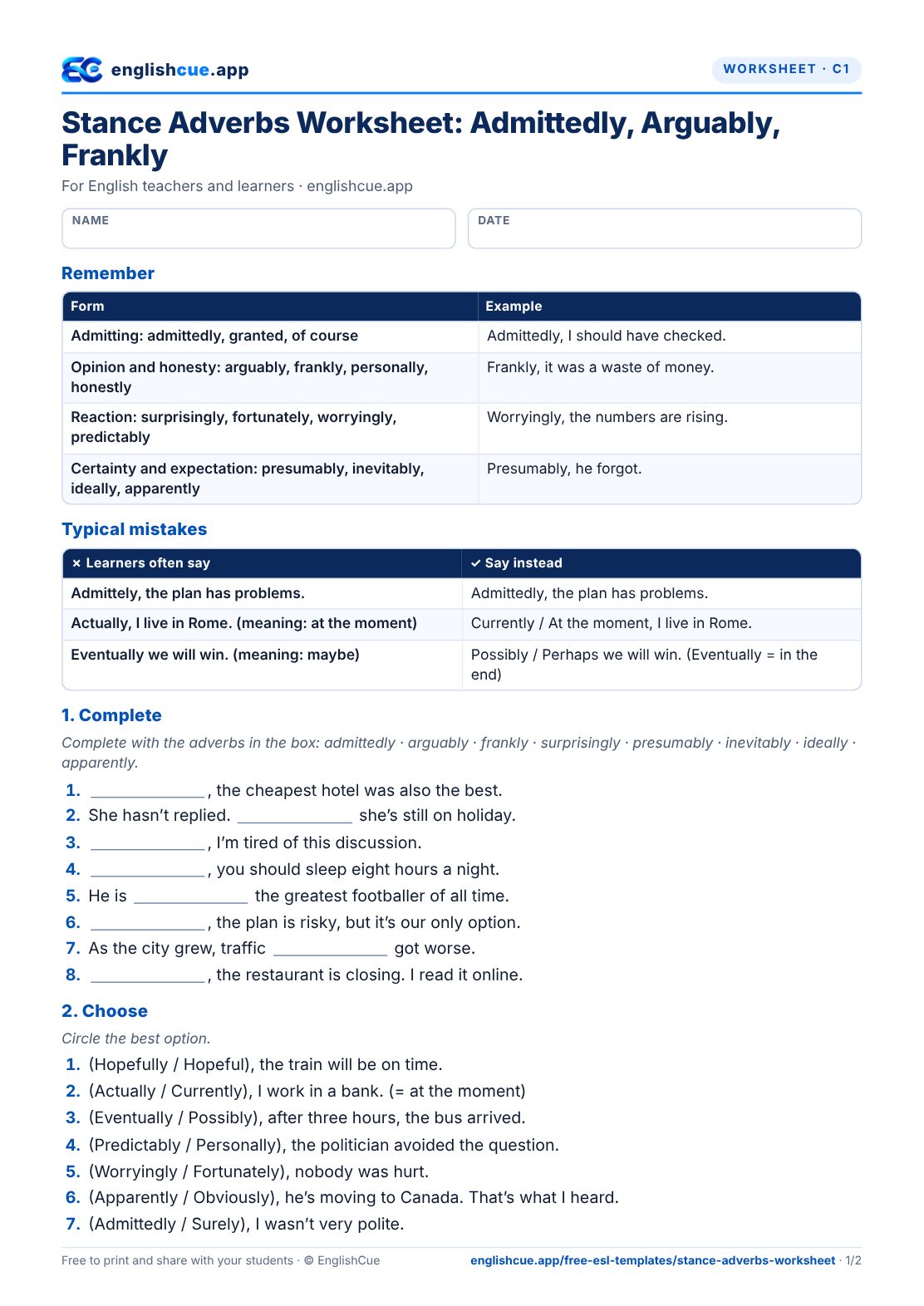 Worksheet · C1 · PDF with answersStance Adverbs Worksheet: Admittedly, Arguably, Frankly
The forms your learner will use by the end of the lesson.
fortunately · surprisingly · ironically · understandably
Surprisingly, they won.
emotionarguably · presumably · apparently · supposedly
Apparently, it’s closing.
how you knowfrankly · admittedly · to be fair · personally
Admittedly, we were lucky.
your voicefront + comma · mid before main verb · end + comma
She has apparently left.
sentence vs manner| Type | Adverbs | Example |
|---|---|---|
| attitude / emotion | fortunately, unfortunately, sadly, surprisingly, interestingly, ironically, understandably, luckily | Surprisingly, the underdogs won. |
| certainty / evidence | arguably, undoubtedly, clearly, presumably, apparently, evidently, seemingly, supposedly | Arguably, it’s his best film. |
| honesty / viewpoint | frankly, honestly, personally, admittedly, to be fair, to be honest, strictly speaking | Admittedly, we were lucky. |
| position: front | adverb + comma | Fortunately, nobody was hurt. |
| position: mid | before the main verb / after be | He has apparently resigned. · She is clearly upset. |
| position: end | comma + adverb (spoken) | He forgot, apparently. |
The same word can be a manner adverb: She answered honestly (= in an honest way) vs Honestly, I don’t know (= I’m being honest).
The errors students make most often with this structure, and how to explain them.
Intensifiers and collocation: utterly ridiculous, deeply concerned, highly unlikely, bitterly disappointed.
Use them as a warm-up or an exit ticket. Answers are below.
All adverbs of place, time and focus lessons → All C1 grammar lessons →
Share your screen and teach: everything from the warm-up to the writing task is ready.