CONDITION
If + past perfect
If I had left earlier, …
imaginary past ENGLISHCUE
Until 30 November: try EnglishCue PRO for US$0.99 your first week, then US$19.90/month, cancel anytime. Try PRO · US$0.99 →
B2 English grammar lesson · Conditionals · PRO · 60 min
If I had left earlier, I wouldn’t have missed the train. If I hadn’t missed it, I wouldn’t have met you!
Five years ago, Emma missed her train to London. “If I had left home earlier, I wouldn’t have missed the train. But if I hadn’t missed it, I wouldn’t have met James in the station café!” Today they are married. By the end of this lesson you can imagine a different past and its results.
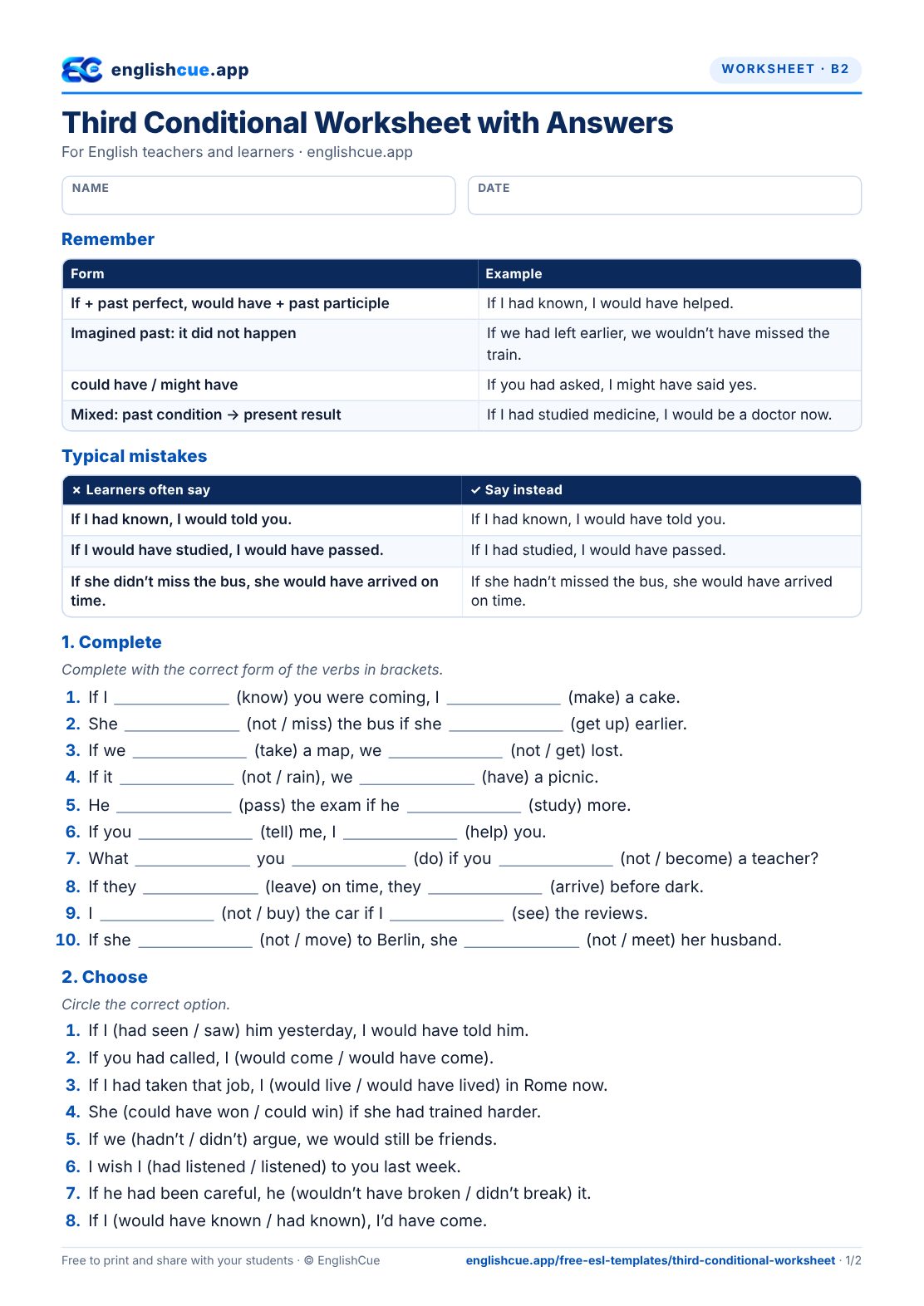 Worksheet · B2 · PDF with answersThird Conditional Worksheet with Answers
The forms your learner will use by the end of the lesson.
If + past perfect
If I had left earlier, …
imaginary pastwould have + past participle
…I wouldn’t have missed the train.
no would after ifability · possibility
We might have won.
other resultsregret · criticism · relief
If you’d listened, this wouldn’t have happened!
’d = had / would| Use | Example |
|---|---|
| regret | If I had studied harder, I would have got into university. |
| criticism | If you had listened to me, this wouldn’t have happened! |
| relief | If I hadn’t worn a helmet, I could have been badly hurt. |
Compare: second conditional = imaginary present / future (If I had money now, I would buy…). Third = imaginary past (If I had had money then, I would have bought…).
The errors students make most often with this structure, and how to explain them.
In speech, both had and would become ’d: “If I’d known, I’d have come.” = If I had known, I would have come. After if → had; before have → would.
Mixed conditionals: If I had studied medicine, I would be a doctor now.
Use them as a warm-up or an exit ticket. Answers are below.
Share your screen and teach: everything from the warm-up to the writing task is ready.