ACTIVE
agent + verb + object
We made mistakes.
accountability ENGLISHCUE
Until 30 November: try EnglishCue PRO for US$0.99 your first week, then US$19.90/month, cancel anytime. Try PRO · US$0.99 →
C2 English grammar lesson · Passive voice · PRO · 60 min
Mistakes were made. → We made mistakes. The vase broke. → I broke the vase. Prices rose. → Companies raised prices.
A company statement: “Mistakes were made, and customer data was exposed. The decision to delay the announcement has been reviewed.” A different CEO: “We made serious mistakes. I decided to delay the announcement, and I was wrong.” Same facts, very different responsibility. A child says: “The vase broke.” Mum asks: “Did it break by itself?” By the end of this lesson you can notice how voice hides or shows agency, and choose it deliberately.
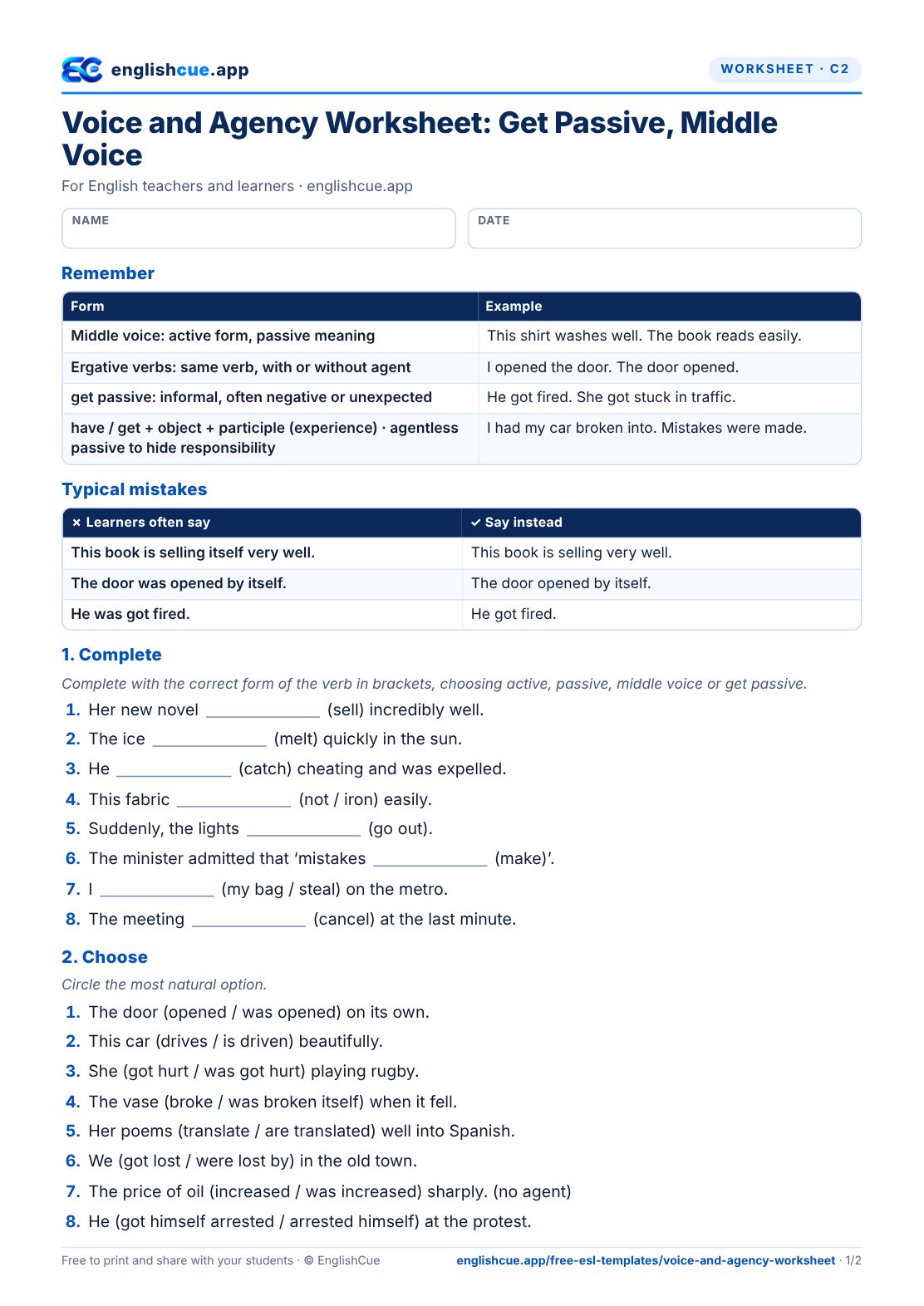 Worksheet · C2 · PDF with answersVoice and Agency Worksheet: Get Passive, Middle Voice
The forms your learner will use by the end of the lesson.
agent + verb + object
We made mistakes.
accountabilitybe + pp (no by)
Mistakes were made.
hidden or unknown agentbreak, rise, open, melt… (no agent)
Prices rose.
no reflexivethe closure of / the decision to
The closure was announced.
ask: by whom?| Structure | Effect | Example |
|---|---|---|
| active | clear responsibility | We made mistakes. · I broke the vase. |
| agentless passive | agent hidden | Mistakes were made. · Data was exposed. |
| ergative verbs | the action seems to happen by itself | The vase broke. · Prices rose. · The door opened. |
| nominalisation | action becomes a thing, no agent | The closure of the factory… · A decision was taken. |
| impersonal it / there | distance | It was decided that… · There have been some errors. |
| get / have passive | events happening to people | He got fired. · I had my bag stolen. |
The passive is not “bad”: it is useful when the agent is unknown or unimportant. But in apologies, news and politics, ask who is responsible.
The errors students make most often with this structure, and how to explain them.
Free indirect speech and reporting in narrative: letting the reader hear a character’s thoughts.
Use them as a warm-up or an exit ticket. Answers are below.
Share your screen and teach: everything from the warm-up to the writing task is ready.