 ENGLISHCUE
Until 30 November: try EnglishCue PRO for US$0.99 your first week, then US$19.90/month, cancel anytime. Try PRO · US$0.99 →
Reference sheet · A2 to B2 · For teachers and students · Free PDF, 1 page
English Modal Verbs Chart: Meaning and Examples
Learners know the modal verbs; what they mix up is the meaning. This chart is organised by the job each modal does, with the present form, the past form and an example, so the difference between mustn’t and don’t have to is visible at a glance.
Preview
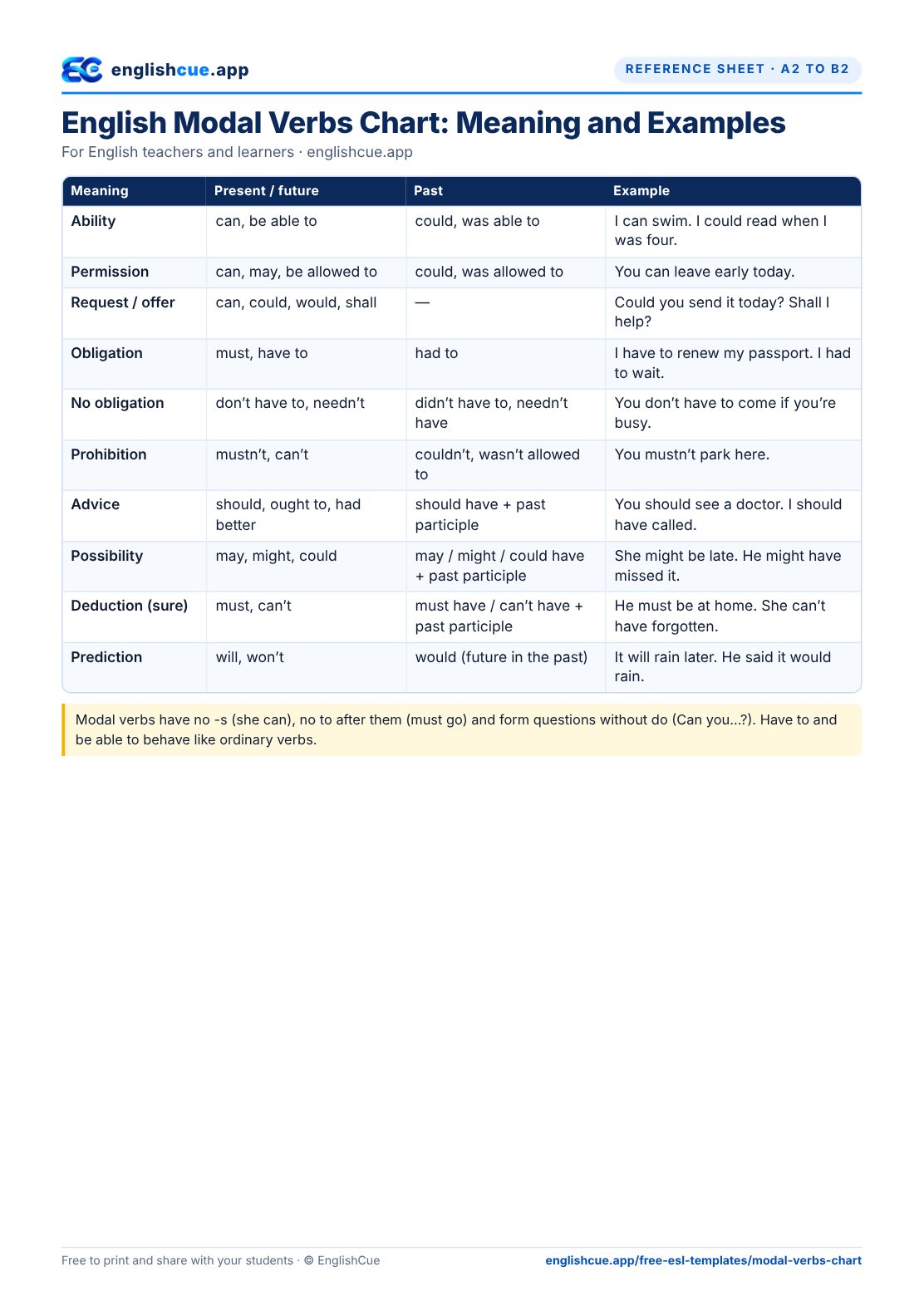
A4, portrait, 1 page. No sign-up. Free to print, copy and share with your students.
How to use it
- Teach one row (one meaning) at a time.
- Give a situation (‘a friend is late’) and ask for one sentence per meaning.
- Cover the past column and ask how to say the same thing about yesterday.
- Point out the two classic traps: mustn’t vs don’t have to, and must have vs had to.
What is on the sheet
The full content, so you can check it before you print or copy an example onto your own slide.
| Meaning | Present / future | Past | Example |
|---|---|---|---|
| Ability | can, be able to | could, was able to | I can swim. I could read when I was four. |
| Permission | can, may, be allowed to | could, was allowed to | You can leave early today. |
| Request / offer | can, could, would, shall | — | Could you send it today? Shall I help? |
| Obligation | must, have to | had to | I have to renew my passport. I had to wait. |
| No obligation | don’t have to, needn’t | didn’t have to, needn’t have | You don’t have to come if you’re busy. |
| Prohibition | mustn’t, can’t | couldn’t, wasn’t allowed to | You mustn’t park here. |
| Advice | should, ought to, had better | should have + past participle | You should see a doctor. I should have called. |
| Possibility | may, might, could | may / might / could have + past participle | She might be late. He might have missed it. |
| Deduction (sure) | must, can’t | must have / can’t have + past participle | He must be at home. She can’t have forgotten. |
| Prediction | will, won’t | would (future in the past) | It will rain later. He said it would rain. |
Modal verbs have no -s (she can), no to after them (must go) and form questions without do (Can you…?). Have to and be able to behave like ordinary verbs.
Use it with
More free templates
The lesson is ready too.
EnglishCue lessons open on screen and teach in 60 minutes: scene, forms, practice, listening, speaking and writing.