AFFIRMATIVE
am / is / are + going to + base form
I’m going to learn to swim.
a plan you made ENGLISHCUE
Until 30 November: try EnglishCue PRO for US$0.99 your first week, then US$19.90/month, cancel anytime. Try PRO · US$0.99 →
A1 English grammar lesson · Verb tenses · PRO · 60 min
Talk about your plans: I’m going to learn to swim. We aren’t going to stay at home.
It’s the 31st of December. Three friends talk about the new year. Ines says: “I’m going to learn to swim. Max is going to look for a new job, and we’re going to travel to Japan in the summer!” By the end of this lesson you can talk about your plans and ask about other people’s.
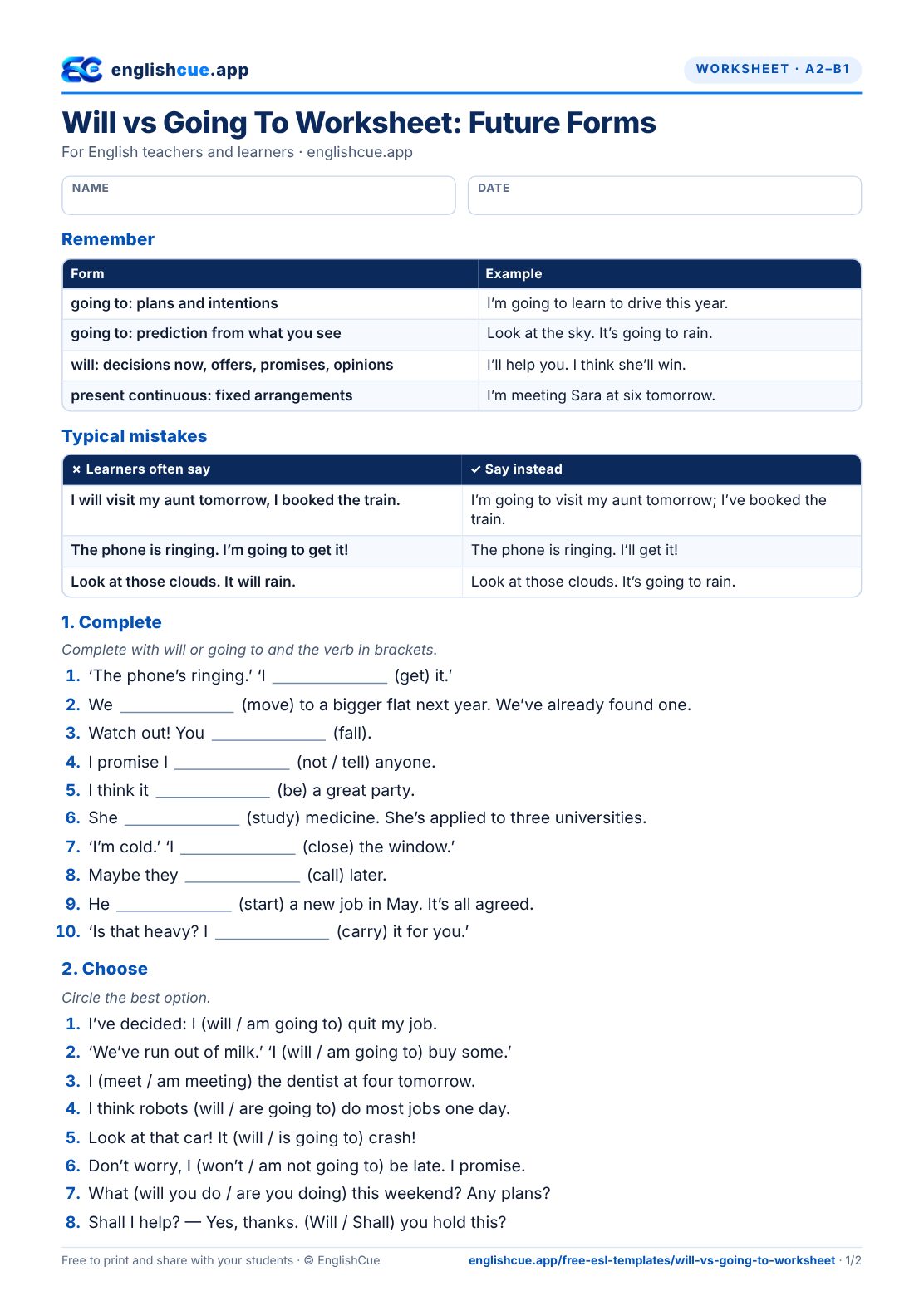 Worksheet · A2–B1 · PDF with answersWill vs Going To Worksheet: Future Forms
The forms your learner will use by the end of the lesson.
am / is / are + going to + base form
I’m going to learn to swim.
a plan you made’m not / isn’t / aren’t going to
We aren’t going to stay.
base form after itAre you going to…? · What are you going to…?
Is she going to come? — Yes, she is.
be, not dotomorrow · next week · this summer · in July
next month (no preposition)
future time| Subject | + | − |
|---|---|---|
| I | ’m going to work | ’m not going to work |
| you · we · they | ’re going to work | aren’t going to work |
| he · she · it | ’s going to work | isn’t going to work |
After going to, always the base form: going to buy, not “going to buys” or “going to bought”.
The errors students make most often with this structure, and how to explain them.
Use going to for a plan: you decided before speaking. “I’m going to learn to swim” = it’s my plan for this year.
This is the last verb lesson of A1. Next come connectors (and, but, because, so) and adjectives, then A2 with past continuous, present perfect and more.
Use them as a warm-up or an exit ticket. Answers are below.
Share your screen and teach: everything from the warm-up to the writing task is ready.