ENGLISHCUE

Until 30 November: try EnglishCue PRO for US$0.99 your first week, then US$19.90/month, cancel anytime. Try PRO · US$0.99 →

A1 English grammar lesson · Verb tenses · PRO · 60 min

Past simple: regular verbs

Talk about finished actions: I worked in a bank, we travelled a lot, she didn’t like school.

The situation

Grace finds a box of old photos at her grandfather’s house. Walter tells her: “In this photo I worked at the port. Your grandmother and I lived in a small flat. We danced every Saturday!” By the end of this lesson you can talk about finished actions in the past with regular verbs.

Free practice worksheet

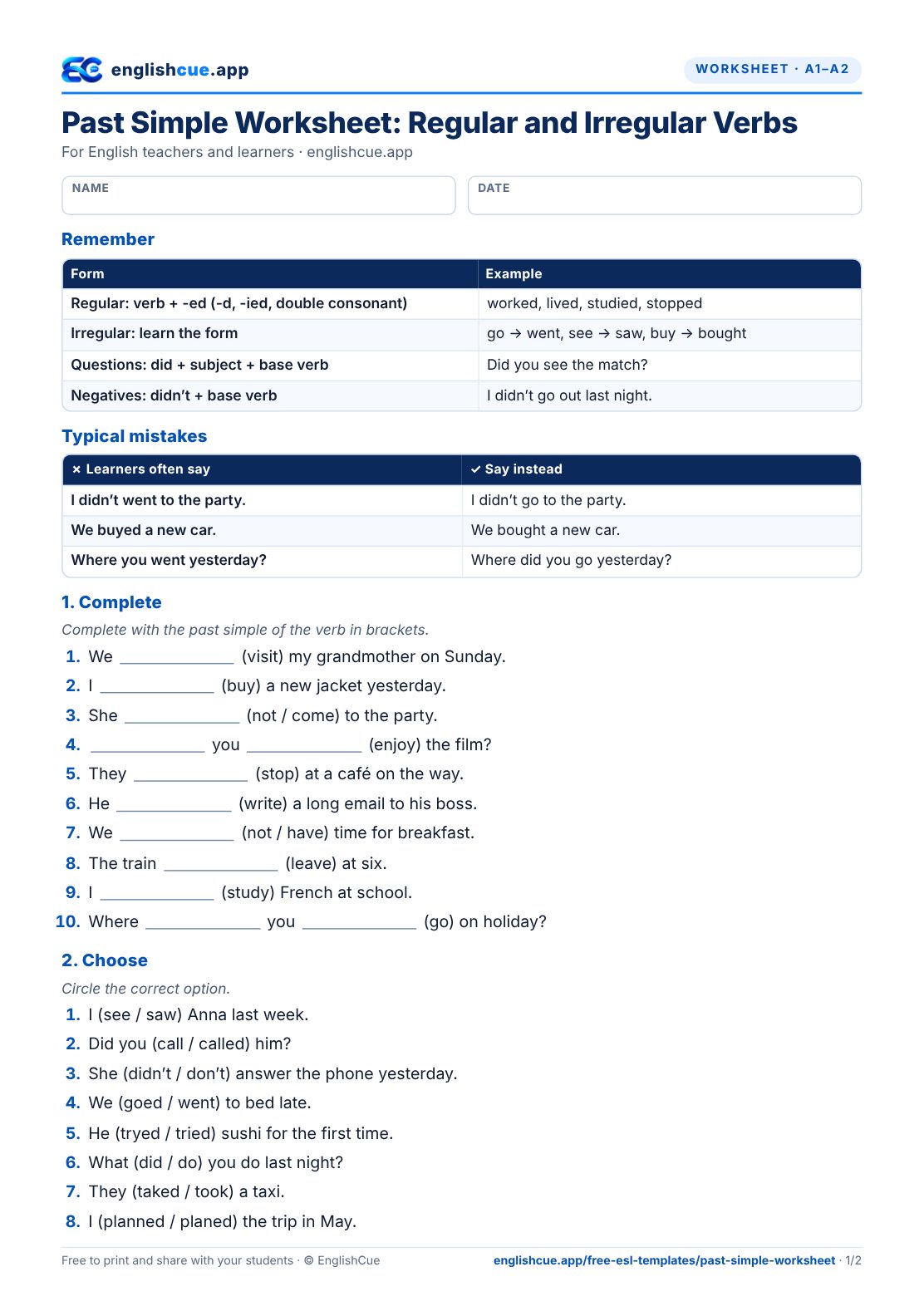
Past Simple Worksheet: Regular and Irregular Verbs previewWorksheet · A1–A2 · PDF with answersPast Simple Worksheet: Regular and Irregular Verbs

The grammar at a glance

The forms your learner will use by the end of the lesson.

AFFIRMATIVE

verb + -ed (all persons)

She worked in a bank.

/t/ /d/ /ɪd/

SPELLING

+d · double · y → ied

lived · stopped · studied

vowel + y: played

NEGATIVE

didn’t + base form

I didn’t like school.

no -ed after didn’t

QUESTION

Did + subject + base form?

Did you enjoy it? — Yes, I did.

Where did you…?

Spelling of -ed

RuleExamples
most verbs: + edwork → worked · play → played · watch → watched
verb ends in -e: + dlive → lived · dance → danced · love → loved
short vowel + one consonant: doublestop → stopped · plan → planned · travel → travelled (UK)
consonant + y: y → iedstudy → studied · try → tried · carry → carried

Vowel + y: just -ed. play → played, stay → stayed. In American English: travel → traveled.

Common mistakes to watch for

The errors students make most often with this structure, and how to explain them.

  • She workeds in a bank. → She worked in a bank.No -s in the past.
  • I didn’t liked it. → I didn’t like it.After didn’t: base form.
  • Did you visited London? → Did you visit London?After did: base form.
  • We studyed English. → We studied English.y → ied.
  • They stoped at the station. → They stopped at the station.Double the p.
  • I no watched the match. → I didn’t watch the match.Negative: didn’t + base form.

Teaching tips

No -s in the past

In the past simple, the verb is the same for every person: I worked, he worked, they worked. There is no -s for he / she / it.

Next lesson

Some very common verbs are irregular: go → went, have → had, see → saw. They’re next.

Quick check: three sample questions

Use them as a warm-up or an exit ticket. Answers are below.

  1. Walter ___ at the port in 1970.
    • worked
    • works
    • workeds
  2. They ___ in a small flat.
    • lived
    • livesd
    • live
  3. She ___ every Saturday. (in the past)
    • danced
    • dances
    • danceds
Show answers
  1. worked. Past: worked.
  2. lived. Past: lived.
  3. danced. Past, same form for she: danced.

What the full lesson includes

  • A scene that shows the structure in use, with guided discovery questions.
  • Forms and examples on screen, with colour-coded contrasts.
  • Self-correcting practice: choose, fix, build and rewrite, with an explanation for every answer.
  • A recorded listening with transcript, a speaking task with follow-up questions and a short writing task with a model answer.
  • Teacher mode and self-study mode, so students can review after class.

Where this lesson fits in the course

More verb tenses lessons

  1. A1Present simple or present continuous?Talk about daily routines and what is happening now or this week.FREE
  2. A1Was and wereTalk about the past with be: I was at home, the weather was great, we weren’t tired.
  3. A1Past simple: common irregular verbsTell what happened with the most common verbs: I went, we saw, she bought, they ate.
  4. A1Going to: plansTalk about your plans: I’m going to learn to swim. We aren’t going to stay at home.

All verb tenses lessons → All A1 grammar lessons →

Teach it and practise it

Teach this lesson with EnglishCue PRO.

Share your screen and teach: everything from the warm-up to the writing task is ready.