 ENGLISHCUE
Until 30 November: try EnglishCue PRO for US$0.99 your first week, then US$19.90/month, cancel anytime. Try PRO · US$0.99 →
Worksheet · A1–A2 · For teachers and students · Free PDF, 2 pages
Past Simple Worksheet: Regular and Irregular Verbs
The past simple is the first tense learners need to tell a story, and irregular verbs are what slow them down. This sheet mixes regular and common irregular verbs, practises did and didn’t (and the base verb after them), and finishes with prompts that make learners tell a short story about their own weekend or a trip.
Preview
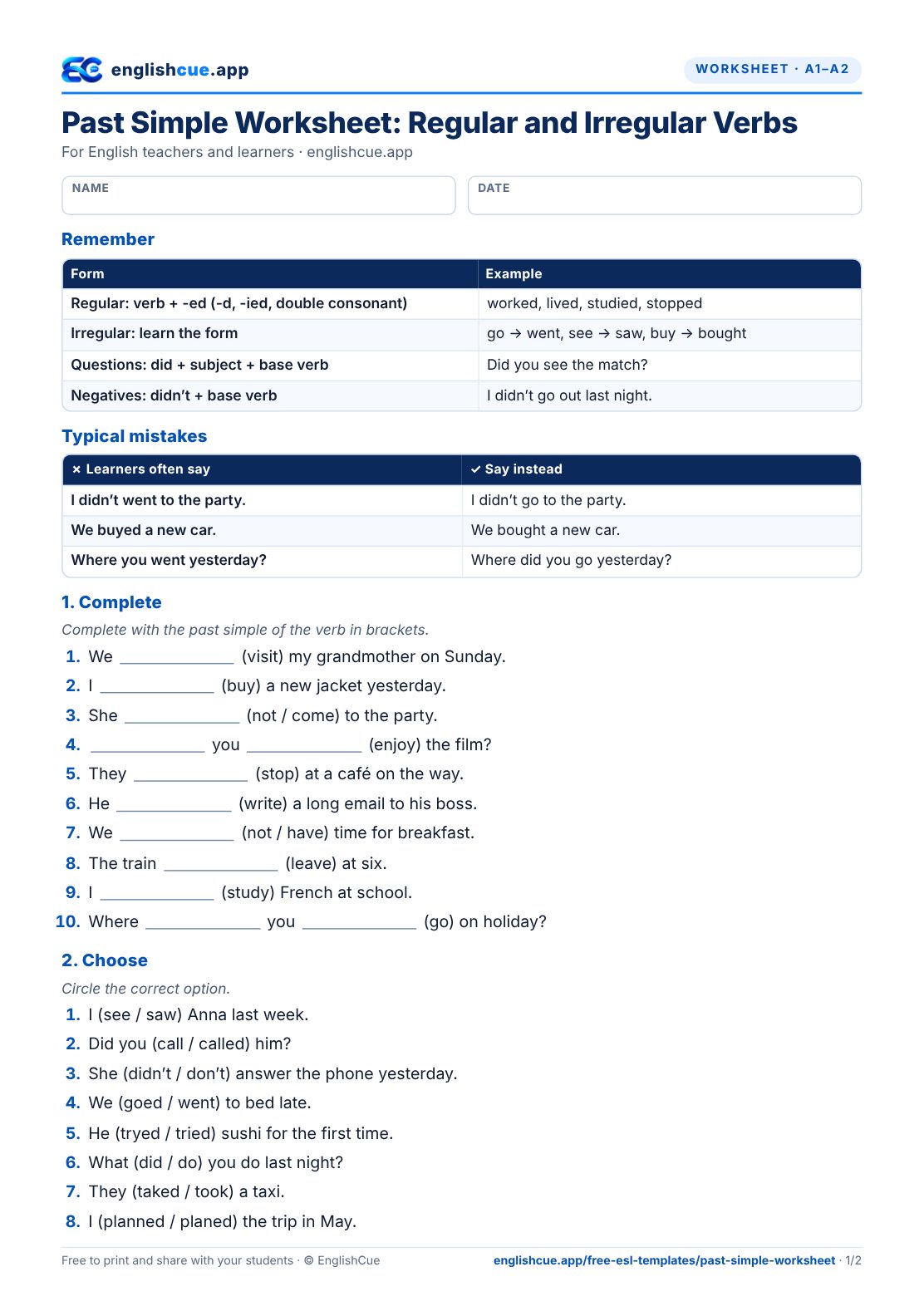
A4, portrait, 2 pages. No sign-up. Free to print, copy and share with your students.
How to use it
- Point out that after did and didn’t the verb goes back to the base form: Did you go? not Did you went?
- Use the storytelling prompts as homework: a five-sentence paragraph is enough to see which irregular verbs are still missing.
- Give the first page in class or share it on screen; the last page ends with a model answer and the answer key, so print it separately or fold it back.
- Do the speaking questions last and spend at least ten minutes on them: the exercises prepare the language, the conversation is where learners own it.
What is on the sheet
The full content, so you can check it before you print or copy an example onto your own slide.
Remember
| Form | Example |
|---|---|
| Regular: verb + -ed (-d, -ied, double consonant) | worked, lived, studied, stopped |
| Irregular: learn the form | go → went, see → saw, buy → bought |
| Questions: did + subject + base verb | Did you see the match? |
| Negatives: didn’t + base verb | I didn’t go out last night. |
Typical mistakes
| ✗ Learners often say | ✓ Say instead |
|---|---|
| I didn’t went to the party. | I didn’t go to the party. |
| We buyed a new car. | We bought a new car. |
| Where you went yesterday? | Where did you go yesterday? |
1. Complete
Complete with the past simple of the verb in brackets.
- We ___ (visit) my grandmother on Sunday.
- I ___ (buy) a new jacket yesterday.
- She ___ (not / come) to the party.
- ___ you ___ (enjoy) the film?
- They ___ (stop) at a café on the way.
- He ___ (write) a long email to his boss.
- We ___ (not / have) time for breakfast.
- The train ___ (leave) at six.
- I ___ (study) French at school.
- Where ___ you ___ (go) on holiday?
2. Choose
Circle the correct option.
- I (see / saw) Anna last week.
- Did you (call / called) him?
- She (didn’t / don’t) answer the phone yesterday.
- We (goed / went) to bed late.
- He (tryed / tried) sushi for the first time.
- What (did / do) you do last night?
- They (taked / took) a taxi.
- I (planned / planed) the trip in May.
3. Correct the mistakes
Each sentence has one mistake. Write it correctly.
- I didn’t went to work.
- Did she saw the email?
- We eated pizza.
- He studyed all night.
- Where you went last summer?
- I buyed it two years ago.
Writing
Write about your last weekend in 6–8 sentences. Use at least four irregular verbs and one negative sentence.
Speaking
- What did you do last weekend? Give three details.
- Tell me about a trip you remember well. Where did you go and what happened?
- What did you eat yesterday?
- When did you last try something for the first time?
Show the answer key
1. Complete: 1 visited · 2 bought · 3 didn’t come · 4 Did … enjoy · 5 stopped · 6 wrote · 7 didn’t have · 8 left · 9 studied · 10 did … go
2. Choose: 1 saw · 2 call · 3 didn’t · 4 went · 5 tried · 6 did · 7 took · 8 planned
3. Correct the mistakes: 1 I didn’t go to work. · 2 Did she see the email? · 3 We ate pizza. · 4 He studied all night. · 5 Where did you go last summer? · 6 I bought it two years ago.
Writing, model answer: Last weekend was very relaxing. On Saturday morning I went to the market and bought fresh fruit. In the afternoon I met my friend Ana and we saw a film. We didn’t like the ending very much. On Sunday I slept late, then I made pancakes for my family. In the evening I read a book and went to bed early.
Use it with
More free worksheets
All 100 free worksheets by level, with a PDF pack per level →
Found this useful?
EnglishCue also has complete interactive lessons that open on screen, with audio, practice and speaking tasks.