 ENGLISHCUE
Until 30 November: try EnglishCue PRO for US$0.99 your first week, then US$19.90/month, cancel anytime. Try PRO · US$0.99 →
Worksheet · B1 · For teachers and students · Free PDF, 2 pages
Past Perfect Worksheet: Had + Past Participle
The past perfect lets a speaker step further back in a story: when we arrived, the film had started. Learners often avoid it or use it for anything in the distant past. This sheet practises the form and the real job of the tense, showing which of two past events came first when the order is not obvious.
Preview
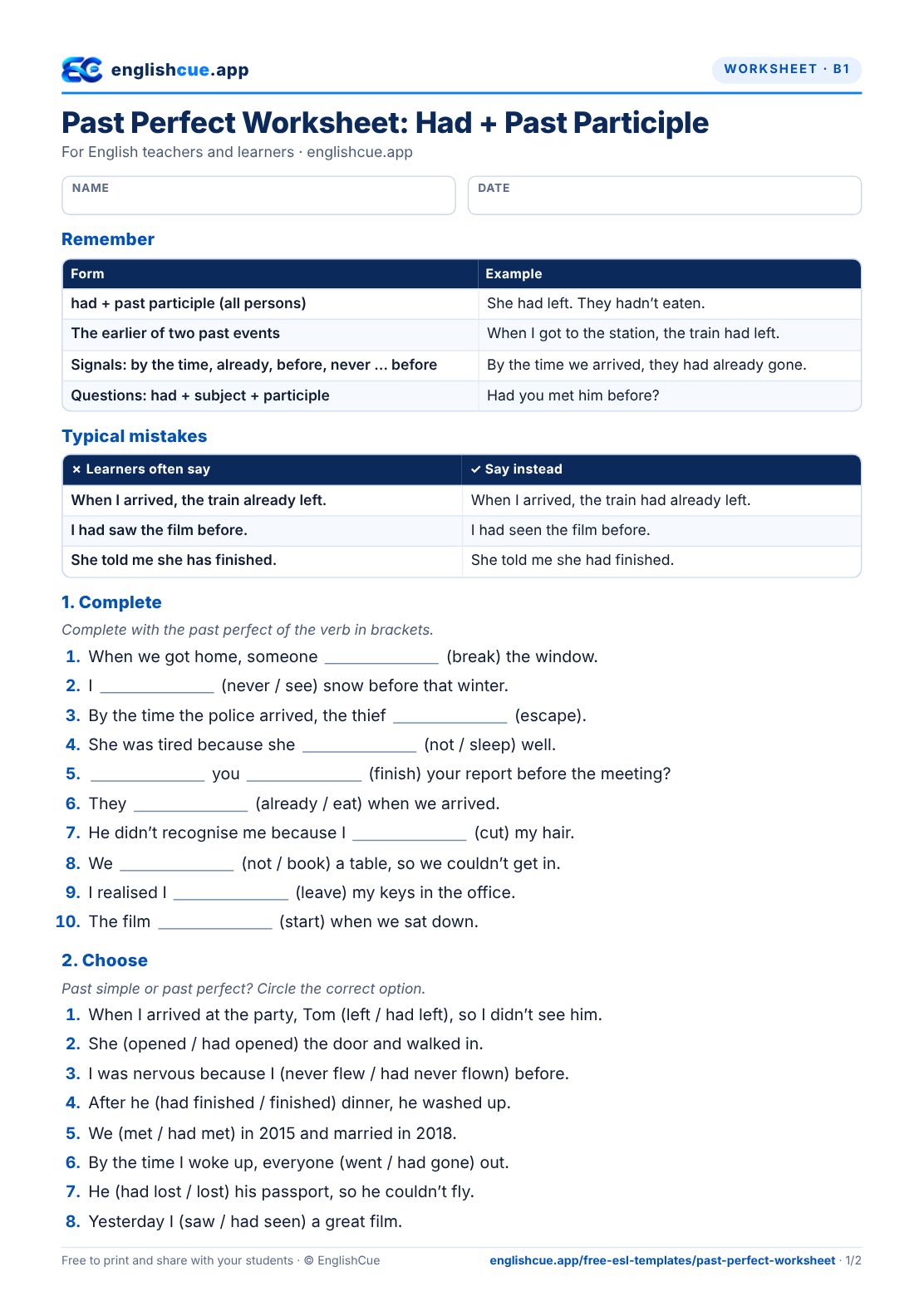
A4, portrait, 2 pages. No sign-up. Free to print, copy and share with your students.
How to use it
- Draw two crosses on a past timeline and label them 1 and 2; the past perfect always marks number 1.
- Point out that with before and after the order is already clear, so the past simple is often fine there too.
- Give the first page in class or share it on screen; the last page ends with a model answer and the answer key, so print it separately or fold it back.
- Do the speaking questions last and spend at least ten minutes on them: the exercises prepare the language, the conversation is where learners own it.
What is on the sheet
The full content, so you can check it before you print or copy an example onto your own slide.
Remember
| Form | Example |
|---|---|
| had + past participle (all persons) | She had left. They hadn’t eaten. |
| The earlier of two past events | When I got to the station, the train had left. |
| Signals: by the time, already, before, never … before | By the time we arrived, they had already gone. |
| Questions: had + subject + participle | Had you met him before? |
Typical mistakes
| ✗ Learners often say | ✓ Say instead |
|---|---|
| When I arrived, the train already left. | When I arrived, the train had already left. |
| I had saw the film before. | I had seen the film before. |
| She told me she has finished. | She told me she had finished. |
1. Complete
Complete with the past perfect of the verb in brackets.
- When we got home, someone ___ (break) the window.
- I ___ (never / see) snow before that winter.
- By the time the police arrived, the thief ___ (escape).
- She was tired because she ___ (not / sleep) well.
- ___ you ___ (finish) your report before the meeting?
- They ___ (already / eat) when we arrived.
- He didn’t recognise me because I ___ (cut) my hair.
- We ___ (not / book) a table, so we couldn’t get in.
- I realised I ___ (leave) my keys in the office.
- The film ___ (start) when we sat down.
2. Choose
Past simple or past perfect? Circle the correct option.
- When I arrived at the party, Tom (left / had left), so I didn’t see him.
- She (opened / had opened) the door and walked in.
- I was nervous because I (never flew / had never flown) before.
- After he (had finished / finished) dinner, he washed up.
- We (met / had met) in 2015 and married in 2018.
- By the time I woke up, everyone (went / had gone) out.
- He (had lost / lost) his passport, so he couldn’t fly.
- Yesterday I (saw / had seen) a great film.
3. Correct the mistakes
Correct the mistake in each sentence.
- When I arrived, the meeting already started.
- She had went home early.
- I had visited Paris last year.
- By the time we got there, the shop has closed.
- Had you ate before the show?
- He didn’t know her because he never met her before.
Writing
Write about a day when things went wrong (6–7 sentences). Use the past perfect to explain what had happened before.
Speaking
- Tell me about a time you arrived somewhere too late. What had happened?
- Had you ever travelled alone before you were twenty?
- Describe a day when everything went wrong. What had you forgotten to do?
- What had you already learned about English before you started classes with me?
Show the answer key
1. Complete: 1 had broken · 2 had never seen · 3 had escaped · 4 hadn’t slept · 5 Had … finished · 6 had already eaten · 7 had cut · 8 hadn’t booked · 9 had left · 10 had started
2. Choose: 1 had left · 2 opened · 3 had never flown · 4 had finished (or finished) · 5 met · 6 had gone · 7 had lost · 8 saw
3. Correct the mistakes: 1 When I arrived, the meeting had already started. · 2 She had gone home early. · 3 I visited Paris last year. · 4 By the time we got there, the shop had closed. · 5 Had you eaten before the show? · 6 He didn’t know her because he had never met her before.
Writing, model answer: Last Monday was a disaster. When I got to the station, my train had just left. I took a taxi, but I realised I had left my wallet at home. Luckily, the driver let me pay by phone. When I finally arrived at the office, the meeting had already started. My boss had moved it to nine without telling me.
Use it with
More free worksheets
All 100 free worksheets by level, with a PDF pack per level →
Found this useful?
EnglishCue also has complete interactive lessons that open on screen, with audio, practice and speaking tasks.