ENGLISHCUE

Until 30 November: try EnglishCue PRO for US$0.99 your first week, then US$19.90/month, cancel anytime. Try PRO · US$0.99 →

B1 English grammar lesson · Sentences, questions and connectors · PRO · 60 min

Indirect questions: could you tell me where…?

Where is the station? → Could you tell me where the station is? Does it open on Sunday? → Do you know if it opens on Sunday?

The situation

Lin is a tourist in Edinburgh. She stops a local: “Excuse me, could you tell me where the castle is?” Then at a café: “Do you know if the museum opens on Sundays?” By the end of this lesson you can ask polite indirect questions with the right word order.

Free practice worksheet

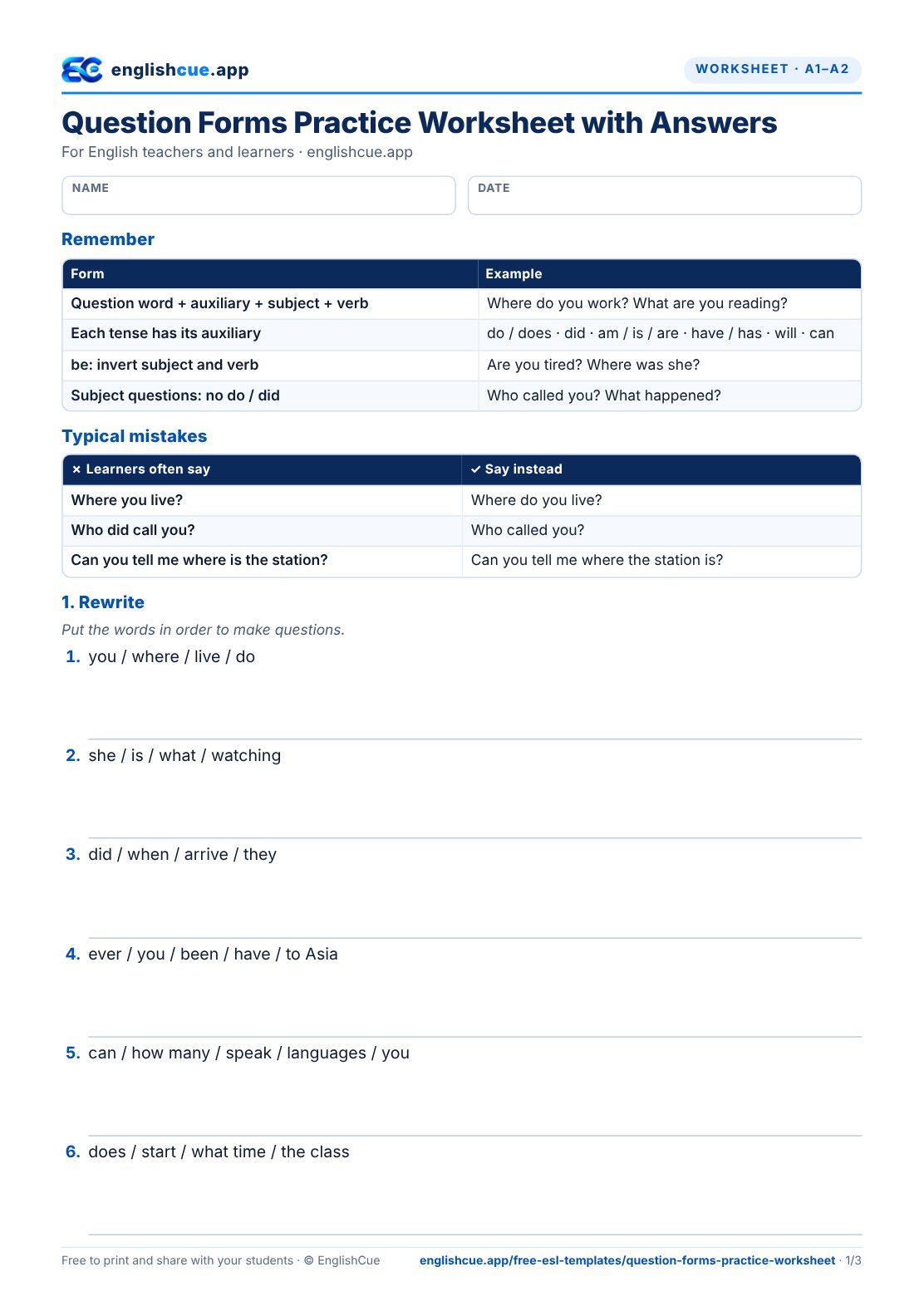
Question Forms Practice Worksheet with Answers previewWorksheet · A1–A2 · PDF with answersQuestion Forms Practice Worksheet with Answers

The grammar at a glance

The forms your learner will use by the end of the lesson.

OPENERS

Could you tell me · Do you know · I was wondering · I’d like to know

Do you know what time it is?

more polite

WORD ORDER

question word + subject + verb

Could you tell me where the station is?

no do / does / did

YES / NO

if / whether + statement

Do you know if it’s open?

no “that if”

PUNCTUATION

question opener → ? · statement opener → .

I wonder where she is.

check the opener

Direct and indirect

Direct questionIndirect question
Where is the castle?Could you tell me where the castle is?
What time does it open?Do you know what time it opens?
How much is this?Can you tell me how much this is?
Does the bus stop here?Do you know if the bus stops here?

After the opener, use statement order (subject + verb) and no do / does / did. For yes / no questions, add if or whether.

Common mistakes to watch for

The errors students make most often with this structure, and how to explain them.

  • Could you tell me where is the post office? → Could you tell me where the post office is?Statement order.
  • Do you know what time does the shop close? → Do you know what time the shop closes?No does; closes.
  • Can you tell me does this bus go to the airport? → Can you tell me if this bus goes to the airport?If + statement.
  • I wonder where did she go? → I wonder where she went.Statement order, full stop.
  • Do you know how much costs this? → Do you know how much this costs?Subject + verb.
  • Could you tell me that if there is a lift? → Could you tell me if there is a lift?No that before if.

Teaching tips

Who / what as subject

If the question word is the subject, the order doesn’t change: “Who lives here?” → “Do you know who lives here?”

Next lesson

Agreeing: so do I, neither do I.

Quick check: three sample questions

Use them as a warm-up or an exit ticket. Answers are below.

  1. Could you tell me where ___ ?
    • the bank is
    • is the bank
    • does the bank
  2. Do you know what time ___ ?
    • the film starts
    • does the film start
    • starts the film
  3. Can you tell me ___ this train goes to York?
    • if
    • does
    • that
Show answers
  1. the bank is. Statement order.
  2. the film starts. No does.
  3. if. Yes / no: if.

What the full lesson includes

  • A scene that shows the structure in use, with guided discovery questions.
  • Forms and examples on screen, with colour-coded contrasts.
  • Self-correcting practice: choose, fix, build and rewrite, with an explanation for every answer.
  • A recorded listening with transcript, a speaking task with follow-up questions and a short writing task with a model answer.
  • Teacher mode and self-study mode, so students can review after class.

Where this lesson fits in the course

More sentences, questions and connectors lessons

  1. B1Question tagsIt’s a beautiful day, isn’t it? You don’t know Sam, do you? Let’s dance, shall we?
  2. B1So do I, neither do I“I love jazz.” “So do I!” “I can’t swim.” “Neither can I.” “I’m tired.” “I’m not.”
  3. B1Linking ideas: although, despite, in spite of, whereasAlthough it rained, we had fun. Despite the rain, we had fun. I love the sea, whereas my sister prefers the mountains.
  4. B1Purpose and result: so that, in order to, so… that, such… thatI left early so that I wouldn’t miss the train. It was so cold that the lake froze. It was such a cold night!

All sentences, questions and connectors lessons → All B1 grammar lessons →

Teach it and practise it

Teach this lesson with EnglishCue PRO.

Share your screen and teach: everything from the warm-up to the writing task is ready.