AGREE (+)
So + auxiliary + subject
“I love jazz.” “So do I.”
so am I, so have I, so can I ENGLISHCUE
Until 30 November: try EnglishCue PRO for US$0.99 your first week, then US$19.90/month, cancel anytime. Try PRO · US$0.99 →
B1 English grammar lesson · Sentences, questions and connectors · PRO · 60 min
“I love jazz.” “So do I!” “I can’t swim.” “Neither can I.” “I’m tired.” “I’m not.”
Amy and Jack are on a first date. Amy: “I love Italian food.” Jack: “So do I!” Amy: “I can’t stand horror films.” Jack: “Neither can I!” Amy: “I’m a morning person.” Jack: “Oh… I’m not.” By the end of this lesson you can agree and disagree naturally.
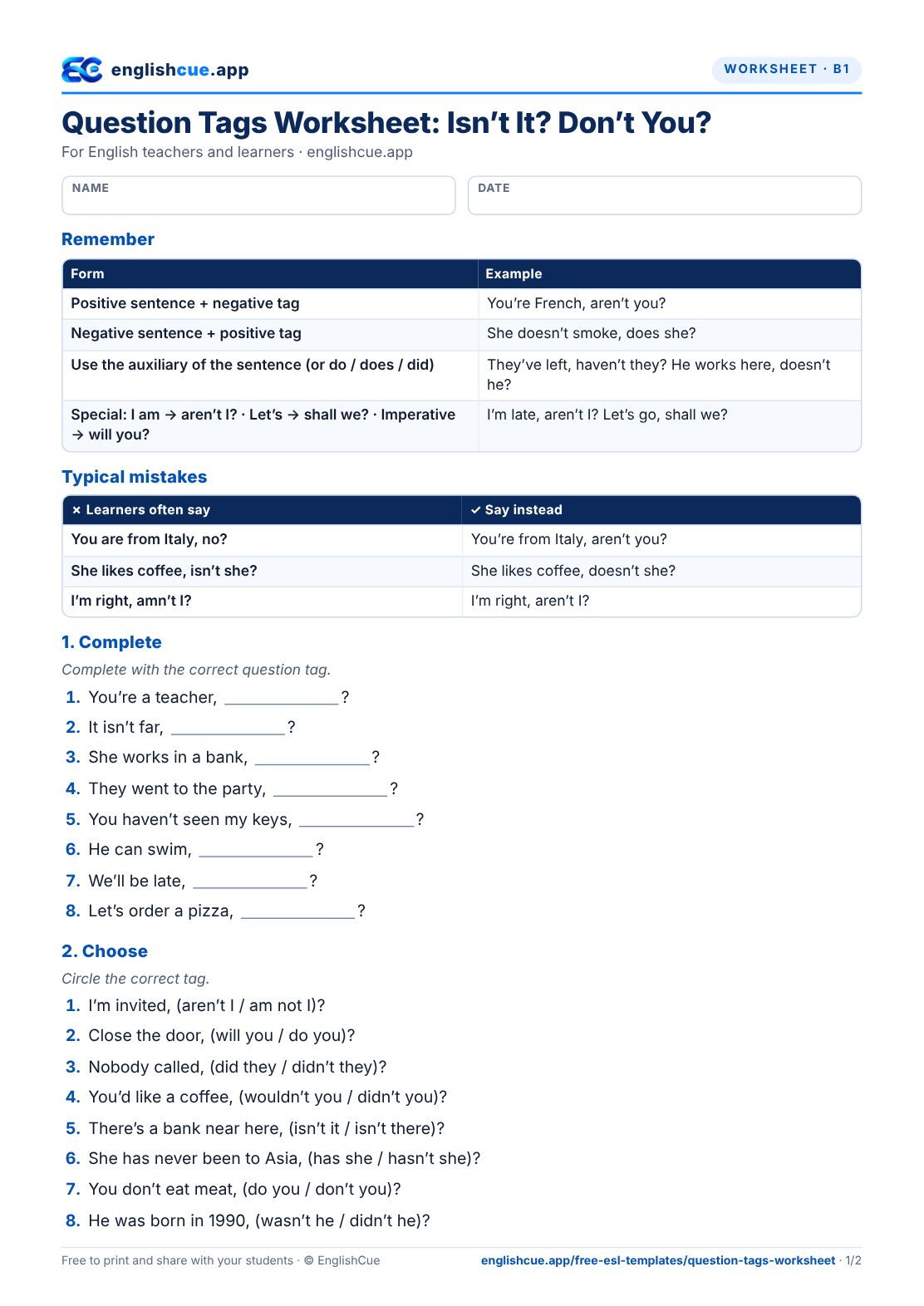 Worksheet · B1 · PDF with answersQuestion Tags Worksheet: Isn’t It? Don’t You?
The forms your learner will use by the end of the lesson.
So + auxiliary + subject
“I love jazz.” “So do I.”
so am I, so have I, so can INeither / Nor + auxiliary + subject
“I can’t swim.” “Neither can I.”
never → neithersubject + opposite auxiliary
“I don’t like tea.” “I do!”
I’m not, I haven’tMe too · Me neither
“I’m tired.” “Me too.”
no tense change| Statement | Agree |
|---|---|
| I love Italian food. (+) | So do I. |
| I’m tired. (+) | So am I. |
| I’ve been to Rome. (+) | So have I. |
| I can’t swim. (−) | Neither can I. |
| I didn’t like the film. (−) | Neither did I. |
| I don’t smoke. (−) | Nor do I. (= Neither do I) |
Word order: So / Neither + auxiliary + subject. The auxiliary matches the statement (am, do, have, can, did, will…).
The errors students make most often with this structure, and how to explain them.
You can use other subjects too: “I love pizza.” “So does my sister.” “Tom can’t drive.” “Neither can I.”
Contrast linkers: although, despite, in spite of, whereas.
Use them as a warm-up or an exit ticket. Answers are below.
All sentences, questions and connectors lessons → All B1 grammar lessons →
Share your screen and teach: everything from the warm-up to the writing task is ready.