NEVER / RARELY / LITTLE
adverbial + aux + subject + verb
Never have I seen it.
do-support if needed ENGLISHCUE
Until 30 November: try EnglishCue PRO for US$0.99 your first week, then US$19.90/month, cancel anytime. Try PRO · US$0.99 →
C1 English grammar lesson · Sentences, questions and connectors · Free · 60 min
Never have I seen such a view. Not only did she win, but she also broke the record. Little did we know…
A famous novelist writes her memoir: “Never had I imagined that my first book would sell a million copies. Not only did publishers reject it ten times, but my own mother also called it boring. No sooner had it been published than a film studio called. Little did I know that my life was about to change.” By the end of this lesson you can use inversion for emphasis in formal writing and powerful speeches.
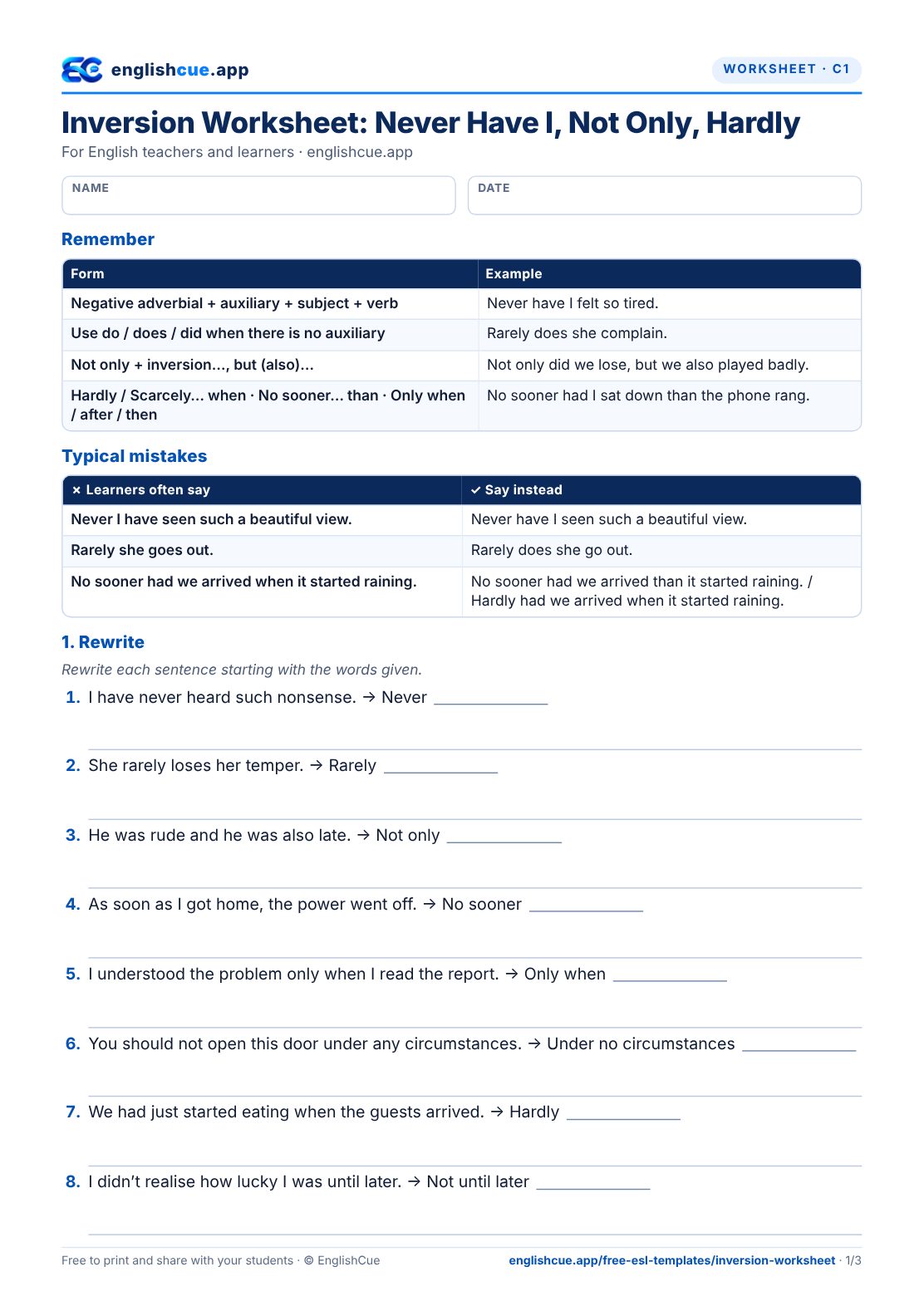 Worksheet · C1 · PDF with answersInversion Worksheet: Never Have I, Not Only, Hardly
The forms your learner will use by the end of the lesson.
adverbial + aux + subject + verb
Never have I seen it.
do-support if neededNot only + aux + subject …, but (also) …
Not only did she win, but…
formal emphasisNo sooner had … than · Hardly had … when
No sooner had we sat down than…
past perfectinversion in the main clause
Only then did I understand.
rules and drama| Adverbial | Structure | Example |
|---|---|---|
| Never / Rarely / Seldom | + auxiliary + subject + verb | Never have I seen such a view. |
| Not only … but (also) | Not only + aux + subject …, but … | Not only did she win, but she also broke the record. |
| No sooner … than | No sooner + had + subject + pp + than | No sooner had we sat down than the phone rang. |
| Hardly / Scarcely … when | Hardly + had + subject + pp + when | Hardly had I closed my eyes when the alarm went off. |
| Only when / Only after / Not until | inversion in the main clause | Only when I left did I realise. |
| Under no circumstances / On no account / At no time | + aux + subject | Under no circumstances should you open this door. |
| Little | Little + did + subject + know / realise | Little did we know what was coming. |
If there is no auxiliary (present / past simple), use do / does / did: Rarely do we see… · Not only did she…
The errors students make most often with this structure, and how to explain them.
Inverted conditionals: Had I known…, Were it not for…, Should you need…
Use them as a warm-up or an exit ticket. Answers are below.
All sentences, questions and connectors lessons → All C1 grammar lessons →
Share your screen and teach: everything from the warm-up to the writing task is ready.