 ENGLISHCUE
Until 30 November: try EnglishCue PRO for US$0.99 your first week, then US$19.90/month, cancel anytime. Try PRO · US$0.99 →
Worksheet · C1 · For teachers and students · Free PDF, 3 pages
Inversion Worksheet: Never Have I, Not Only, Hardly
Never have I seen such chaos. Not only did he forget my birthday, he also forgot the party. Inversion after negative and limiting adverbials adds drama and formality, and C1 exams test it constantly. This sheet practises the most useful triggers, the auxiliary-subject order (including do / does / did), and when inversion sounds natural rather than theatrical.
Preview
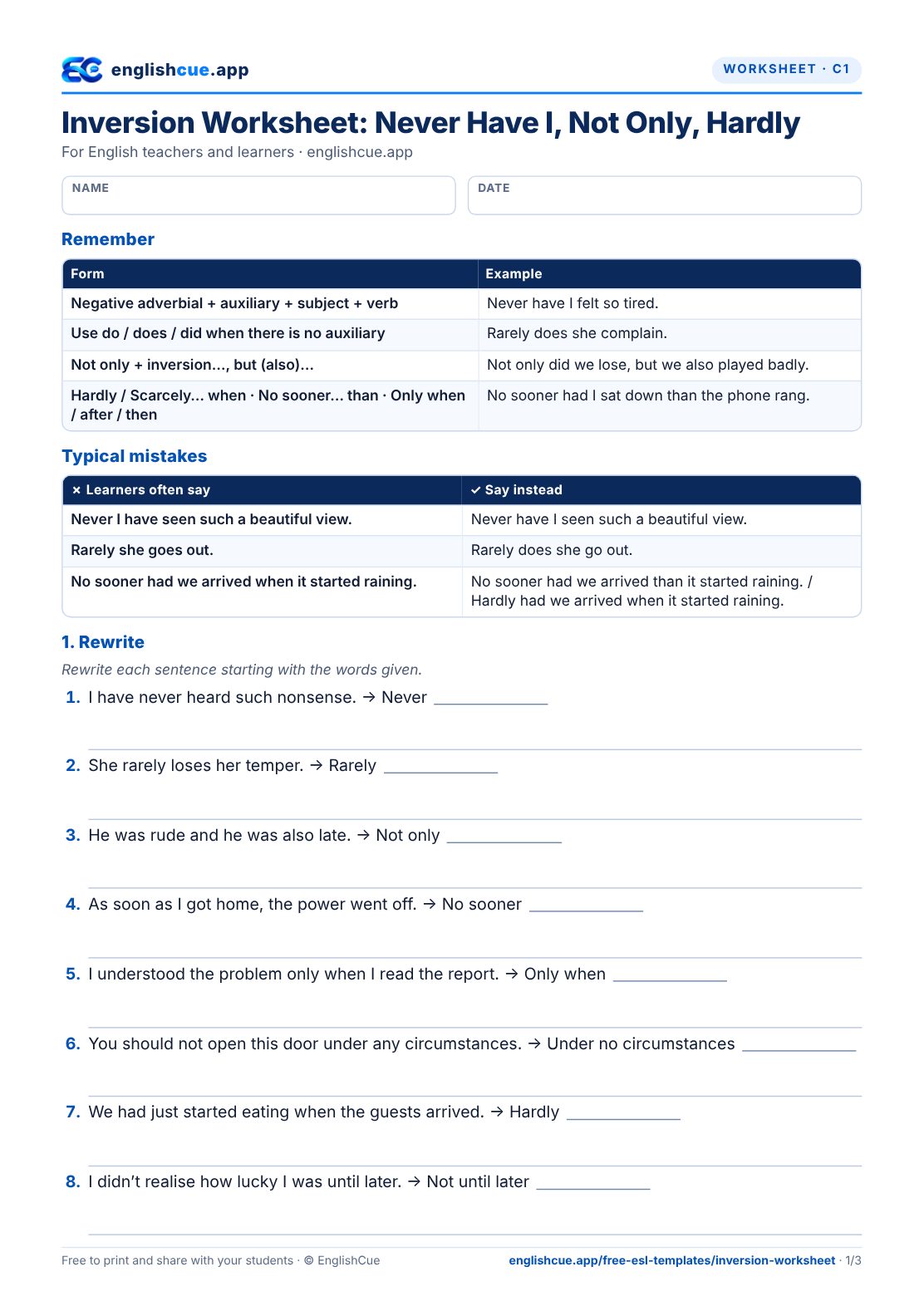
A4, portrait, 3 pages. No sign-up. Free to print, copy and share with your students.
How to use it
- Build every inverted sentence from a normal one: ‘I have never seen…’ → ‘Never have I seen…’ The auxiliary jumps in front of the subject.
- Tell learners to save inversion for speeches, formal writing and storytelling for effect, not for ordering coffee.
- Give the first page in class or share it on screen; the last page ends with a model answer and the answer key, so print it separately or fold it back.
- Do the speaking questions last and spend at least ten minutes on them: the exercises prepare the language, the conversation is where learners own it.
What is on the sheet
The full content, so you can check it before you print or copy an example onto your own slide.
Remember
| Form | Example |
|---|---|
| Negative adverbial + auxiliary + subject + verb | Never have I felt so tired. |
| Use do / does / did when there is no auxiliary | Rarely does she complain. |
| Not only + inversion…, but (also)… | Not only did we lose, but we also played badly. |
| Hardly / Scarcely… when · No sooner… than · Only when / after / then | No sooner had I sat down than the phone rang. |
Typical mistakes
| ✗ Learners often say | ✓ Say instead |
|---|---|
| Never I have seen such a beautiful view. | Never have I seen such a beautiful view. |
| Rarely she goes out. | Rarely does she go out. |
| No sooner had we arrived when it started raining. | No sooner had we arrived than it started raining. / Hardly had we arrived when it started raining. |
1. Rewrite
Rewrite each sentence starting with the words given.
- I have never heard such nonsense. → Never ___
- She rarely loses her temper. → Rarely ___
- He was rude and he was also late. → Not only ___
- As soon as I got home, the power went off. → No sooner ___
- I understood the problem only when I read the report. → Only when ___
- You should not open this door under any circumstances. → Under no circumstances ___
- We had just started eating when the guests arrived. → Hardly ___
- I didn’t realise how lucky I was until later. → Not until later ___
2. Choose
Circle the correct option.
- Seldom (we see / do we see) such talent.
- Not only (she sings / does she sing), she also writes her songs.
- No sooner had he left (than / when) she called.
- Only after the meeting (I realised / did I realise) my mistake.
- Little (did they know / they knew) what was coming.
- At no time (was the public / the public was) in danger.
- Hardly had I closed my eyes (than / when) the alarm went off.
- Never before (has the city / the city has) been so crowded.
3. Correct the mistakes
Each sentence has one mistake. Write it correctly.
- Not only she is clever, but she is also kind.
- Rarely I have eaten such good food.
- Only then I understood.
- No sooner I had paid than the price dropped.
- Little he knew about the surprise.
- Under no circumstances you should leave the room.
Writing
Write the opening of a dramatic speech or a short story (6 sentences). Use at least four different inversion structures.
Speaking
- Describe the best meal you have ever had, starting with ‘Never have I…’
- Talk about a time things went wrong: ‘No sooner had I… than…’
- Give three rules for a dangerous job, starting with ‘Under no circumstances…’
- What did you only understand when you got older? Start with ‘Only when…’
Show the answer key
1. Rewrite: 1 Never have I heard such nonsense. · 2 Rarely does she lose her temper. · 3 Not only was he rude, but he was also late. · 4 No sooner had I got home than the power went off. · 5 Only when I read the report did I understand the problem. · 6 Under no circumstances should you open this door. · 7 Hardly had we started eating when the guests arrived. · 8 Not until later did I realise how lucky I was.
2. Choose: 1 do we see · 2 does she sing · 3 than · 4 did I realise · 5 did they know · 6 was the public · 7 when · 8 has the city
3. Correct the mistakes: 1 Not only is she clever, but she is also kind. · 2 Rarely have I eaten such good food. · 3 Only then did I understand. · 4 No sooner had I paid than the price dropped. · 5 Little did he know about the surprise. · 6 Under no circumstances should you leave the room.
Writing, model answer: Never before had the village seen such a storm. Not only did the river burst its banks, but the bridge also collapsed. No sooner had the last family left their home than the water reached the roof. Only when the sun rose did we understand the scale of the damage. At no time, however, did anyone lose hope. Rarely have I been so proud of my neighbours.
Use it with
More free worksheets
All 100 free worksheets by level, with a PDF pack per level →
Found this useful?
EnglishCue also has complete interactive lessons that open on screen, with audio, practice and speaking tasks.