 ENGLISHCUE
Until 30 November: try EnglishCue PRO for US$0.99 your first week, then US$19.90/month, cancel anytime. Try PRO · US$0.99 →
Worksheet · A2 · For teachers and students · Free PDF, 2 pages
Present Simple vs Present Continuous Worksheet
Learners usually know both tenses separately and mix them up as soon as they are side by side. This sheet puts them together: routines and facts against actions in progress, the time expressions that signal each one, and state verbs like know, want and like that do not normally take -ing.
Preview
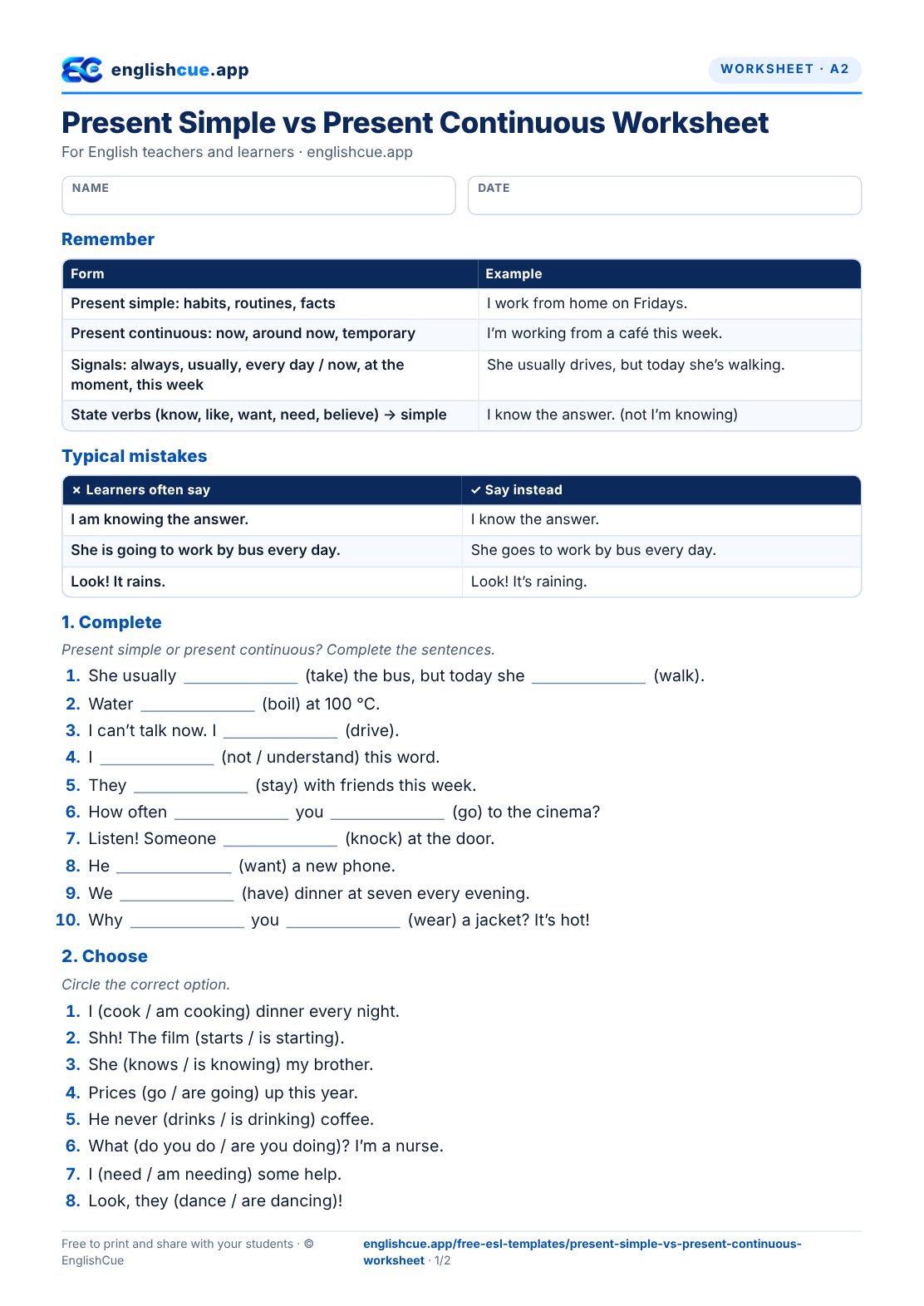
A4, portrait, 2 pages. No sign-up. Free to print, copy and share with your students.
How to use it
- Draw two columns, ‘usually’ and ‘now’, and sort the time expressions (every day, at the moment, never, this week) before exercise 1.
- When a learner says ‘I am knowing’, ask ‘Is it an action or a state?’ instead of correcting.
- Give the first page in class or share it on screen; the last page ends with a model answer and the answer key, so print it separately or fold it back.
- Do the speaking questions last and spend at least ten minutes on them: the exercises prepare the language, the conversation is where learners own it.
What is on the sheet
The full content, so you can check it before you print or copy an example onto your own slide.
Remember
| Form | Example |
|---|---|
| Present simple: habits, routines, facts | I work from home on Fridays. |
| Present continuous: now, around now, temporary | I’m working from a café this week. |
| Signals: always, usually, every day / now, at the moment, this week | She usually drives, but today she’s walking. |
| State verbs (know, like, want, need, believe) → simple | I know the answer. (not I’m knowing) |
Typical mistakes
| ✗ Learners often say | ✓ Say instead |
|---|---|
| I am knowing the answer. | I know the answer. |
| She is going to work by bus every day. | She goes to work by bus every day. |
| Look! It rains. | Look! It’s raining. |
1. Complete
Present simple or present continuous? Complete the sentences.
- She usually ___ (take) the bus, but today she ___ (walk).
- Water ___ (boil) at 100 °C.
- I can’t talk now. I ___ (drive).
- I ___ (not / understand) this word.
- They ___ (stay) with friends this week.
- How often ___ you ___ (go) to the cinema?
- Listen! Someone ___ (knock) at the door.
- He ___ (want) a new phone.
- We ___ (have) dinner at seven every evening.
- Why ___ you ___ (wear) a jacket? It’s hot!
2. Choose
Circle the correct option.
- I (cook / am cooking) dinner every night.
- Shh! The film (starts / is starting).
- She (knows / is knowing) my brother.
- Prices (go / are going) up this year.
- He never (drinks / is drinking) coffee.
- What (do you do / are you doing)? I’m a nurse.
- I (need / am needing) some help.
- Look, they (dance / are dancing)!
3. Correct the mistakes
Correct the mistake in each sentence.
- I am liking this song.
- She is go to work by car every day.
- Look! The bus comes.
- Do you working today?
- He is believing you.
- We are usually eat at home.
Writing
Write a short paragraph (6–7 sentences) comparing your normal week with this week. What do you usually do, and what are you doing differently now?
Speaking
- What do you usually do after work, and what are you doing differently this month?
- What are you learning or working on at the moment?
- What does a normal weekday look like for you?
- Is anything changing in your city or your job these days?
Show the answer key
1. Complete: 1 takes … is walking · 2 boils · 3 am driving · 4 don’t understand · 5 are staying · 6 do … go · 7 is knocking · 8 wants · 9 have · 10 are … wearing
2. Choose: 1 cook · 2 is starting · 3 knows · 4 are going · 5 drinks · 6 do you do · 7 need · 8 are dancing
3. Correct the mistakes: 1 I like this song. · 2 She goes to work by car every day. · 3 Look! The bus is coming. · 4 Are you working today? · 5 He believes you. · 6 We usually eat at home.
Writing, model answer: I usually work in the office from Monday to Friday, but this week I’m working from home because the office is closed. Normally I take the train at eight; now I’m starting at nine. I usually have lunch with colleagues, but this week I’m cooking for myself. I don’t like working alone very much, but I’m enjoying the extra sleep.
Use it with
More free worksheets
All 100 free worksheets by level, with a PDF pack per level →
Found this useful?
EnglishCue also has complete interactive lessons that open on screen, with audio, practice and speaking tasks.