Until 30 November: try EnglishCue PRO for US$0.99 your first week, then US$19.90/month, cancel anytime. Try PRO · US$0.99 →
ENGLISHCUE English grammar lessons B2 grammar Participle clauses: Feeling tired, I went home B2 English grammar lesson · Sentences, questions and connectors · PRO · 60 min
Participle clauses: Feeling tired, I went home Arriving late, we missed the ferry. Having paid, we left. Built in 1890, the hotel…
The situation Maya writes a travel blog about a road trip in Scotland. Arriving late at the port, she missed the ferry. Having checked the timetable, she found a small hotel. The hotel, built in 1890, was full of old maps. The man sitting next to her at dinner was a fisherman. By the end of this lesson you can write compact, elegant sentences with participle clauses.
The grammar at a glance The forms your learner will use by the end of the lesson.
-ING same time · reason
Feeling tired, I went home.
not + -ing = negative HAVING + PP earlier action
Having paid, we left.
before the main verb PAST PARTICIPLE passive meaning
Built in 1890, the hotel…
= which was built REDUCED RELATIVE noun + -ing / pp
the man sitting next to me
= who was sitting Participle clauses Form Meaning Full clause → participle clause -ing same time, or reason Because she felt tired, she… → Feeling tired , she… having + past participle one action finished before the other After she had paid, she left. → Having paid , she left. past participle passive meaning The hotel, which was built in 1890, … → The hotel, built in 1890 , … noun + -ing / past participle reduced relative clause the man who is sitting there → the man sitting there conjunction + -ing after, before, while, since, when Before she signed, she read it. → Before signing , she read it.
Common mistakes to watch for The errors students make most often with this structure, and how to explain them.
Driving to work, the radio played my favourite song. Driving to work, I heard my favourite song on the radio. Same subject: I was driving. Finished my homework, I went out. Having finished my homework, I went out. Earlier action: having + past participle. Writing in 1605, the book is still popular. Written in 1605, the book is still popular. Passive: written. Not having money, so I stayed home. Not having any money, I stayed home. No so: the participle already shows the reason. The people waited outside were angry. The people waiting outside were angry. Active: who were waiting → waiting. After to finish, we had dinner. After finishing, we had dinner. Conjunction + -ing. Teaching tips Next lesson Cleft sentences : What I need is… It was Tom who…
Quick check: three sample questions Use them as a warm-up or an exit ticket. Answers are below.
Because I didn’t know the way, I used my phone. → ___ the way, I used my phone. Not knowing Knowing not Not known After she had finished her coffee, she left. → ___ her coffee, she left. Having finished Finished Have finishing The car, which was made in Italy, is fast. → The car, ___ in Italy, is fast. Show answers Not knowing . Negative: not + -ing. Having finished . Having + past participle = before. made . Passive: past participle. What the full lesson includes A scene that shows the structure in use, with guided discovery questions. Forms and examples on screen, with colour-coded contrasts. Self-correcting practice: choose, fix, build and rewrite, with an explanation for every answer. A recorded listening with transcript, a speaking task with follow-up questions and a short writing task with a model answer. Teacher mode and self-study mode, so students can review after class. Where this lesson fits in the course More sentences, questions and connectors lessons B2 Cleft sentences: What I need is… / It was Tom who…It wasn’t me who ate it! What I really need is a holiday. All I want is some sleep. B2 Discourse markers in writing: however, moreover, thereforeHowever, there are risks. Moreover, workers are happier. As a result, productivity rises. B2 Discourse markers in speech: anyway, actually, mind youActually, I didn’t like it. Anyway, how’s work? It was expensive. Mind you, the food was amazing. B2 Ellipsis and substitution: I think so, So do I, the red oneIs it open? I think so. I love sushi. So do I. Which jacket? The black one. I’d love to. Teach this lesson with EnglishCue PRO. Share your screen and teach: everything from the warm-up to the writing task is ready.
 ENGLISHCUE
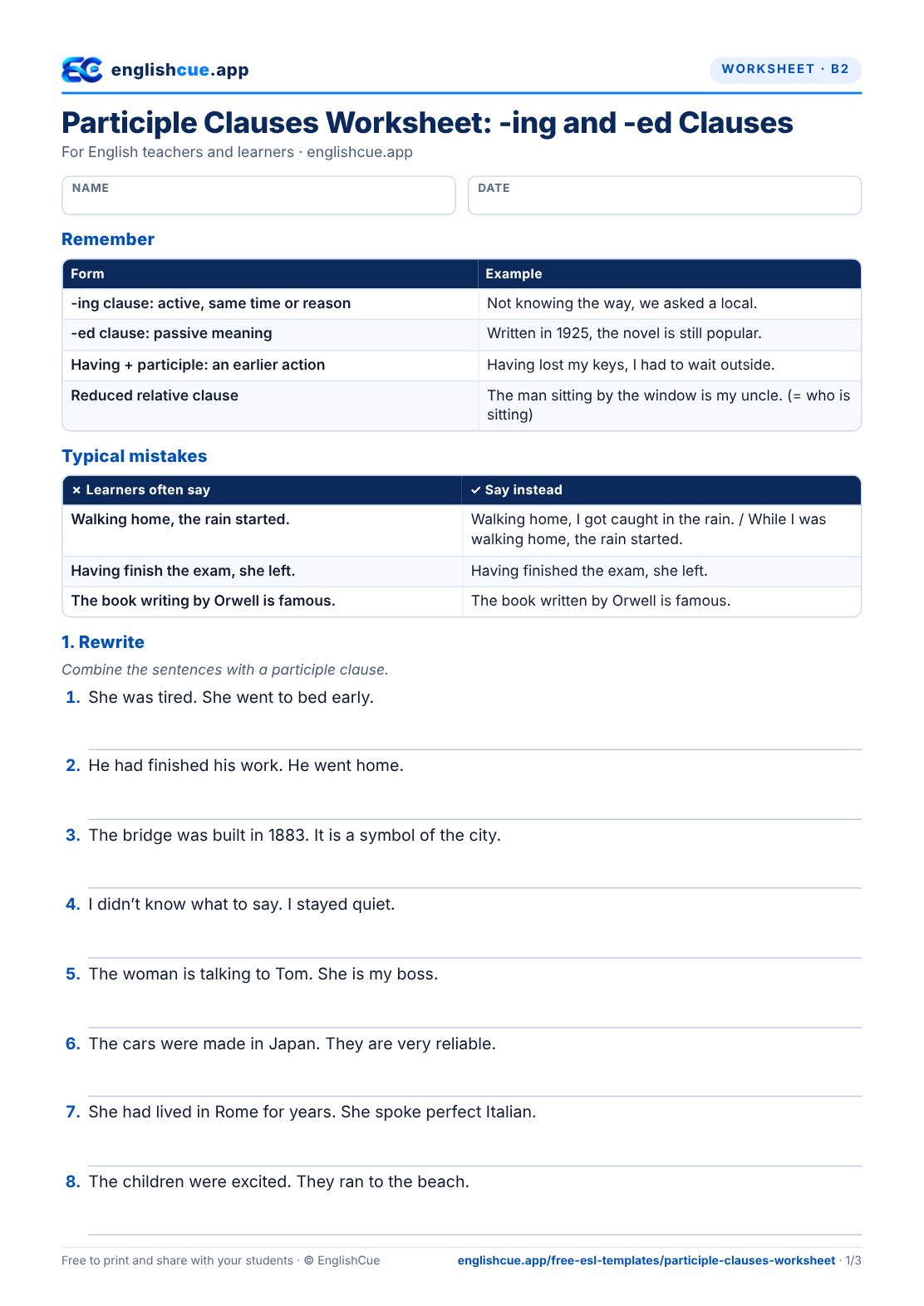 Worksheet · B2 · PDF with answersParticiple Clauses Worksheet: -ing and -ed Clauses