 ENGLISHCUE
Until 30 November: try EnglishCue PRO for US$0.99 your first week, then US$19.90/month, cancel anytime. Try PRO · US$0.99 →
Worksheet · B2 · For teachers and students · Free PDF, 3 pages
Participle Clauses Worksheet: -ing and -ed Clauses
Feeling tired, she went to bed. Built in 1890, the station is a landmark. Having finished the report, he went home. Participle clauses make writing more concise and are expected at B2 and above, but they go wrong when the subject does not match (the famous dangling participle). This sheet practises all three types and how to check the subject.
Preview
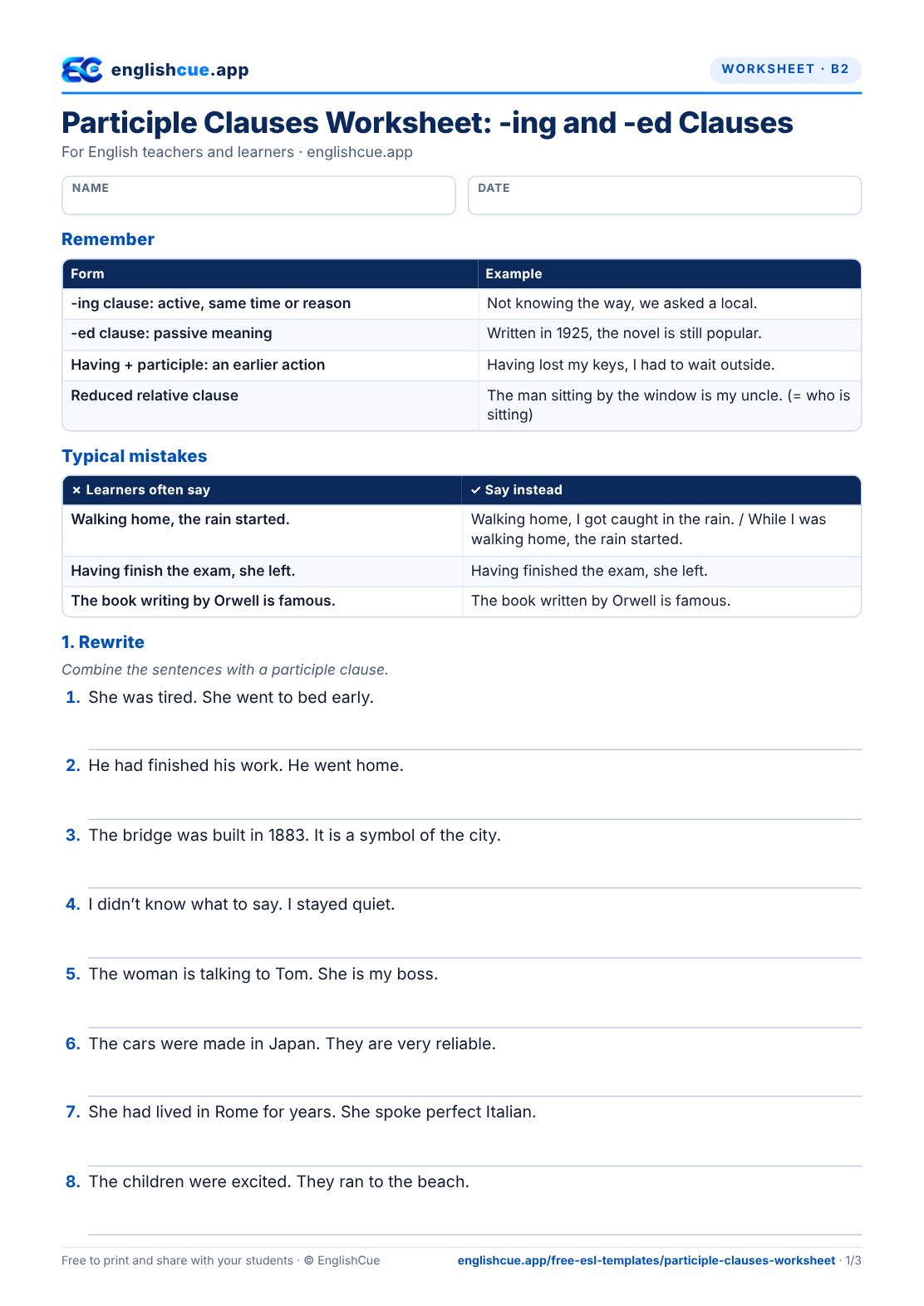
A4, portrait, 3 pages. No sign-up. Free to print, copy and share with your students.
How to use it
- Give two simple sentences with the same subject and ask learners to combine them with a participle clause.
- Show a dangling participle for a laugh: ‘Walking into the room, the lights went out.’ Who was walking?
- Give the first page in class or share it on screen; the last page ends with a model answer and the answer key, so print it separately or fold it back.
- Do the speaking questions last and spend at least ten minutes on them: the exercises prepare the language, the conversation is where learners own it.
What is on the sheet
The full content, so you can check it before you print or copy an example onto your own slide.
Remember
| Form | Example |
|---|---|
| -ing clause: active, same time or reason | Not knowing the way, we asked a local. |
| -ed clause: passive meaning | Written in 1925, the novel is still popular. |
| Having + participle: an earlier action | Having lost my keys, I had to wait outside. |
| Reduced relative clause | The man sitting by the window is my uncle. (= who is sitting) |
Typical mistakes
| ✗ Learners often say | ✓ Say instead |
|---|---|
| Walking home, the rain started. | Walking home, I got caught in the rain. / While I was walking home, the rain started. |
| Having finish the exam, she left. | Having finished the exam, she left. |
| The book writing by Orwell is famous. | The book written by Orwell is famous. |
1. Rewrite
Combine the sentences with a participle clause.
- She was tired. She went to bed early.
- He had finished his work. He went home.
- The bridge was built in 1883. It is a symbol of the city.
- I didn’t know what to say. I stayed quiet.
- The woman is talking to Tom. She is my boss.
- The cars were made in Japan. They are very reliable.
- She had lived in Rome for years. She spoke perfect Italian.
- The children were excited. They ran to the beach.
2. Choose
Circle the correct option.
- (Living / Lived) near the sea, we swim every day.
- The painting (stolen / stealing) last year has been found.
- (Having seen / Seeing) the film before, I knew the ending.
- Anyone (wanting / wanted) a ticket should call this number.
- (Surprised / Surprising) by the news, she didn’t know what to say.
- The man (arrested / arresting) yesterday has been released.
- (Not having / Having not) a car, I take the bus.
- Students (taking / taken) the exam must arrive early.
3. Correct the mistakes
Each sentence has one mistake. Write it correctly.
- Having eat lunch, we went for a walk.
- The letter sending yesterday arrived today.
- Opening the door, the cold air hit me.
- Knowing not the answer, he guessed.
- Builded in 1900, the house needs repairs.
- The girl sat next to me is from Peru. (= who is sitting)
Writing
Write a short description (6 sentences) of a famous place or building, or a short story, using at least four participle clauses.
Speaking
- Describe a famous building in your city using ‘Built in…’ or ‘Designed by…’
- Having finished school, what did you do next?
- Tell me about someone you know: ‘Having lived abroad, he…’
- Which is the person sitting or standing nearest to you right now? Describe them.
Show the answer key
1. Rewrite: 1 Feeling tired, she went to bed early. · 2 Having finished his work, he went home. · 3 Built in 1883, the bridge is a symbol of the city. · 4 Not knowing what to say, I stayed quiet. · 5 The woman talking to Tom is my boss. · 6 Made in Japan, the cars are very reliable. / The cars made in Japan are very reliable. · 7 Having lived in Rome for years, she spoke perfect Italian. · 8 Excited, the children ran to the beach. / Feeling excited, the children ran to the beach.
2. Choose: 1 Living · 2 stolen · 3 Having seen · 4 wanting · 5 Surprised · 6 arrested · 7 Not having · 8 taking
3. Correct the mistakes: 1 Having eaten lunch, we went for a walk. · 2 The letter sent yesterday arrived today. · 3 Opening the door, I felt the cold air hit me. / When I opened the door, the cold air hit me. · 4 Not knowing the answer, he guessed. · 5 Built in 1900, the house needs repairs. · 6 The girl sitting next to me is from Peru.
Writing, model answer: Built in the 19th century, the Teatro Colón is one of the best opera houses in the world. Designed by three different architects, it took twenty years to finish. Visitors entering the main hall always look up at the dome. Having been restored in 2010, it looks as good as new. Known for its perfect acoustics, it attracts the best singers. Sitting in the gallery, you can hear every note.
Use it with
More free worksheets
All 100 free worksheets by level, with a PDF pack per level →
Found this useful?
EnglishCue also has complete interactive lessons that open on screen, with audio, practice and speaking tasks.