ENGLISHCUE

Until 30 November: try EnglishCue PRO for US$0.99 your first week, then US$19.90/month, cancel anytime. Try PRO · US$0.99 →

B2 English grammar lesson · Pronouns and relative clauses · PRO · 60 min

Advanced relative clauses: whose, whom, most of which

The inventor, whose daughter ran the company… Twenty guests, most of whom were artists.

The situation

In a small museum, an audio guide tells the story of the Harts, a family of inventors. Edward Hart, whose daughter later ran the company, built the first machine in 1890. He had six workers, most of whom came from the same village. The factory closed in 1950, which shocked the town. By the end of this lesson you can join ideas in long, elegant sentences.

Free practice worksheet

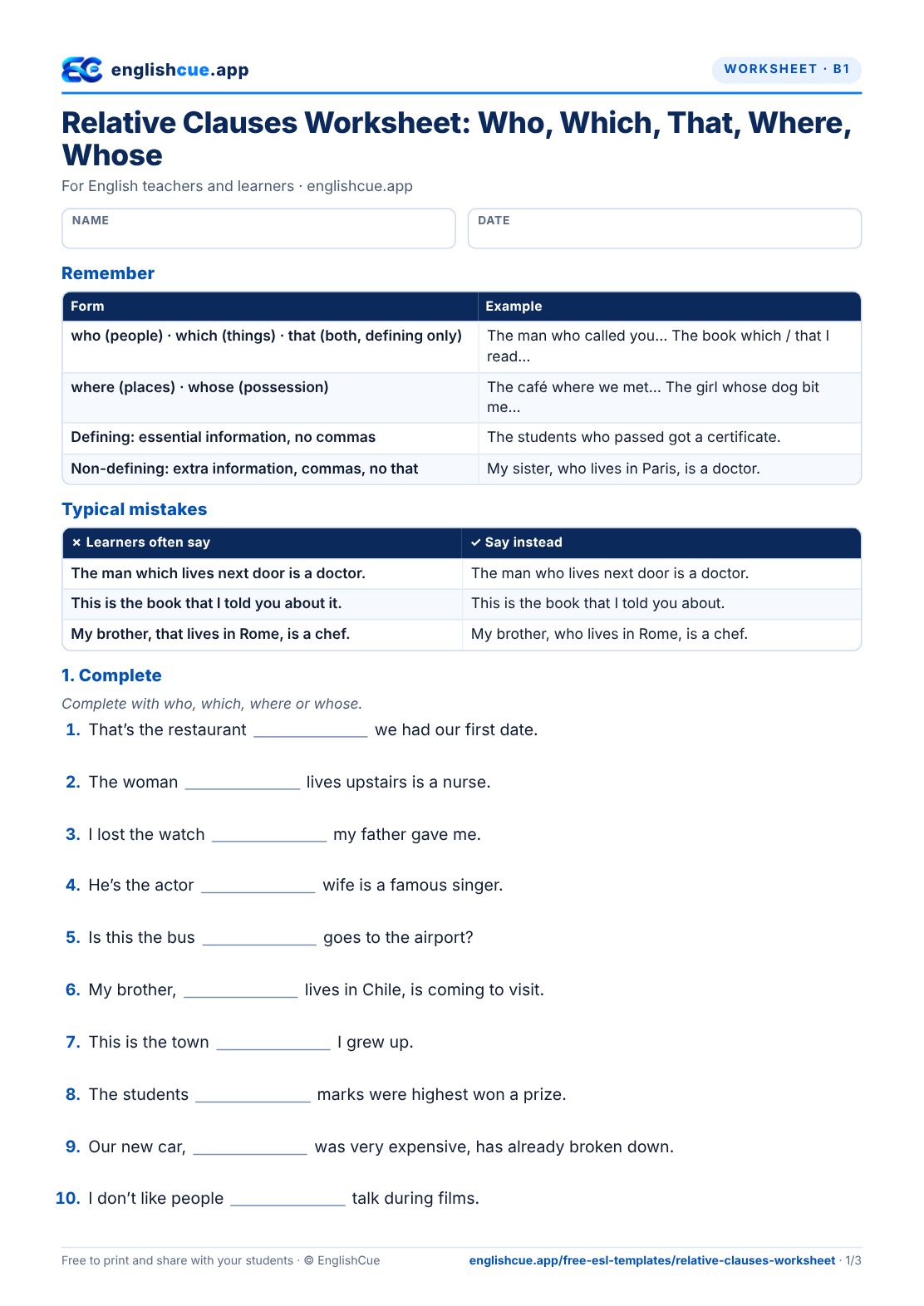
Relative Clauses Worksheet: Who, Which, That, Where, Whose previewWorksheet · B1 · PDF with answersRelative Clauses Worksheet: Who, Which, That, Where, Whose

The grammar at a glance

The forms your learner will use by the end of the lesson.

WHOSE

whose + noun

Edward, whose father was a farmer, …

people and things

PREP + WHOM / WHICH

with whom · in which

the engineer with whom he worked

formal

…, WHICH

comment on the whole clause

It closed, which shocked the town.

never what / that

MOST OF WHOM

quantifier + of whom / which

six workers, most of whom were young

people: whom · things: which

Advanced relative structures

StructureUseExample
whose + nounpossession, people or thingsEdward, whose daughter ran the company, …
preposition + whomformal; peoplethe engineer with whom he worked
preposition + whichformal; thingsthe room in which he slept
…, whichcomments on the whole previous clauseThe factory closed, which shocked the town.
most / some / all of whompart of a group of peoplesix workers, most of whom were young
many / none / both of whichpart of a group of thingsthree machines, none of which still work

Informal English prefers the preposition at the end: the engineer he worked with. Formal writing: the engineer with whom he worked.

Common mistakes to watch for

The errors students make most often with this structure, and how to explain them.

  • My brother, that lives in Leeds, is a doctor. → My brother, who lives in Leeds, is a doctor.No that in non-defining clauses.
  • I have two sisters, both of them are teachers. → I have two sisters, both of whom are teachers.Join with whom (or use a full stop).
  • The man to who I spoke was rude. → The man to whom I spoke was rude.Preposition + whom.
  • She arrived late, what annoyed the boss. → She arrived late, which annoyed the boss.…, which for the whole idea.
  • The writer who's books I love is coming. → The writer whose books I love is coming.whose (possession), not who's (who is).
  • The city in which I live in is small. → The city in which I live is small.Only one preposition.

Teaching tips

Next lesson

Participle clauses: Feeling tired, I went home. Built in 1890, the house…

Quick check: three sample questions

Use them as a warm-up or an exit ticket. Answers are below.

  1. Edward Hart, ___ wife was a painter, lived in this house.
    • whose
    • who
    • which
  2. He had six workers, most of ___ were young.
    • whom
    • them
    • who
  3. The factory closed, ___ shocked everyone.
    • which
    • that
    • what
Show answers
  1. whose. Possession: whose wife.
  2. whom. Most of whom.
  3. which. …, which = the whole idea.

What the full lesson includes

  • A scene that shows the structure in use, with guided discovery questions.
  • Forms and examples on screen, with colour-coded contrasts.
  • Self-correcting practice: choose, fix, build and rewrite, with an explanation for every answer.
  • A recorded listening with transcript, a speaking task with follow-up questions and a short writing task with a model answer.
  • Teacher mode and self-study mode, so students can review after class.

Where this lesson fits in the course

More pronouns and relative clauses lessons

  1. B1Defining and non-defining relative clausesThe woman who lives next door is a pilot. My aunt, who lives in Rome, is a chef.
  2. B1Reflexive pronouns and each otherI cut myself. She made it herself. They looked at each other.
  3. C1Relative clauses: …, which surprised everyone; most of whichThe train was late, which meant we missed the show. She wrote ten books, most of which were bestsellers.
  4. C1Preparatory it and there: I find it hard to…, There’s no point…It’s worth asking. I find it hard to concentrate. I’d appreciate it if you called. There seems to be a problem.

All pronouns and relative clauses lessons → All B2 grammar lessons →

Teach it and practise it

Teach this lesson with EnglishCue PRO.

Share your screen and teach: everything from the warm-up to the writing task is ready.