IT AS SUBJECT
It’s + adj + to / that · It’s worth / no use + -ing
It’s worth asking.
never “Is important” ENGLISHCUE
Until 30 November: try EnglishCue PRO for US$0.99 your first week, then US$19.90/month, cancel anytime. Try PRO · US$0.99 →
C1 English grammar lesson · Pronouns and relative clauses · PRO · 60 min
It’s worth asking. I find it hard to concentrate. I’d appreciate it if you called. There seems to be a problem.
Elena starts a new job. Her manager says: “It’s important to ask questions. It’s no use pretending you understand. I find it helpful to take notes. It takes about a month to learn the systems. There’s no need to stay late. And I’d appreciate it if you could arrive by nine.” By the end of this lesson you can use preparatory it and there naturally, in speech and in writing.
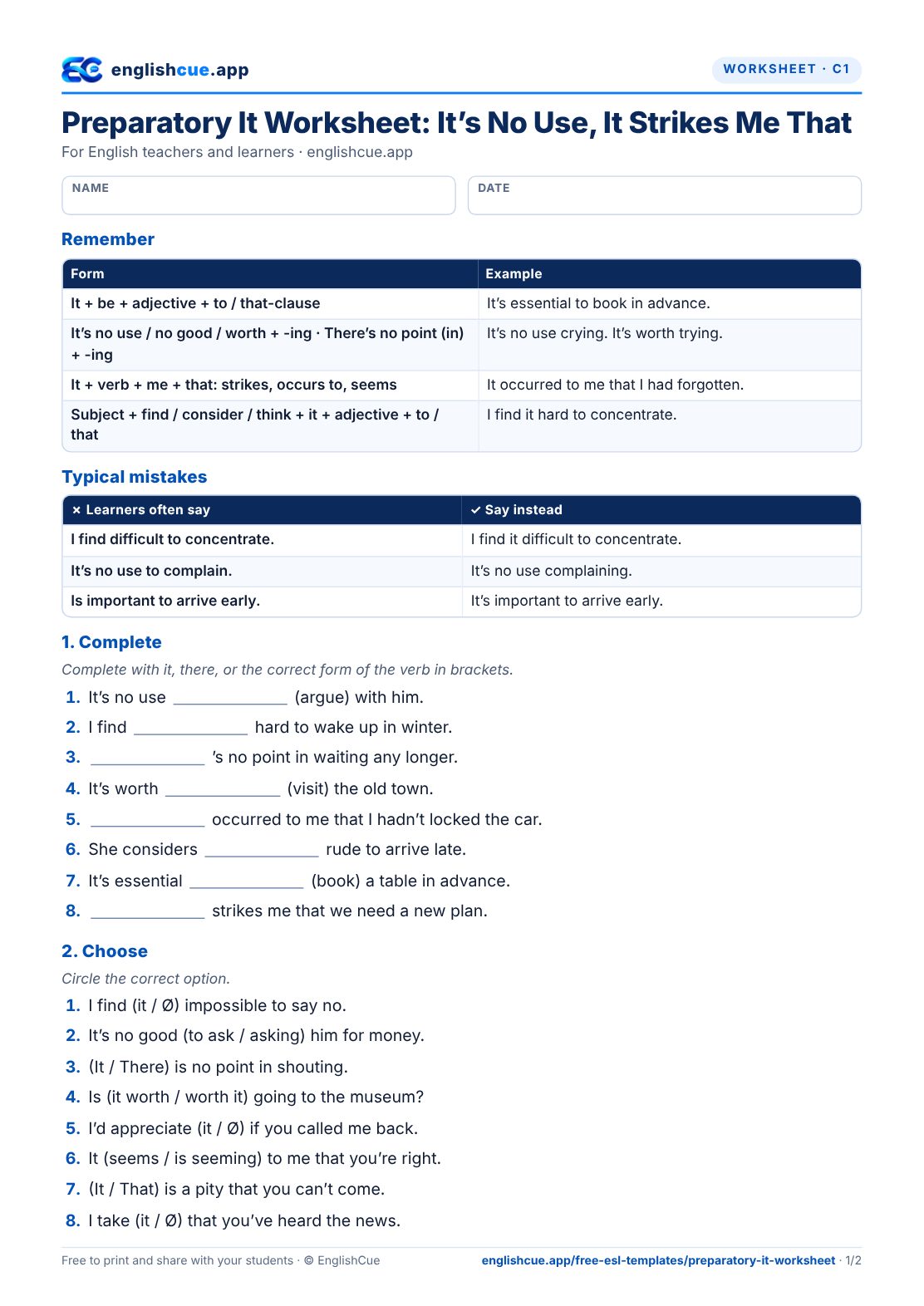 Worksheet · C1 · PDF with answersPreparatory It Worksheet: It’s No Use, It Strikes Me That
The forms your learner will use by the end of the lesson.
It’s + adj + to / that · It’s worth / no use + -ing
It’s worth asking.
never “Is important”find / make + it + adj + to · appreciate it if
I find it hard to relax.
don’t drop itIt seems / turns out that · It takes + time + to
It takes me an hour.
impersonalThere’s no point / no need · There seems to be
There’s no point waiting.
existence| Structure | Use | Example |
|---|---|---|
| It + be + adjective + to / that | long subject moved to the end | It’s important to ask questions. · It’s clear that… |
| It’s no use / no good / worth + -ing | evaluation of an action | It’s worth asking. · It’s no use crying. |
| find / make / consider + it + adj + to | preparatory object | I find it hard to concentrate. |
| I’d appreciate it if / I take it (that) / I leave it to you to | fixed expressions | I’d appreciate it if you called. |
| It seems / appears / turns out that | reporting impressions | It turns out that she’s my neighbour. |
| It takes (person) + time + to | time needed | It takes me an hour to get to work. |
| There + be / seem to be | existence, new information | There seems to be a problem. |
| There’s no point (in) / no need to | useless / unnecessary | There’s no point waiting. · There’s no need to worry. |
Spanish and other languages often drop the subject. English always needs one: ✗ Is important → It is important.
The errors students make most often with this structure, and how to explain them.
Complex verb patterns: perfect and passive infinitives and gerunds (to have done, being told, having been).
Use them as a warm-up or an exit ticket. Answers are below.
All pronouns and relative clauses lessons → All C1 grammar lessons →
Share your screen and teach: everything from the warm-up to the writing task is ready.