Until 30 November: try EnglishCue PRO for US$0.99 your first week, then US$19.90/month, cancel anytime. Try PRO · US$0.99 →
ENGLISHCUE English grammar lessons B1 grammar Defining and non-defining relative clauses B1 English grammar lesson · Pronouns and relative clauses · PRO · 60 min
Defining and non-defining relative clauses The woman who lives next door is a pilot. My aunt, who lives in Rome, is a chef.
The situation Grace shows her friend an old photo album. “This is the house where I grew up. The man who is holding the baby is my grandfather. And this is my aunt Rosa, who lives in Rome now. She’s the one whose cake you loved at my party!” By the end of this lesson you can use two kinds of relative clauses .
The grammar at a glance The forms your learner will use by the end of the lesson.
DEFINING which one? · no commas · that OK
The man who lives next door…
necessary information NON-DEFINING extra info · commas · no that
My aunt, who lives in Rome, …
names, unique things WHOSE · WHERE · WHEN possession · place · time
The woman whose dog bit me.
, which = the whole idea NO PRONOUN defining + object only
The film (that) we saw.
never in non-defining Rules Defining Non-defining commas no yes that yes (people and things) no: only who / which leave out the pronoun? yes, if it’s the object : the film (that) we saw never
Common mistakes to watch for The errors students make most often with this structure, and how to explain them.
My mother that is a teacher lives in York. My mother, who is a teacher, lives in York. One mother: non-defining with commas, no that. London, that is very big, is expensive. London, which is very big, is expensive. No that in non-defining clauses. That’s the man who his car was stolen. That’s the man whose car was stolen. Possession: whose. The man lives next door is a pilot. The man who lives next door is a pilot. Subject pronoun can’t be left out. My brother, lives in Paris, is a chef. My brother, who lives in Paris, is a chef. Never leave out the pronoun in non-defining. He was late, what annoyed everyone. He was late, which annoyed everyone. Whole sentence: which. Teaching tips Next lesson Reflexive pronouns and each other (myself, themselves, each other).
Quick check: three sample questions Use them as a warm-up or an exit ticket. Answers are below.
Which sentence needs commas? My brother who lives in Leeds is a nurse. (I have one brother) The students who passed got a prize. The book that I read was great. Paris, ___ is the capital of France, is beautiful. The film ___ we saw last night was amazing. Show answers My brother who lives in Leeds is a nurse. (I have one brother) . One brother: extra information. which . Non-defining: no that. (that) . Defining object: that or nothing. What the full lesson includes A scene that shows the structure in use, with guided discovery questions. Forms and examples on screen, with colour-coded contrasts. Self-correcting practice: choose, fix, build and rewrite, with an explanation for every answer. A recorded listening with transcript, a speaking task with follow-up questions and a short writing task with a model answer. Teacher mode and self-study mode, so students can review after class. Where this lesson fits in the course More pronouns and relative clauses lessons A2 Something, anyone, nobody, everywhereIs anybody home? There’s something in the fridge. Nobody knows. I looked everywhere! A2 Relative clauses: who, which, that, whereA chef is a person who cooks in a restaurant. This is the café where we met. B1 Reflexive pronouns and each otherI cut myself. She made it herself. They looked at each other. B2 Advanced relative clauses: whose, whom, most of whichThe inventor, whose daughter ran the company… Twenty guests, most of whom were artists. Teach this lesson with EnglishCue PRO. Share your screen and teach: everything from the warm-up to the writing task is ready.
 ENGLISHCUE
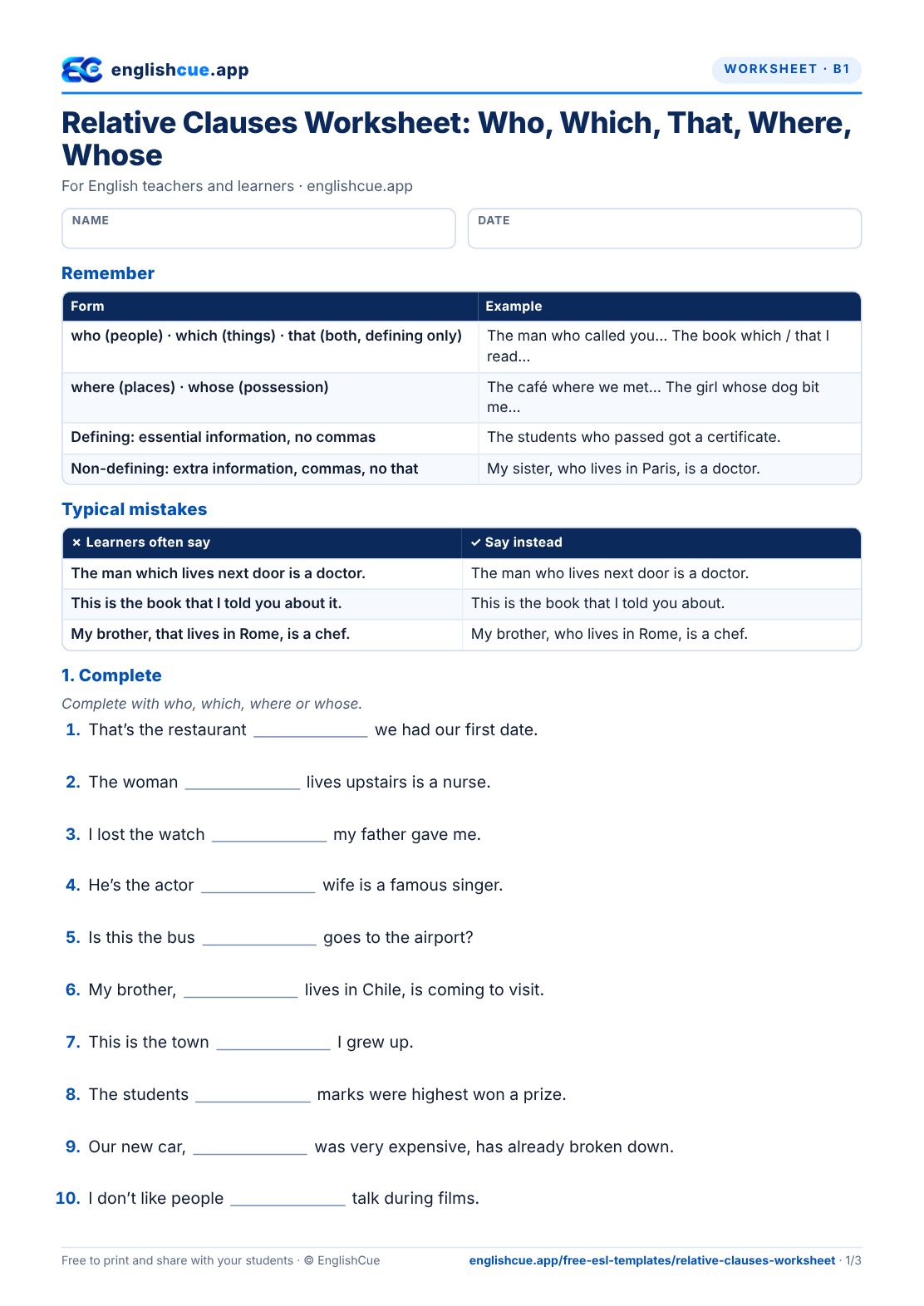 Worksheet · B1 · PDF with answersRelative Clauses Worksheet: Who, Which, That, Where, Whose