WHO
people
A nurse is a person who helps doctors.
or that ENGLISHCUE
Until 30 November: try EnglishCue PRO for US$0.99 your first week, then US$19.90/month, cancel anytime. Try PRO · US$0.99 →
A2 English grammar lesson · Pronouns and relative clauses · PRO · 60 min
A chef is a person who cooks in a restaurant. This is the café where we met.
After dinner, the Morgan family plays a word game. Grandma: “It’s a person who works in a hospital and helps doctors.” Ella: “A nurse!” Dad: “It’s a thing which you use to open doors.” By the end of this lesson you can describe people, things and places with who, which, that and where.
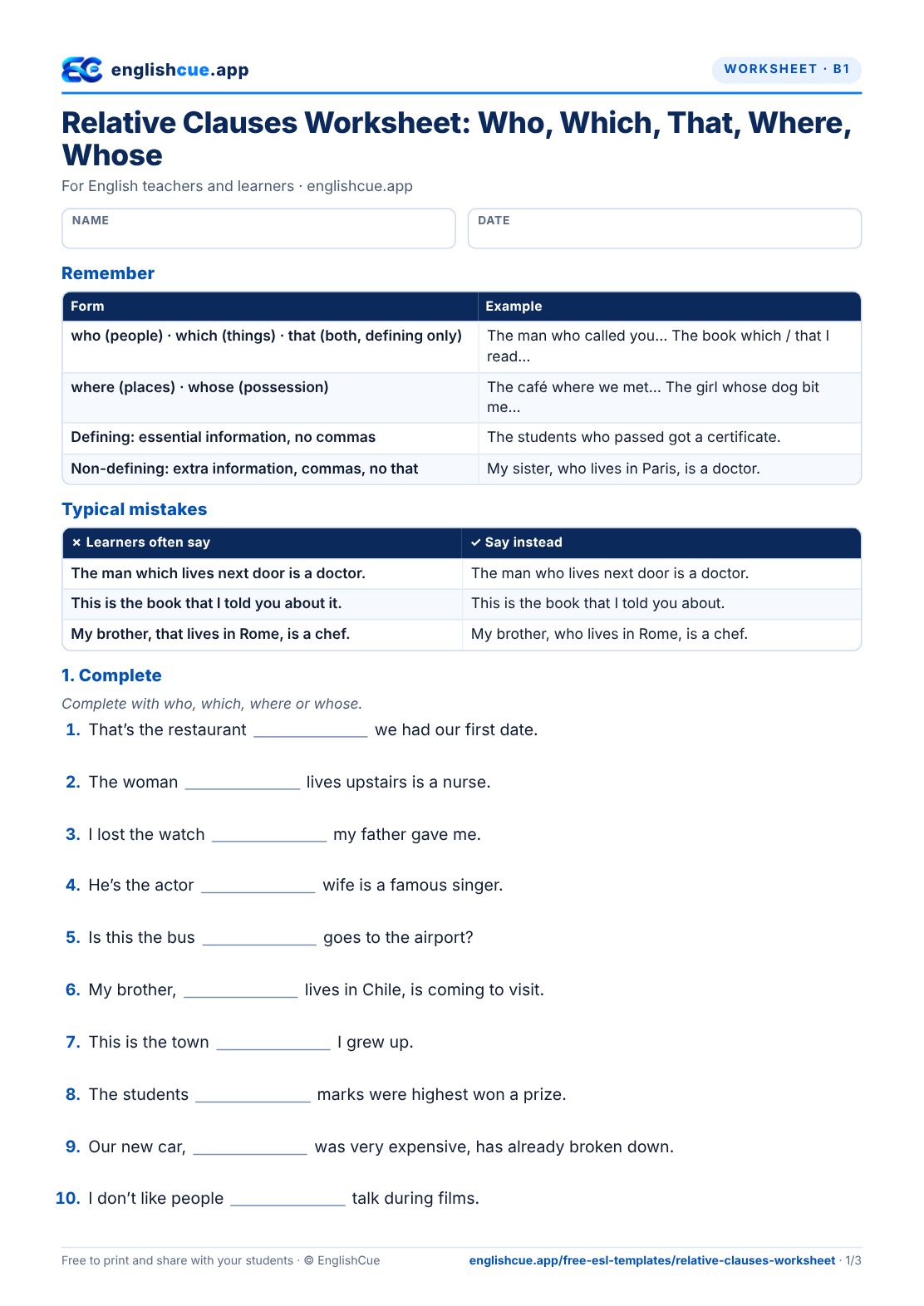 Worksheet · B1 · PDF with answersRelative Clauses Worksheet: Who, Which, That, Where, Whose
The forms your learner will use by the end of the lesson.
people
A nurse is a person who helps doctors.
or thatthings, animals
A key is a thing which opens doors.
or thatplaces + subject + verb
That’s the café where we met.
not whichwho = he / she
The man who lives next door…
not who he lives| For | Pronoun | Example |
|---|---|---|
| people | who / that | A nurse is a person who helps doctors. |
| things, animals | which / that | A key is a thing which opens doors. |
| places | where | A library is a place where you borrow books. |
The relative clause tells us which person, thing or place we mean. That is common in speaking for people and things.
The errors students make most often with this structure, and how to explain them.
Not “the man who he lives next door” but “the man who lives next door”. Who already means he.
How we do things: adverbs of manner (quickly, well, hard).
Use them as a warm-up or an exit ticket. Answers are below.
All pronouns and relative clauses lessons → All A2 grammar lessons →
Share your screen and teach: everything from the warm-up to the writing task is ready.