AFFIRMATIVE
am / is / are + -ing
The kids are playing.
I’m · she’s · they’re ENGLISHCUE
Until 30 November: try EnglishCue PRO for US$0.99 your first week, then US$19.90/month, cancel anytime. Try PRO · US$0.99 →
A1 English grammar lesson · Verb tenses · PRO · 60 min
Describe what people are doing now: I’m cooking, the kids are playing, it’s raining.
It’s Sunday. Grandma Rose calls her daughter Kate on video. Kate says: “Hi Mum! I’m cooking lunch. Tom is reading the paper, and the kids are playing in the garden. Oh, and it’s raining!” By the end of this lesson you can describe what is happening now.
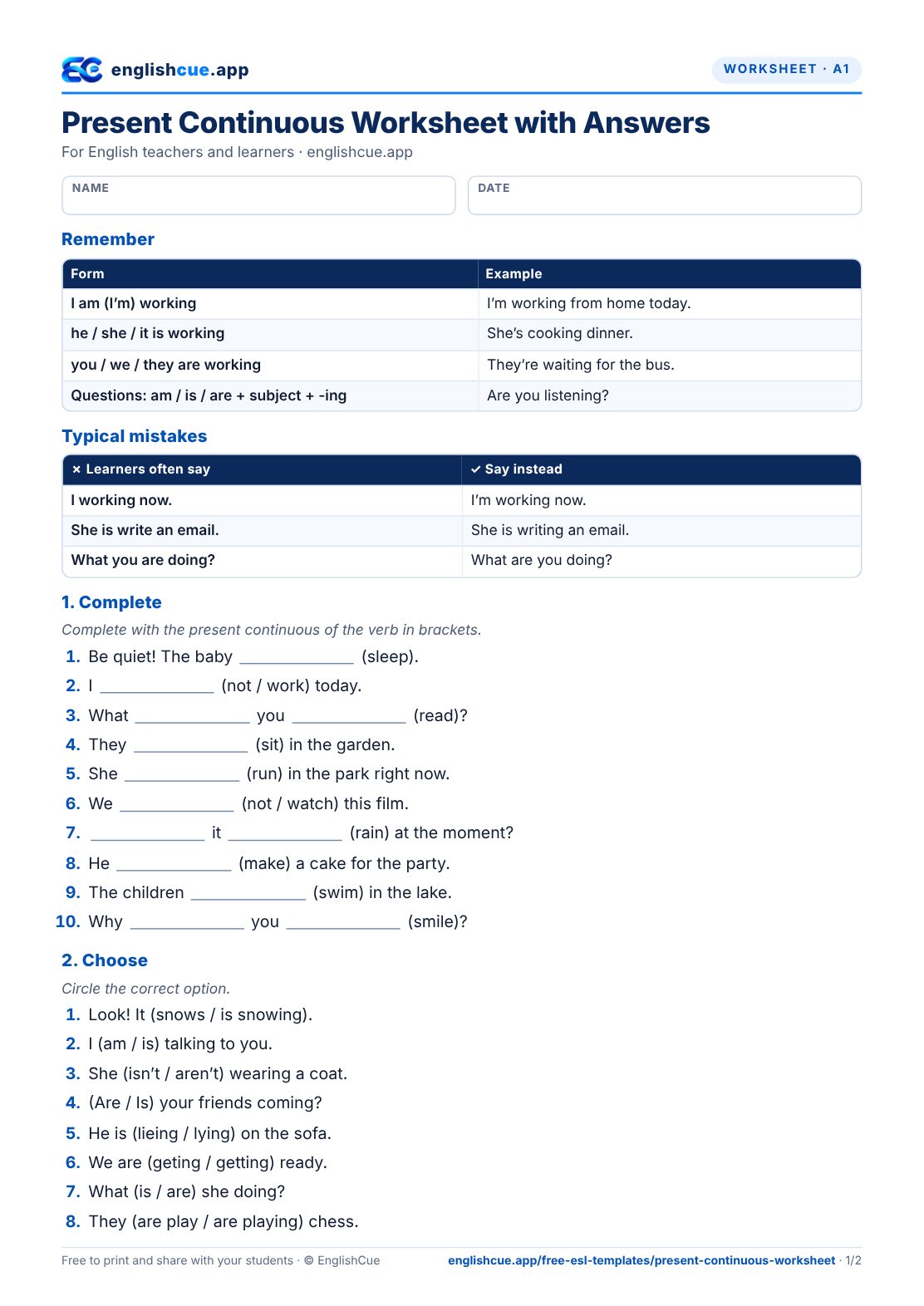 Worksheet · A1 · PDF with answersPresent Continuous Worksheet with Answers
The forms your learner will use by the end of the lesson.
am / is / are + -ing
The kids are playing.
I’m · she’s · they’re’m not / isn’t / aren’t + -ing
Tom isn’t working.
two parts alwaysAm / Is / Are + subject + -ing?
What are you doing?
Yes, I am. · No, she isn’t.now · at the moment · this week
I’m reading a good book this week.
now and around now| Subject | + | − |
|---|---|---|
| I | am working · I’m working | ’m not working |
| you · we · they | are working · we’re working | aren’t working |
| he · she · it | is working · she’s working | isn’t working |
The -ing spelling rules are the same as in the like + -ing lesson: making, swimming, sitting, lying.
The errors students make most often with this structure, and how to explain them.
The present continuous has two parts: am / is / are and the -ing form. Not “I cooking” and not “I am cook”. Say I’m cooking.
Already on the site: Present simple or present continuous? It compares routines (I cook every day) and now (I’m cooking now).
Use them as a warm-up or an exit ticket. Answers are below.
Share your screen and teach: everything from the warm-up to the writing task is ready.