FORM
have / has + past participle
I’ve been to Japan.
been · seen · eaten · met ENGLISHCUE
Until 30 November: try EnglishCue PRO for US$0.99 your first week, then US$19.90/month, cancel anytime. Try PRO · US$0.99 →
A2 English grammar lesson · Verb tenses · PRO · 60 min
Talk about your life experiences: Have you ever been to Japan? I’ve never eaten sushi.
At a party, friends play a game. Kemal asks: “Have you ever been to Japan?” Lina says: “Yes, I have! I went there in 2019.” Tom says: “No, I’ve never been to Asia.” By the end of this lesson you can talk about your life experiences and ask other people about theirs.
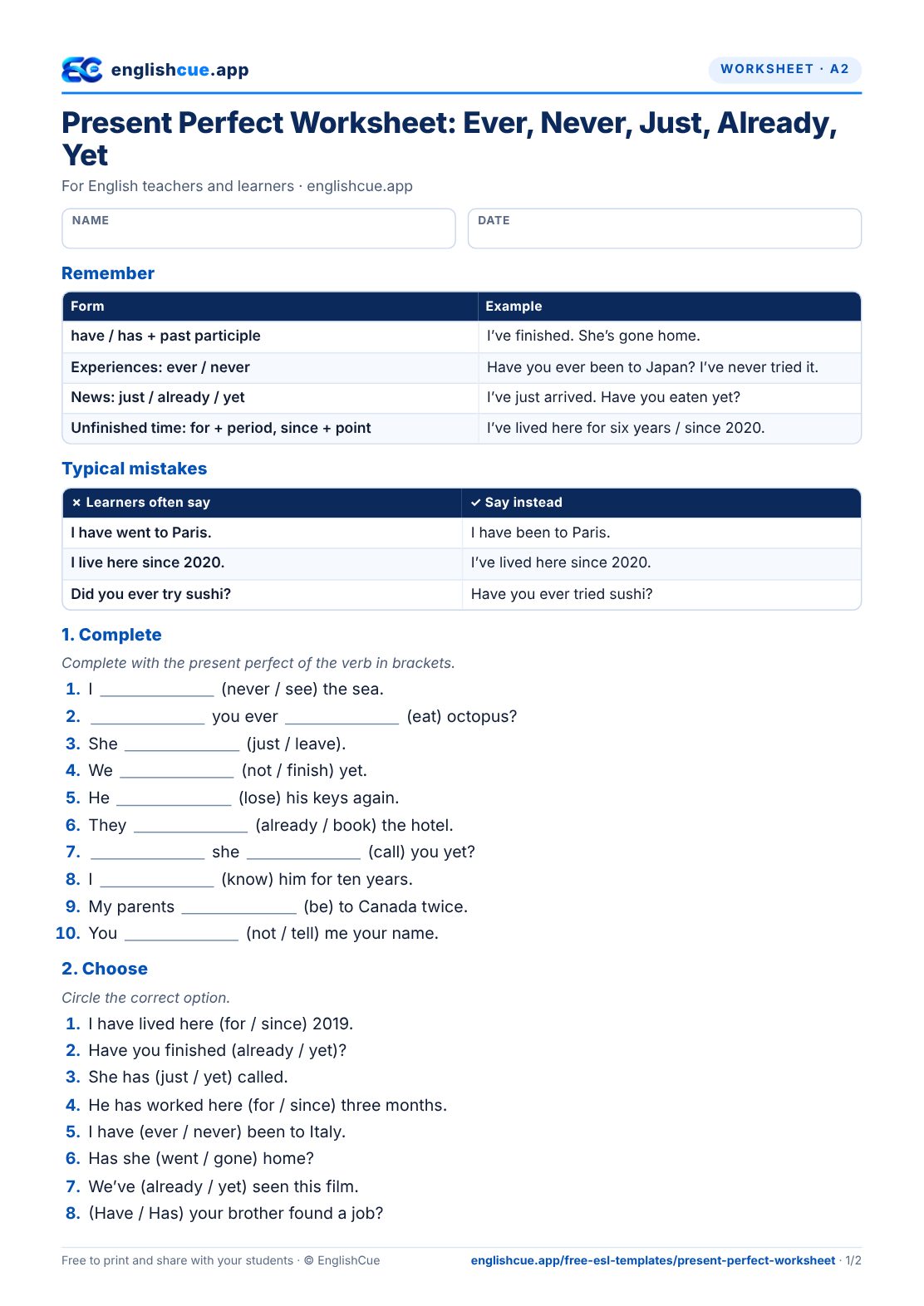 Worksheet · A2 · PDF with answersPresent Perfect Worksheet: Ever, Never, Just, Already, Yet
The forms your learner will use by the end of the lesson.
have / has + past participle
I’ve been to Japan.
been · seen · eaten · metHave you ever + participle?
Yes, I have. · No, I haven’t.
ever before the participlehave / has never + participle
I’ve never eaten sushi.
one negativepast simple + time
I went there in 2019.
been ≠ gone| Subject | + | − | ? |
|---|---|---|---|
| I · you · we · they | have been · I’ve been | haven’t been · ’ve never been | Have you ever been…? |
| he · she · it | has been · she’s been | hasn’t been · ’s never been | Has she ever been…? |
Short answers: Yes, I have. / No, I haven’t. · Yes, she has. / No, she hasn’t.
The errors students make most often with this structure, and how to explain them.
The present perfect talks about an experience in your life up to now. The time is not important or not known. When you say when (in 2019, last year), switch to the past simple.
The present perfect for recent news: just, already and yet.
Use them as a warm-up or an exit ticket. Answers are below.
Share your screen and teach: everything from the warm-up to the writing task is ready.