For: the length of time
have/has + past participle + for + length of time
I've lived here for three years.
Use for to describe how long a situation has continued and is still true now. ENGLISHCUE
Until 30 November: try EnglishCue PRO for US$0.99 your first week, then US$19.90/month, cancel anytime. Try PRO · US$0.99 →
A2 English grammar lesson · Verb tenses · PRO · 60 min
Talk about situations that started in the past and continue now.
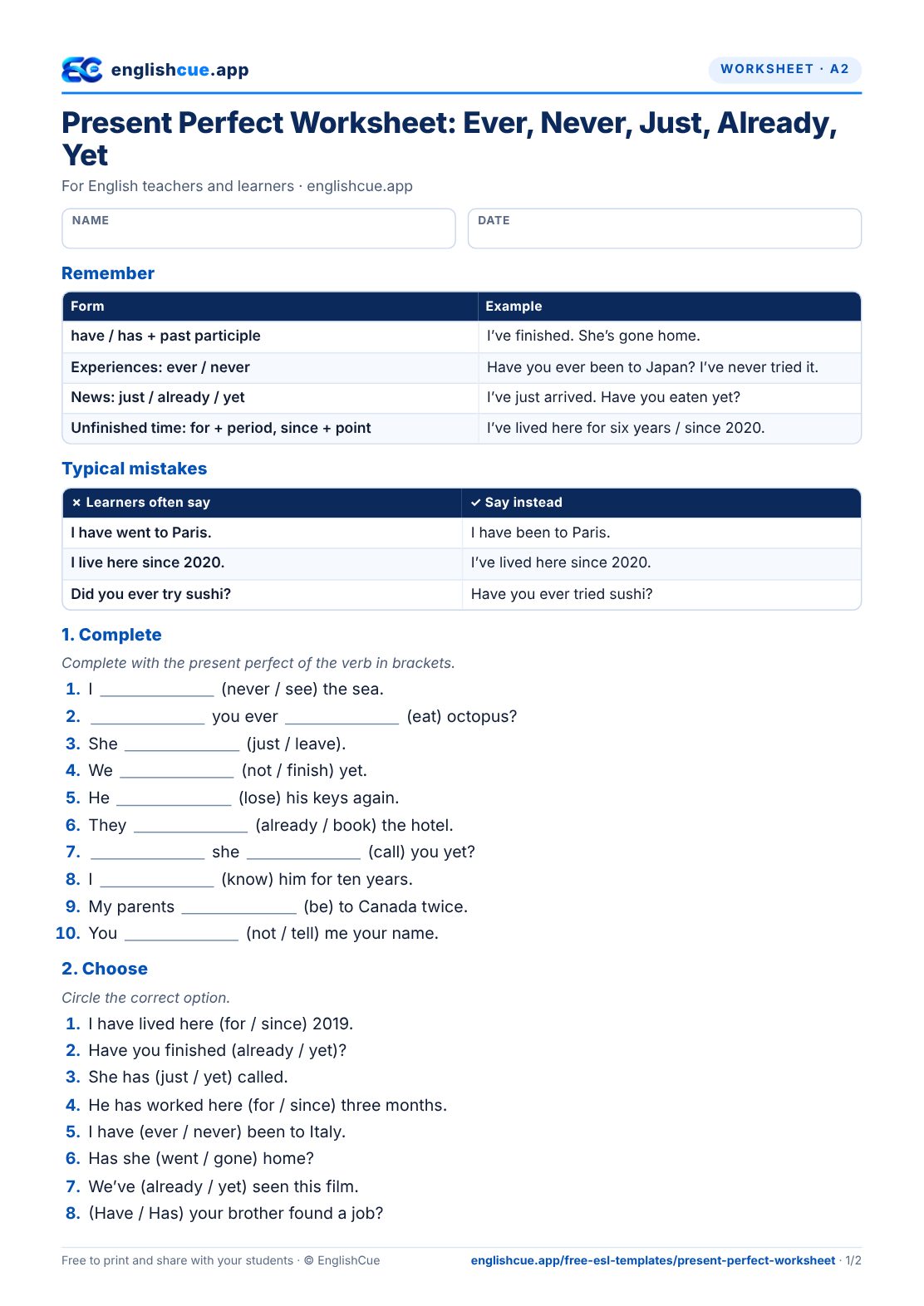 Worksheet · A2 · PDF with answersPresent Perfect Worksheet: Ever, Never, Just, Already, Yet
The forms your learner will use by the end of the lesson.
have/has + past participle + for + length of time
I've lived here for three years.
Use for to describe how long a situation has continued and is still true now.have/has + past participle + since + starting point
I've lived here since 2023.
Use since to identify when an unfinished situation began. The situation continues now.past simple + time period + ago
I moved here two years ago.
Use ago to say how far back in time a finished event happened. The event is in the past.For answers the question How long? It is followed by a length of time, such as two weeks, five years, or a long time.
Since answers the question When did it start? It is followed by a specific starting point, such as Monday, January, 2020, or college.
Ago counts backward from now and goes with the past simple, not the present perfect. Compare: I moved here two years ago / I've lived here for two years.
Use them as a warm-up or an exit ticket. Answers are below.
Share your screen and teach: everything from the warm-up to the writing task is ready.