FORM
will / ’ll + base form · won’t
She’ll come. She won’t come. Will she come?
same for every person ENGLISHCUE
Until 30 November: try EnglishCue PRO for US$0.99 your first week, then US$19.90/month, cancel anytime. Try PRO · US$0.99 →
A2 English grammar lesson · Verb tenses · PRO · 60 min
I think it’ll rain. I’ll carry that for you. OK, I’ll have the pizza.
Tomorrow is Grandma Rose’s 80th birthday party. Her grandson Tom looks at the sky: “I think it’ll rain.” His sister Amy: “Don’t worry, I’ll bring the big umbrellas.” Their mum: “And I won’t forget the cake this time, I promise!” By the end of this lesson you can make predictions, offers, promises and quick decisions with will.
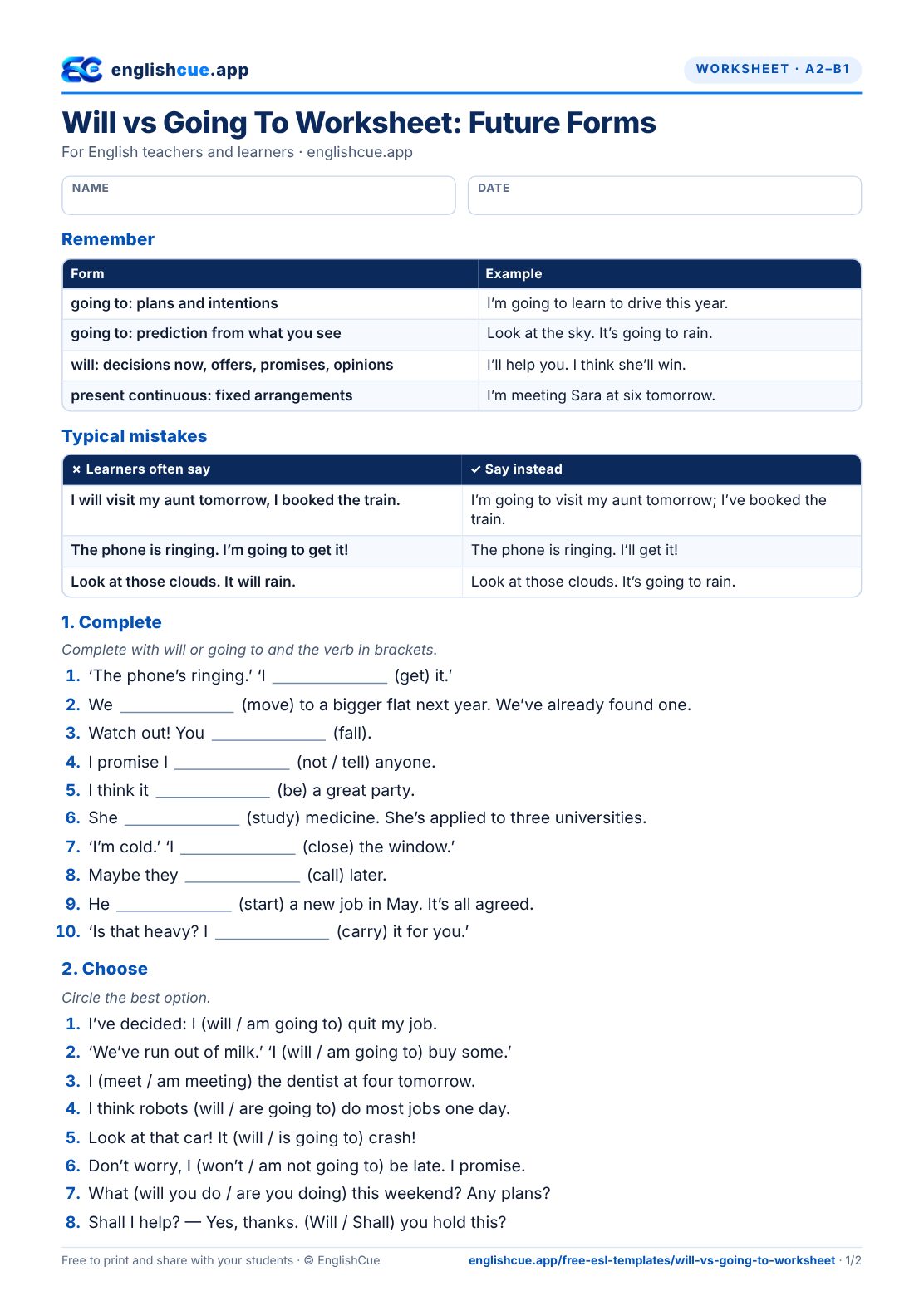 Worksheet · A2–B1 · PDF with answersWill vs Going To Worksheet: Future Forms
The forms your learner will use by the end of the lesson.
will / ’ll + base form · won’t
She’ll come. She won’t come. Will she come?
same for every personI think / probably + will
I think it’ll rain.
I don’t think + willOK, I’ll…
I’ll have the soup.
not a plan from beforeI’ll… · Shall I…? · I won’t…
Shall I help? I won’t tell anyone.
Will you…? = a request| Positive | Negative | Question |
|---|---|---|
| I will / I’ll help | I won’t help | Will I help? |
| you / we / they’ll come | you / we / they won’t come | Will you come? |
| he / she / it’ll rain | he / she / it won’t rain | Will it rain? |
Will is the same for every person: no -s, no to. Short answers: Yes, I will. / No, I won’t. In speaking, use ’ll: I’ll, you’ll, it’ll.
The errors students make most often with this structure, and how to explain them.
After will, before won’t: “It’ll probably rain.” “She probably won’t come.”
Plans already fixed: the present continuous for the future (I’m meeting Sara on Friday).
Use them as a warm-up or an exit ticket. Answers are below.
Share your screen and teach: everything from the warm-up to the writing task is ready.