I · YOU · WE · THEY
base form
I start at nine.
no change ENGLISHCUE
Until 30 November: try EnglishCue PRO for US$0.99 your first week, then US$19.90/month, cancel anytime. Try PRO · US$0.99 →
A1 English grammar lesson · Verb tenses · PRO · 60 min
Talk about routines and facts: I start at nine, he starts at four, the shop opens at six.
Lily shares a flat with Sam. Sam is a baker, so their days are very different. Lily says: “I get up at seven and I start work at nine. Sam gets up at three! He starts work at four, and he finishes at midday.” By the end of this lesson you can describe routines and facts about you and about other people.
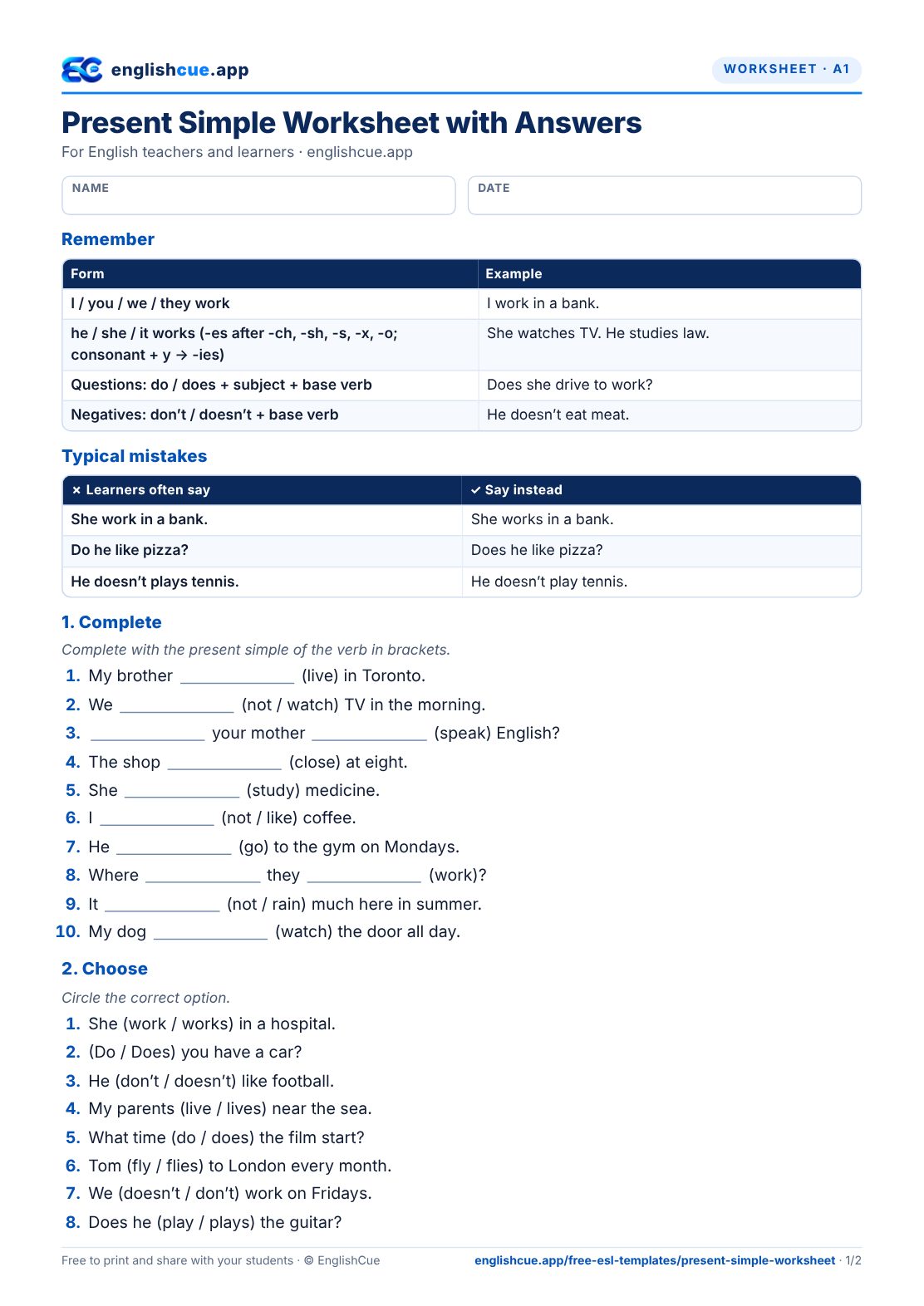 Worksheet · A1 · PDF with answersPresent Simple Worksheet with Answers
The forms your learner will use by the end of the lesson.
base form
I start at nine.
no changeverb + s
He starts at four.
also names and one thing-es · -ies · has
goes · finishes · studies · has
o, s, sh, ch, x · consonant + yat · on · every
at six · on Sundays · every day
usually at the end| Subject | Verb | Example |
|---|---|---|
| I | work | I work in an office. |
| you | work | You work a lot. |
| he · she · it | works | He works in a bakery. |
| we | work | We work together. |
| they | work | They work at night. |
A name or one thing is he, she or it: Sam works, my sister works, the oven works. Two people are they: Sam and Lily work.
The errors students make most often with this structure, and how to explain them.
Use it for things that are always or usually true: routines (I get up at seven), facts (The shop opens at six) and likes (She loves bread). It is not only for “now”.
Ask: is the subject he, she, it, a name or one thing? Then the verb takes -s. Everything else: no -s.
Use them as a warm-up or an exit ticket. Answers are below.
Share your screen and teach: everything from the warm-up to the writing task is ready.