EACH / BOTH / NEITHER
each of + singular verb · both / either / neither = two
Neither of them came.
no double negative ENGLISHCUE
Until 30 November: try EnglishCue PRO for US$0.99 your first week, then US$19.90/month, cancel anytime. Try PRO · US$0.99 →
B2 English grammar lesson · Comparison and quantity · PRO · 60 min
Each of the students has a laptop. Hardly anyone came. There’s plenty of time. Few people know.
The town of Millford did a survey about free time. The majority of residents walk every week. Hardly anyone uses the old swimming pool. Few teenagers read newspapers, but plenty of them listen to podcasts. The council spent a great deal of money on the new park, and each of the neighbourhoods now has a playground. By the end of this lesson you can describe quantities precisely, like in a report.
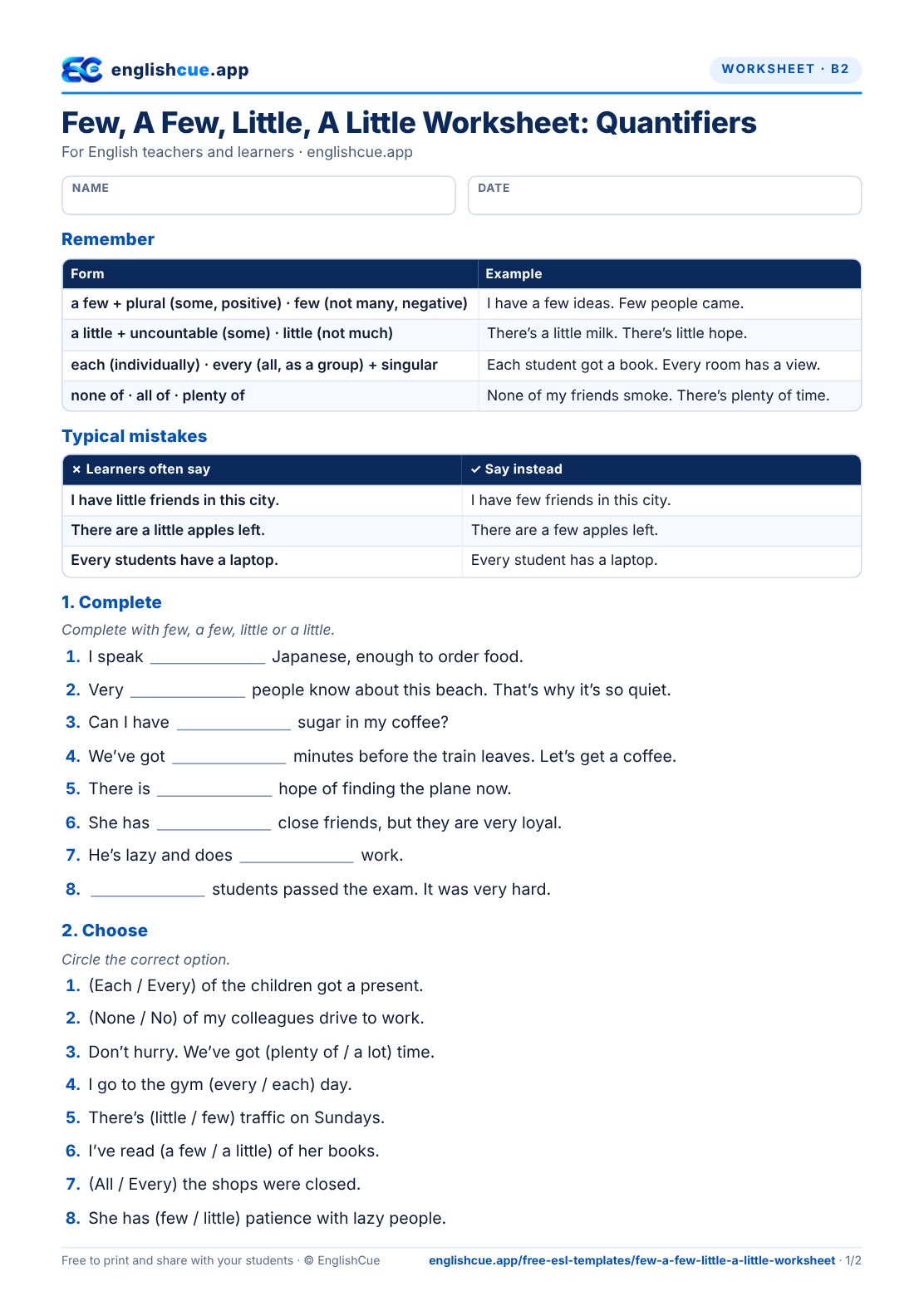 Worksheet · B2 · PDF with answersFew, A Few, Little, A Little Worksheet: Quantifiers
The forms your learner will use by the end of the lesson.
each of + singular verb · both / either / neither = two
Neither of them came.
no double negativefew, little (negative) · a few, a little (positive)
Hardly anyone came.
not hardly noplenty of · a great deal of (U) · a large number of (C)
a great deal of money
formalthe majority of · none of
None of my friends smokes.
report style| Quantifier | Use | Example |
|---|---|---|
| each (of) / every | each = individually; every = all, as a group · + singular verb | Each of the rooms has a TV. · Every room has a TV. |
| both / either / neither (of) | two things | Neither of them came. · You can take either bus. |
| hardly any / hardly anyone | almost none / almost nobody | Hardly anyone uses the pool. |
| few / little vs a few / a little | few, little = not enough (negative) · a few, a little = some (positive) | Few people know. · I have a few friends here. |
| plenty of | more than enough (countable + uncountable) | There’s plenty of time. |
| a great deal of / a large number of | uncountable / countable (formal) | a great deal of money · a large number of people |
| the majority of / none of | most / not one | The majority of residents walk. · None of my friends smoke. |
Each of / every one of / neither of / none of + plural noun usually take a singular verb in formal English: Each of the students has…
The errors students make most often with this structure, and how to explain them.
Advanced comparison: far better, by far the best, nowhere near as, just as.
Use them as a warm-up or an exit ticket. Answers are below.
All comparison and quantity lessons → All B2 grammar lessons →
Share your screen and teach: everything from the warm-up to the writing task is ready.