ENGLISHCUE

Until 30 November: try EnglishCue PRO for US$0.99 your first week, then US$19.90/month, cancel anytime. Try PRO · US$0.99 →

B2 English grammar lesson · Verb patterns and phrasal verbs · PRO · 60 min

Would rather, had better, it’s time

I’d rather stay at home. You’d better hurry. It’s time we left.

The situation

The Turner family is planning a summer holiday. Dad: “I’d rather go to the mountains than to the beach.” Mum: “I’d rather we stayed somewhere cheap this year.” Their son: “You’d better book soon, prices go up!” Grandma: “It’s time you took a real holiday!” By the end of this lesson you can express preferences, give warnings and say something should happen now.

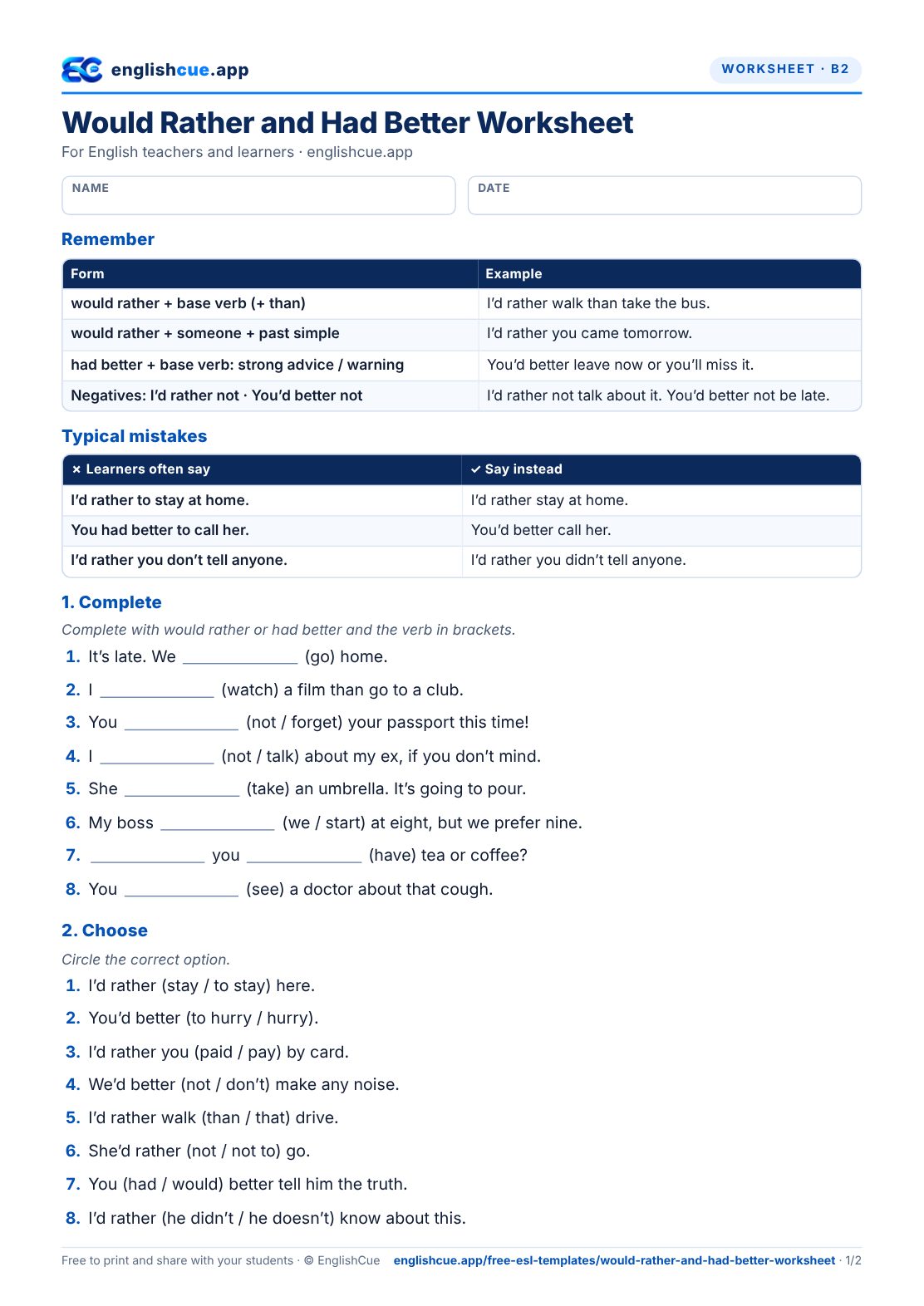
Free practice worksheet

Would Rather and Had Better Worksheet previewWorksheet · B2 · PDF with answersWould Rather and Had Better Worksheet

The grammar at a glance

The forms your learner will use by the end of the lesson.

WOULD RATHER

would rather + base (+ than)

I’d rather walk than drive.

no to

RATHER + PERSON

would rather + person + past

I’d rather you didn’t go.

present meaning

HAD BETTER

had better (not) + base

You’d better hurry.

warning, now

IT’S TIME

it’s time + person + past / to + base

It’s time we left.

high / about time

The structures

StructureMeaningExample
would rather + base form (+ than)my preferenceI’d rather go to the mountains than the beach.
would rather + person + past simplemy preference about someone elseI’d rather you didn’t smoke here.
had better (not) + base formstrong advice / warning (now or soon)You’d better book soon. · We’d better not be late.
it’s (high / about) time + subject + pastit should already be happeningIt’s time we left. · It’s high time you got a job.
it’s time + to + basethe right moment for an actionIt’s time to go.

Contractions are normal: I’d rather = I would rather · You’d better = you had better. The past in I’d rather you went and It’s time we went refers to the present or future.

Common mistakes to watch for

The errors students make most often with this structure, and how to explain them.

  • I’d rather to walk. → I’d rather walk.No to after would rather.
  • You’d better to call her. → You’d better call her.No to after had better.
  • It’s time we go to bed. → It’s time we went to bed. / It’s time to go to bed.It’s time + subject + past.
  • I’d rather you don’t tell anyone. → I’d rather you didn’t tell anyone.Another person: past.
  • You hadn’t better be late. → You’d better not be late.Negative: had better not.
  • I’d rather tea that coffee. → I’d rather have tea than coffee.Rather … than.

Teaching tips

Next lesson

Advanced quantifiers: each of, hardly any, plenty of, a great deal of.

Quick check: three sample questions

Use them as a warm-up or an exit ticket. Answers are below.

  1. I’d rather ___ at home tonight.
    • stay
    • to stay
    • staying
  2. You’d better ___ an umbrella. It’s going to rain.
    • take
    • to take
    • took
  3. It’s time we ___ home.
    • went
    • go
    • going
Show answers
  1. stay. Would rather + base form.
  2. take. Had better + base form.
  3. went. It’s time + subject + past.

What the full lesson includes

  • A scene that shows the structure in use, with guided discovery questions.
  • Forms and examples on screen, with colour-coded contrasts.
  • Self-correcting practice: choose, fix, build and rewrite, with an explanation for every answer.
  • A recorded listening with transcript, a speaking task with follow-up questions and a short writing task with a model answer.
  • Teacher mode and self-study mode, so students can review after class.

Where this lesson fits in the course

More verb patterns and phrasal verbs lessons

  1. B2Patterns after adjectives and nouns: keen on doing, the chance to doI’m keen on learning. It’s easy to use. I had the chance to travel. There’s no point waiting.
  2. B2Three-part phrasal verbs: put up with, run out of, come up withI can’t put up with the noise. We’ve run out of milk. She came up with a great idea.
  3. C1Complex verb patterns: to have done, having done, stop to / stop -ingShe seems to have left. He denied having taken it. I stopped to buy a coffee. I saw her crossing the road.
  4. C1Phrasal verbs and register: find out → discover, put off → postponeWe put off the meeting → The meeting was postponed. They’re looking into it → The matter is being investigated.

All verb patterns and phrasal verbs lessons → All B2 grammar lessons →

Teach it and practise it

Teach this lesson with EnglishCue PRO.

Share your screen and teach: everything from the warm-up to the writing task is ready.