PERFECT INFINITIVE
seem / claim + to have + pp · to be + -ing
She seems to have left.
earlier action ENGLISHCUE
Until 30 November: try EnglishCue PRO for US$0.99 your first week, then US$19.90/month, cancel anytime. Try PRO · US$0.99 →
C1 English grammar lesson · Verb patterns and phrasal verbs · PRO · 60 min
She seems to have left. He denied having taken it. I stopped to buy a coffee. I saw her crossing the road.
A detective questions a witness about a stolen painting. “The thief seems to have entered through the window. You claim to have been at home all night?” “Yes. I remember hearing a noise at midnight. I saw a man running away.” The suspect, later: “I deny having taken anything. I stopped to look at the painting, that’s all.” By the end of this lesson you can use perfect infinitives and gerunds and verbs that change meaning.
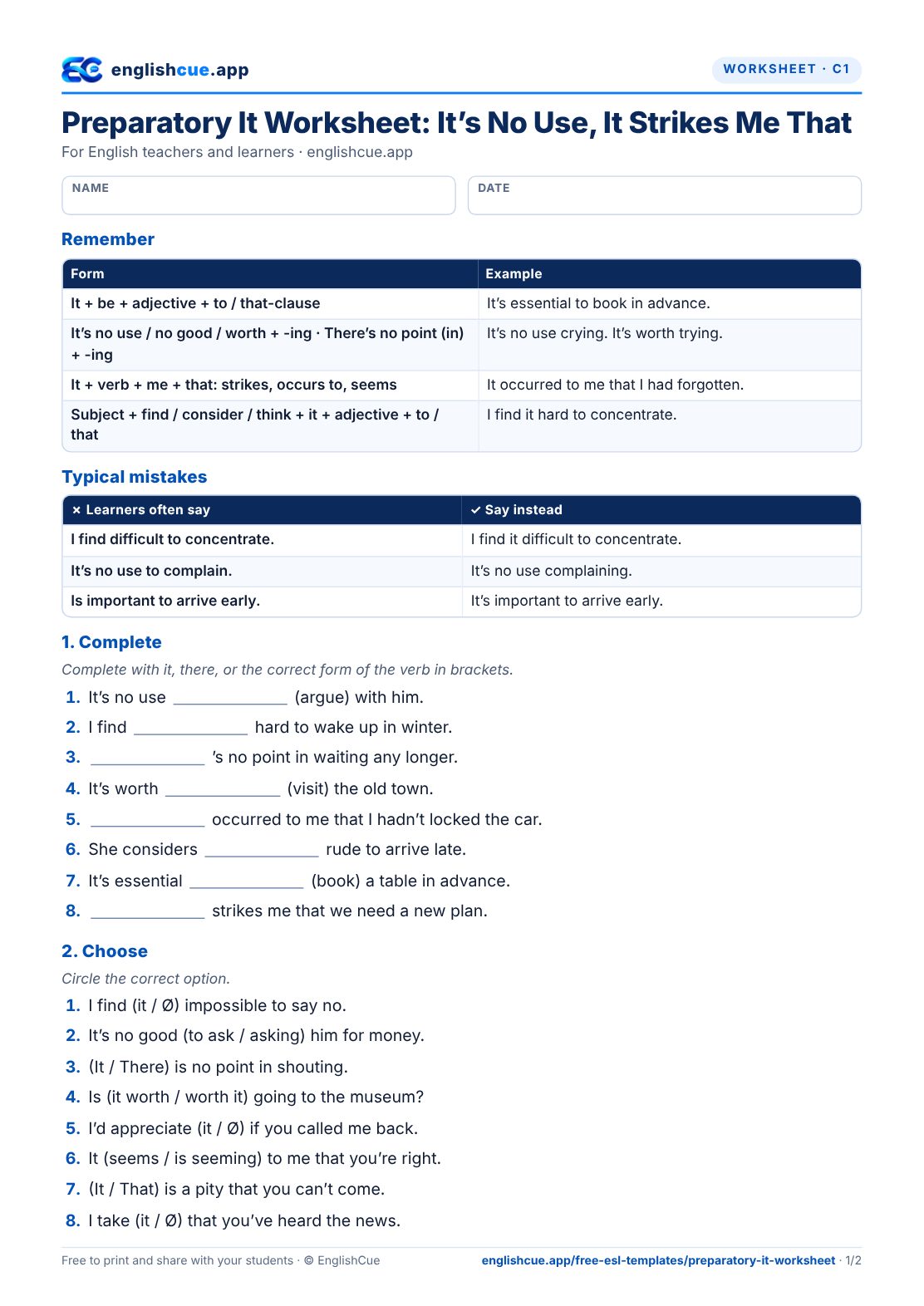 Worksheet · C1 · PDF with answersPreparatory It Worksheet: It’s No Use, It Strikes Me That
The forms your learner will use by the end of the lesson.
seem / claim + to have + pp · to be + -ing
She seems to have left.
earlier actiondeny / admit + having + pp
He denied having taken it.
after -ing verbsremember / stop / try / regret / go on / mean
I stopped to buy coffee.
-ing ≠ tosee / hear + obj + base / -ing · imagine + obj + -ing
I saw her crossing.
no to| Pattern | Meaning | Example |
|---|---|---|
| to have + pp | earlier than the main verb | He seems to have left. · She claims to have won. |
| would like to have + pp | unfulfilled past wish | I’d like to have seen that concert. |
| to be + -ing | in progress now | He appears to be sleeping. |
| having + pp | earlier action after -ing verbs | He denied having taken it. |
| remember / forget + -ing vs to | memory of past vs duty | I remember locking it. · Remember to lock it. |
| stop / try / go on / regret / mean | different meanings | I stopped smoking (quit). · I stopped to smoke (in order to). |
| see / hear + object + base / -ing | whole action / action in progress | I saw him cross / crossing the road. |
| can’t imagine / don’t mind + object + -ing | someone else does it | I can’t imagine him cooking. |
Seem, appear, claim, pretend, be said, be thought + to have + pp = the action is past: She seems to have forgotten.
The errors students make most often with this structure, and how to explain them.
Phrasal verbs and register: formal equivalents (find out → discover, put off → postpone).
Use them as a warm-up or an exit ticket. Answers are below.
All verb patterns and phrasal verbs lessons → All C1 grammar lessons →
Share your screen and teach: everything from the warm-up to the writing task is ready.