RELATIONSHIPS
get on with · fall out with · look up to
I get on with my boss.
people ENGLISHCUE
Until 30 November: try EnglishCue PRO for US$0.99 your first week, then US$19.90/month, cancel anytime. Try PRO · US$0.99 →
B2 English grammar lesson · Verb patterns and phrasal verbs · PRO · 60 min
I can’t put up with the noise. We’ve run out of milk. She came up with a great idea.
Four people share a flat. Max gets on with everyone. Zoe can’t put up with the mess. They always run out of milk. Last week, Zoe came up with a cleaning rota, and now everyone is looking forward to a cleaner kitchen. By the end of this lesson you can use common three-part phrasal verbs in everyday situations.
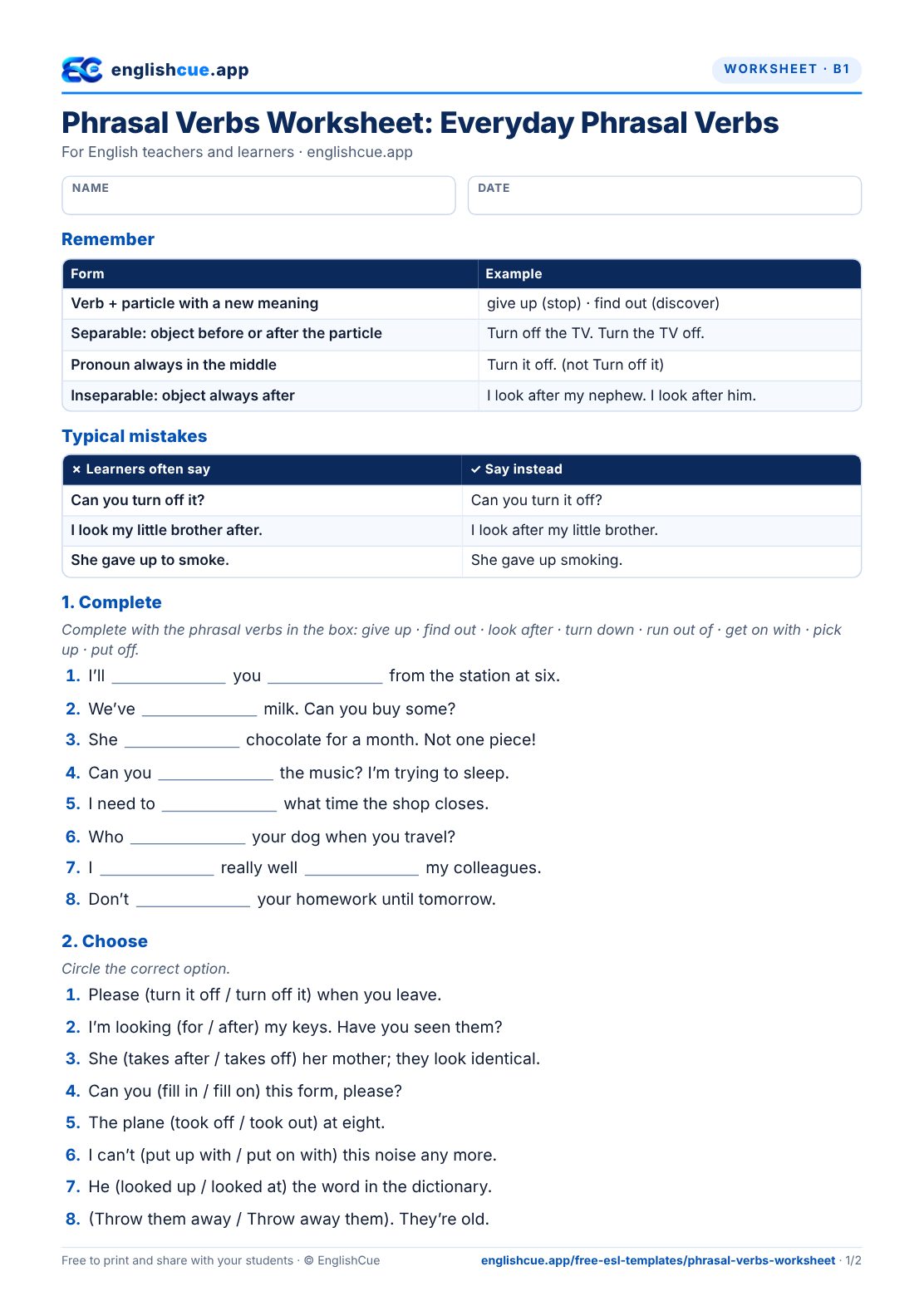 Worksheet · B1 · PDF with answersPhrasal Verbs Worksheet: Everyday Phrasal Verbs
The forms your learner will use by the end of the lesson.
get on with · fall out with · look up to
I get on with my boss.
peopleput up with · get away with
I can’t put up with it.
tolerate / escaperun out of · cut down on · keep up with
We’ve run out of milk.
no more / lesscome up with · look forward to + -ing · make up for
I look forward to seeing you.
object at the end| Verb | Meaning | Example |
|---|---|---|
| get on with | have a good relationship | Max gets on with everyone. |
| fall out with | stop being friends after an argument | I fell out with my cousin. |
| look up to / look down on | admire / think you are better than | She looks up to her grandmother. |
| put up with | tolerate | I can’t put up with the noise. |
| get away with | not be punished | He cheated and got away with it. |
| run out of | have no more | We’ve run out of milk. |
| cut down on | reduce | I’m cutting down on sugar. |
| keep up with / catch up with | stay at the same level / reach | I can’t keep up with the class. |
| come up with | think of an idea | Zoe came up with a rota. |
| look forward to + -ing | be happy about a future event | I’m looking forward to seeing you. |
| make up for | compensate | I’ll make up for being late. |
Three-part verbs are inseparable: the object always goes at the end: put up with it, run out of time.
The errors students make most often with this structure, and how to explain them.
Would rather, had better, it’s time: preferences, warnings and overdue actions.
Use them as a warm-up or an exit ticket. Answers are below.
All verb patterns and phrasal verbs lessons → All B2 grammar lessons →
Share your screen and teach: everything from the warm-up to the writing task is ready.