ENGLISHCUE

Until 30 November: try EnglishCue PRO for US$0.99 your first week, then US$19.90/month, cancel anytime. Try PRO · US$0.99 →

B2 English grammar lesson · Verb patterns and phrasal verbs · PRO · 60 min

Patterns after adjectives and nouns: keen on doing, the chance to do

I’m keen on learning. It’s easy to use. I had the chance to travel. There’s no point waiting.

The situation

Paula is 45 and wants to change careers. Her coach asks questions. Paula: “I’m tired of working in an office. I’m keen on cooking, and I’d love the chance to open a café. But I’m afraid of failing.” Coach: “There’s no point worrying. It’s never too late to start.” By the end of this lesson you can use the right pattern after common adjectives and nouns.

Free practice worksheet

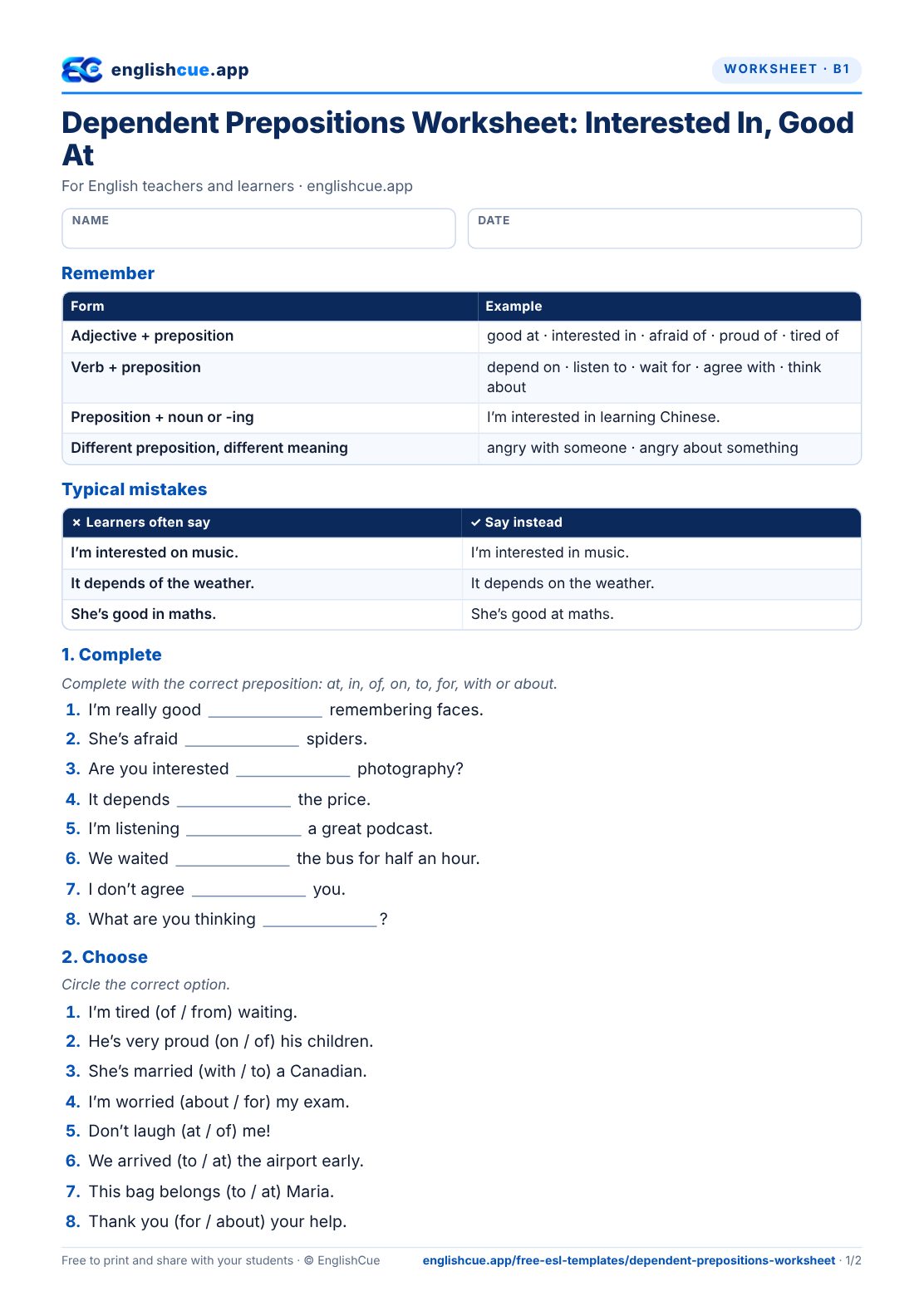
Dependent Prepositions Worksheet: Interested In, Good At previewWorksheet · B1 · PDF with answersDependent Prepositions Worksheet: Interested In, Good At

The grammar at a glance

The forms your learner will use by the end of the lesson.

ADJECTIVE + TO

happy · ready · easy · likely + to

It’s easy to use.

base form

ADJ + PREP + -ING

good at · keen on · afraid of · used to

I’m keen on cooking.

preposition → -ing

NOUN + TO

the chance · the decision · the right + to

the chance to travel

base form

NOUN + OF + -ING

the idea of · no point · worth

There’s no point waiting.

-ing

Patterns after adjectives and nouns

PatternCommon wordsExample
adjective + tohappy, ready, easy, hard, likely, lucky, surprised, sorryIt’s easy to use. · I was lucky to find it.
adjective + preposition + -inggood at, keen on, afraid of, tired of, interested in, responsible for, used toI’m keen on cooking. · She’s good at listening.
noun + tothe chance, the decision, the right, time, the ability, an attemptI had the chance to travel.
noun + of + -ingthe idea of, the risk of, the point of, the habit of, the thought ofThe idea of moving scares me.
no point / no use + -ingthere’s no point (in), it’s no use, it’s (not) worthThere’s no point waiting.

After a preposition, the verb is always -ing: interested in learning, used to getting up (to is a preposition here).

Common mistakes to watch for

The errors students make most often with this structure, and how to explain them.

  • I’m interested to learn Italian. → I’m interested in learning Italian.General interest: interested in + -ing.
  • She’s used to get up at 5. → She’s used to getting up at 5.Be used to + -ing.
  • He’s good in solving problems. → He’s good at solving problems.Good at.
  • It’s no point to argue. → There’s no point arguing. / It’s no use arguing.There’s no point + -ing.
  • I’m tired to wait. → I’m tired of waiting.Tired of + -ing.
  • The idea to move abroad scares me. → The idea of moving abroad scares me.The idea of + -ing.

Teaching tips

Next lesson

Three-part phrasal verbs: look forward to, get on with, run out of, put up with.

Quick check: three sample questions

Use them as a warm-up or an exit ticket. Answers are below.

  1. This app is easy ___.
    • to use
    • using
    • for using
  2. She’s really good ___ people.
    • at managing
    • to manage
    • in manage
  3. I never had the chance ___ abroad.
    • to study
    • of studying
    • studying
Show answers
  1. to use. Adjective + to.
  2. at managing. Good at + -ing.
  3. to study. The chance to.

What the full lesson includes

  • A scene that shows the structure in use, with guided discovery questions.
  • Forms and examples on screen, with colour-coded contrasts.
  • Self-correcting practice: choose, fix, build and rewrite, with an explanation for every answer.
  • A recorded listening with transcript, a speaking task with follow-up questions and a short writing task with a model answer.
  • Teacher mode and self-study mode, so students can review after class.

Where this lesson fits in the course

More verb patterns and phrasal verbs lessons

  1. B2Three-part phrasal verbs: put up with, run out of, come up withI can’t put up with the noise. We’ve run out of milk. She came up with a great idea.
  2. B2Would rather, had better, it’s timeI’d rather stay at home. You’d better hurry. It’s time we left.
  3. C1Complex verb patterns: to have done, having done, stop to / stop -ingShe seems to have left. He denied having taken it. I stopped to buy a coffee. I saw her crossing the road.
  4. C1Phrasal verbs and register: find out → discover, put off → postponeWe put off the meeting → The meeting was postponed. They’re looking into it → The matter is being investigated.

All verb patterns and phrasal verbs lessons → All B2 grammar lessons →

Teach it and practise it

Teach this lesson with EnglishCue PRO.

Share your screen and teach: everything from the warm-up to the writing task is ready.