The forms your learner will use by the end of the lesson.
Be going to: plans and intentions
Subject + am/is/are + going to + base verb
I'm going to study for my exam this weekend.
Use be going to for plans, intentions, and decisions made before the moment of speaking. It is also common for predictions based on present evidence.
Will: instant decisions, promises, and offers
Subject + will + base verb. Negative: will not (won't) + base verb.
The phone is ringing. I'll answer it.
Use will when you decide something at the moment of speaking. It also expresses promises, offers, and willingness to do something.
Will: predictions and beliefs
Subject + will + base verb. Negative: subject + won't + base verb.
I think people will work fewer hours in the future.
Use will for predictions based on opinions, expectations, or beliefs, especially when there is no clear present evidence. Use it to express what you think or expect about the future.
Teaching tips
Be going to: plans and intentions
The decision already exists before you speak. For predictions, look for something you can see or observe now. Negative: I'm not going to travel this summer. Question: Are you going to apply for the job?
Will: instant decisions, promises, and offers
The decision is made now, not planned earlier. After will, always use the base form of the verb. Say I'll help, not I'll helping or I'll to help.
Will: predictions and beliefs
Use expressions such as I think, I believe, probably, and I'm sure to introduce opinions about the future. Compare: I think it will rain tomorrow (opinion) and Look at those clouds! It's going to rain (present evidence).
Quick check: three sample questions
Use them as a warm-up or an exit ticket. Answers are below.
I've already booked the hotel. I ___ visit New York next month.
will
am going to
am
Your friend is carrying too many bags. You say: 'Here, ___ you with those.'
I'm going to help
I help
I'll help
Look at that car! It ___ hit the wall!
will
is going to
is
Show answers
am going to. The hotel is already booked, so the trip is a previous plan. Use am going to.
I'll help. You decide to help at the moment of speaking. Use will for an instant decision or offer.
is going to. There is clear present evidence of a possible accident. Use be going to for a prediction based on what you can see.
What the full lesson includes
A scene that shows the structure in use, with guided discovery questions.
Forms and examples on screen, with colour-coded contrasts.
Self-correcting practice: choose, fix, build and rewrite, with an explanation for every answer.
A recorded listening with transcript, a speaking task with follow-up questions and a short writing task with a model answer.
Teacher mode and self-study mode, so students can review after class.
 ENGLISHCUE
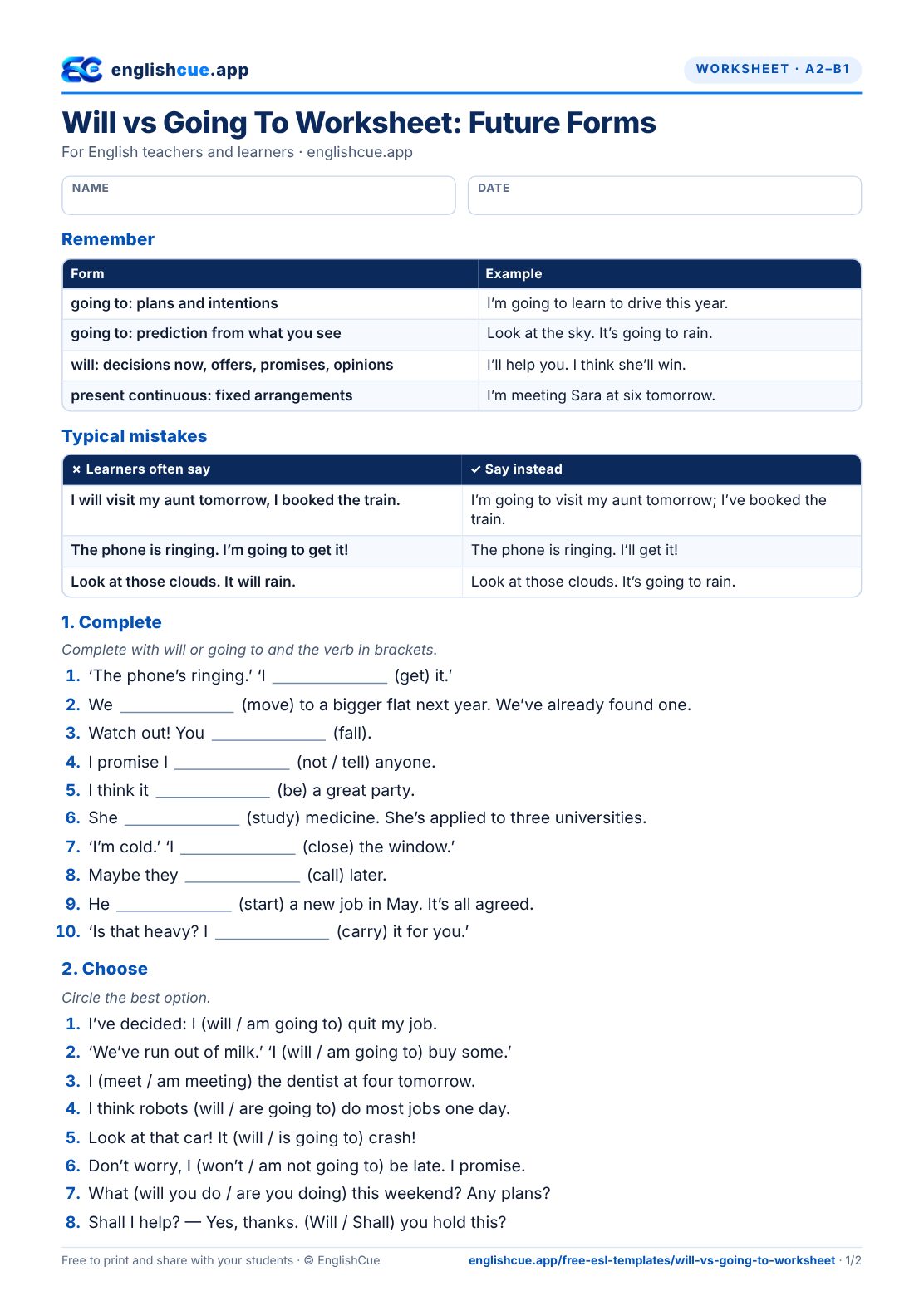 Worksheet · A2–B1 · PDF with answersWill vs Going To Worksheet: Future Forms