The forms your learner will use by the end of the lesson.
First conditional: real future possibilities
If + present simple, will + base verb. Alternative order: Will + base verb + if + present simple.
If it rains tomorrow, I'll stay home.
Use the first conditional for situations that are possible or realistic in the future and their expected results.
Second conditional: imaginary situations
If + past simple, would + base verb. Alternative order: Would + base verb + if + past simple.
If I had more time, I would learn another language.
Use the second conditional to imagine situations that are unreal, unlikely, or different from the present. You can also use it to imagine unlikely future possibilities.
Choosing between the first and second conditional
First: If + present simple, will + base verb. Second: If + past simple, would + base verb.
If I get a promotion, I'll buy a new laptop.
Choose the first conditional when you see a situation as a real possibility. Choose the second conditional when you imagine a different or unlikely situation.
Teaching tips
First conditional: real future possibilities
Use the present simple after if, not will. Say If it rains, I'll stay home, not If it will rain. The two clauses can change order. Use a comma when the if-clause comes first.
Second conditional: imaginary situations
Although the if-clause uses the past simple, the meaning is not necessarily about the past. It describes an imaginary present or future. Would is followed by the base verb, not to + infinitive. Were is common with all subjects in the expression If I were you.
Choosing between the first and second conditional
The difference is the speaker's view of the situation, not simply the time. First conditional: a real possibility. Second conditional: an imaginary or less likely possibility. In both structures, don't use will or would directly after if.
Quick check: three sample questions
Use them as a warm-up or an exit ticket. Answers are below.
If I ___ enough time tomorrow, I'll help you with your project.
will have
have
would have
If I lived near the beach, I ___ swimming every morning.
will go
go
would go
If she ___ the job, she'll move to another city.
gets
will get
would get
Show answers
have. This is a first conditional sentence about a real future possibility. Use the present simple after if: If I have.
would go. This is a second conditional sentence describing an imaginary situation. Use would + base verb in the result clause.
gets. Use the present simple after if in the first conditional. Gets agrees with the subject she.
What the full lesson includes
A scene that shows the structure in use, with guided discovery questions.
Forms and examples on screen, with colour-coded contrasts.
Self-correcting practice: choose, fix, build and rewrite, with an explanation for every answer.
A recorded listening with transcript, a speaking task with follow-up questions and a short writing task with a model answer.
Teacher mode and self-study mode, so students can review after class.
 ENGLISHCUE
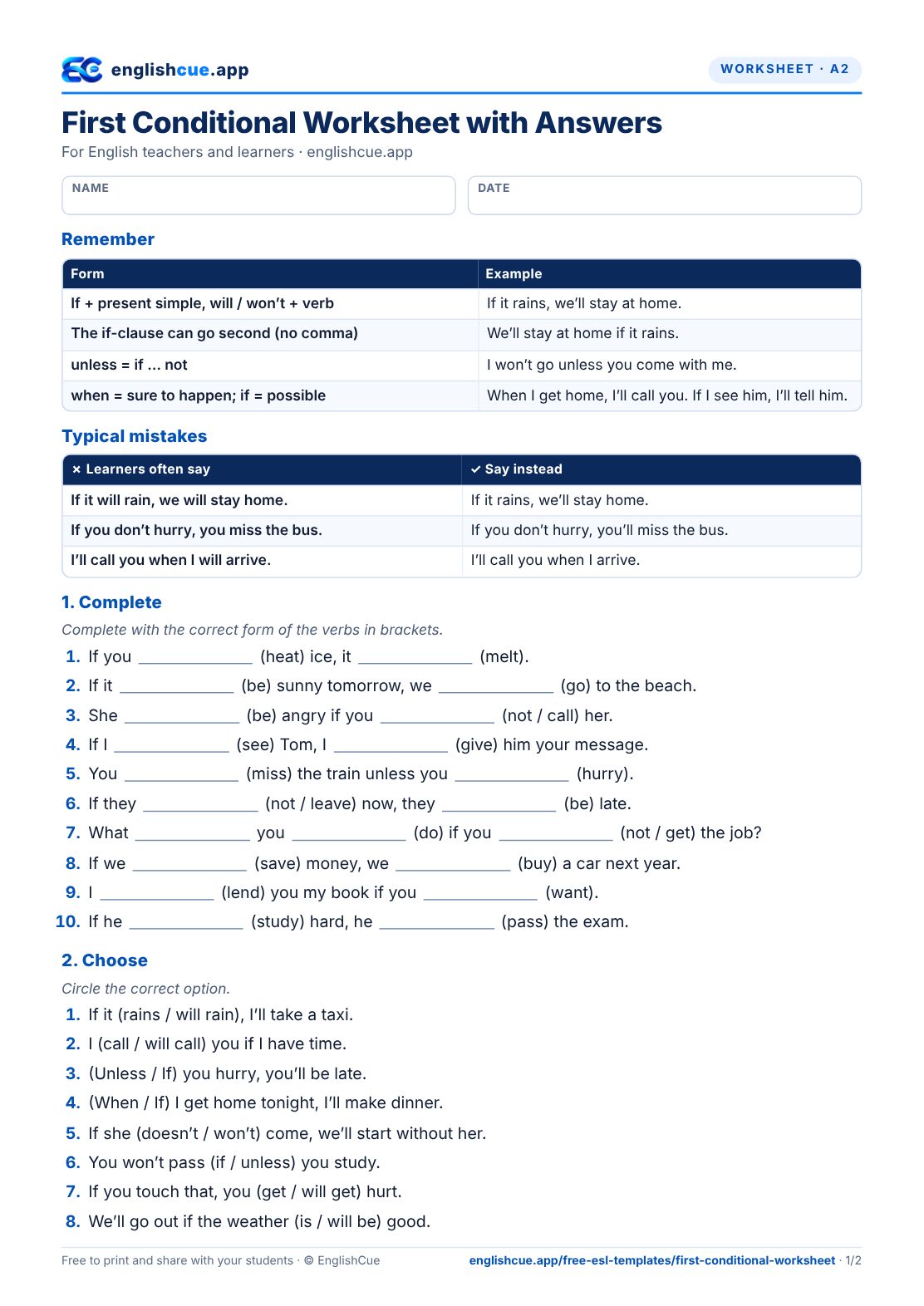 Worksheet · A2 · PDF with answersFirst Conditional Worksheet with Answers