USED TO
used to + base form
I used to drive everywhere.
habits and states ENGLISHCUE
Until 30 November: try EnglishCue PRO for US$0.99 your first week, then US$19.90/month, cancel anytime. Try PRO · US$0.99 →
B1 English grammar lesson · Verb patterns and phrasal verbs · PRO · 60 min
I used to live in Leeds. I’m used to the cold. I’m getting used to driving on the left.
Tom is from Manchester. Two years ago he moved to Osaka to teach English. “I used to drive everywhere. On Sundays, my family would have a big roast dinner. Now I’m used to taking the train, but I still haven’t got used to the summer heat!” By the end of this lesson you can talk about past habits and getting accustomed to new things.
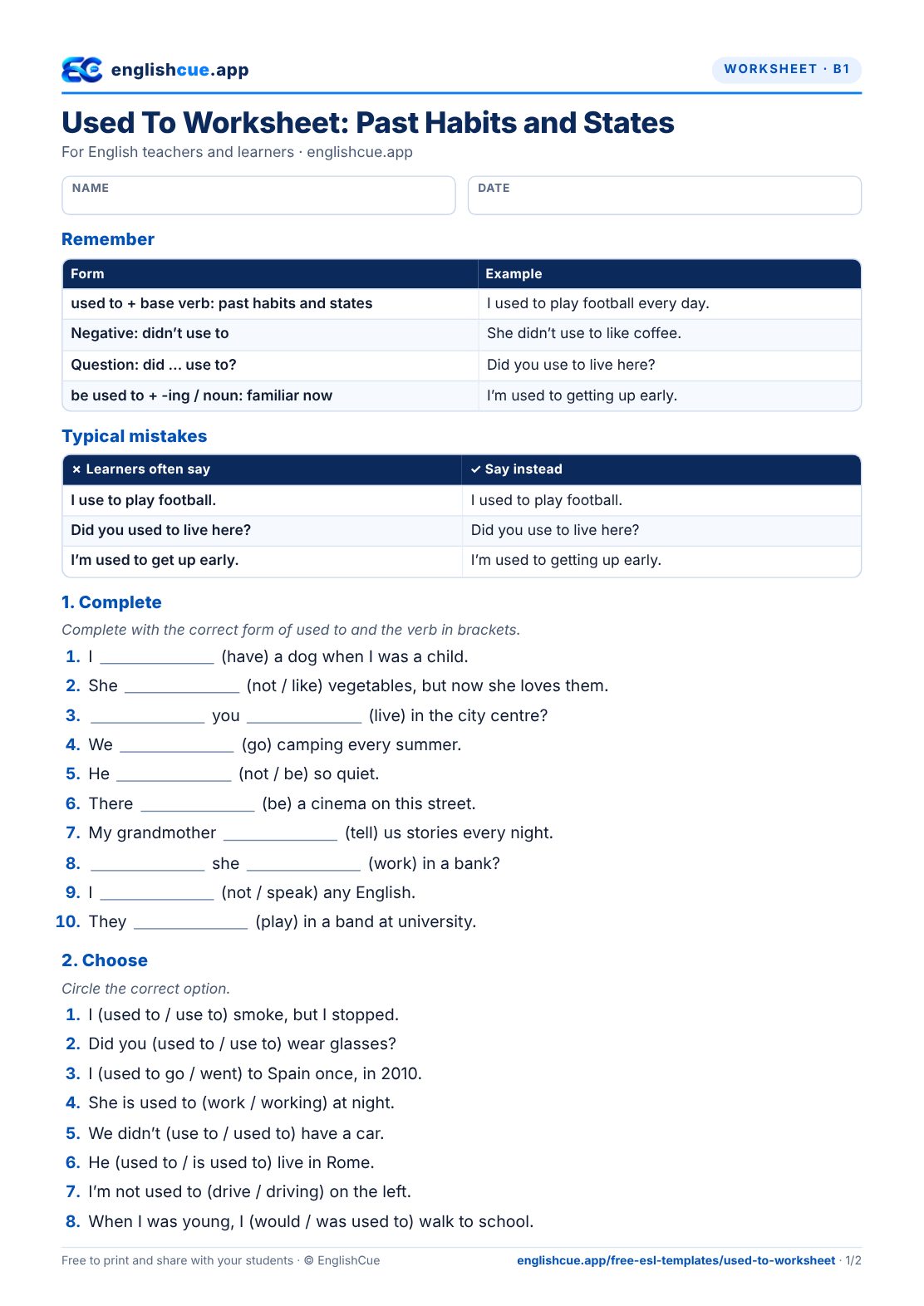 Worksheet · B1 · PDF with answersUsed To Worksheet: Past Habits and States
The forms your learner will use by the end of the lesson.
used to + base form
I used to drive everywhere.
habits and stateswould + action verb
We would have a roast every Sunday.
not for statesbe used to + -ing / noun
I’m used to taking the train.
it’s normal for meget used to + -ing / noun
I’m getting used to the heat.
a process, any tense| Form | Meaning | Example |
|---|---|---|
| used to + base form | past habit or state, not now | I used to drive everywhere. |
| would + base form | past repeated action (not states) | On Sundays, we would have a roast dinner. |
| be used to + -ing / noun | it’s normal for me, familiar | I’m used to taking the train. |
| get used to + -ing / noun | it’s becoming normal (a process) | I’m getting used to the heat. |
After be used to and get used to, to is a preposition: use a noun or -ing.
The errors students make most often with this structure, and how to explain them.
Real and imaginary situations: first and second conditional.
Use them as a warm-up or an exit ticket. Answers are below.
All verb patterns and phrasal verbs lessons → All B1 grammar lessons →
Share your screen and teach: everything from the warm-up to the writing task is ready.