ENGLISHCUE

Until 30 November: try EnglishCue PRO for US$0.99 your first week, then US$19.90/month, cancel anytime. Try PRO · US$0.99 →

A2 English grammar lesson · Conditionals · PRO · 60 min

Zero conditional: facts and routines

If you heat ice, it melts. If I’m tired, I go to bed early.

The situation

Ms Rivera teaches science. She heats some ice: “Look. If you heat ice, it melts. If you heat water to 100 degrees, it boils.” A student says: “And if I don’t eat breakfast, I get a headache!” By the end of this lesson you can talk about facts and routines with if.

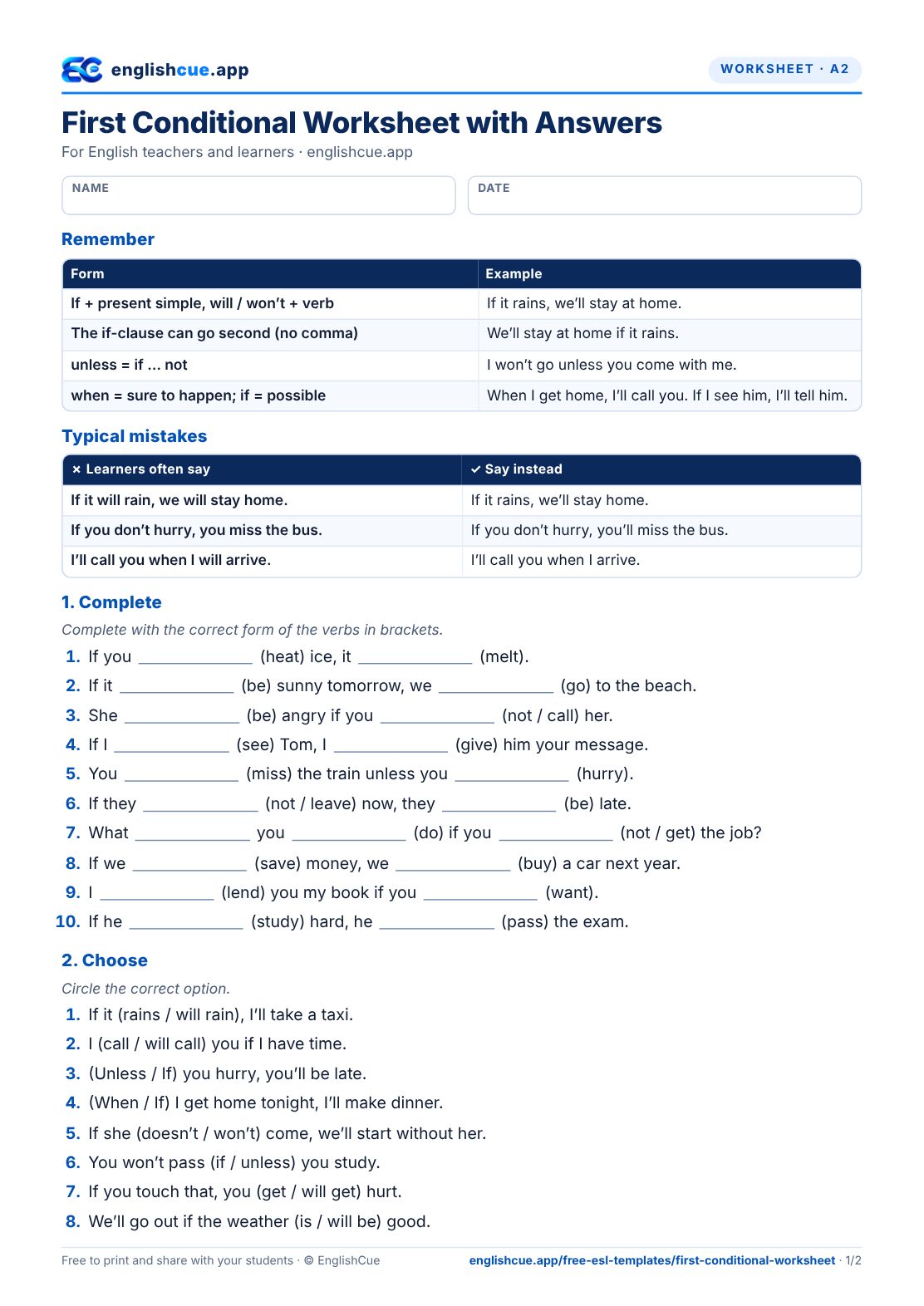
Free practice worksheet

First Conditional Worksheet with Answers previewWorksheet · A2 · PDF with answersFirst Conditional Worksheet with Answers

The grammar at a glance

The forms your learner will use by the end of the lesson.

FORM

If + present simple, present simple

If you heat ice, it melts.

no will

ROUTINES

If / When I…, I…

If I’m tired, I go to bed early.

if = when

INSTRUCTIONS

If + present, imperative

If you feel ill, call the doctor.

do / don’t

COMMA

If first → comma

If it rains, we stay home. / We stay home if it rains.

if second → no comma

Common mistakes to watch for

The errors students make most often with this structure, and how to explain them.

  • If you will mix red and blue, you get purple. → If you mix red and blue, you get purple.No will in the if part.
  • If water freeze, it becomes ice. → If water freezes, it becomes ice.Water freezes (third person).
  • If I’m hungry, I eating a sandwich. → If I’m hungry, I eat a sandwich.Present simple.
  • If you don’t sleep you feel tired. → If you don’t sleep, you feel tired.Comma after the if part.
  • When it will rain, I take an umbrella. → When it rains, I take an umbrella.Present simple after when.
  • If you feel ill, you call the doctor! (an instruction) → If you feel ill, call the doctor.For instructions, use the imperative.

Teaching tips

If or when?

In the zero conditional, if and when mean almost the same: “When you heat ice, it melts.” It happens every time.

The comma

When if comes first, use a comma: “If it rains, we stay at home.” When if comes second, no comma: “We stay at home if it rains.”

Next lesson

Real possibilities in the future: the first conditional (If it rains tomorrow, we’ll stay home).

Quick check: three sample questions

Use them as a warm-up or an exit ticket. Answers are below.

  1. If you ___ ice, it melts.
    • heat
    • will heat
    • heated
  2. If water ___ to 100 °C, it boils.
    • get
    • gets
    • will get
  3. Plants die if they ___ light.
    • don’t get
    • won’t get
    • not get
Show answers
  1. heat. Present simple.
  2. gets. Water gets (third person).
  3. don’t get. Present simple negative.

What the full lesson includes

  • A scene that shows the structure in use, with guided discovery questions.
  • Forms and examples on screen, with colour-coded contrasts.
  • Self-correcting practice: choose, fix, build and rewrite, with an explanation for every answer.
  • A recorded listening with transcript, a speaking task with follow-up questions and a short writing task with a model answer.
  • Teacher mode and self-study mode, so students can review after class.

Where this lesson fits in the course

More conditionals lessons

  1. A2First conditional: if, when, unlessIf it rains, we’ll stay at home. Unless you hurry, you’ll miss the bus.
  2. B1First and second conditionalTalk about real future possibilities and imaginary situations.
  3. B1Second conditional: wishes and advice — if I were youIf I won the lottery, I’d buy a boat. If I were you, I’d talk to her.
  4. B1Wish + past simpleI wish I had more free time. I wish I could speak Japanese. If only it weren’t Monday!

All conditionals lessons → All A2 grammar lessons →

Teach it and practise it

Teach this lesson with EnglishCue PRO.

Share your screen and teach: everything from the warm-up to the writing task is ready.