ENGLISHCUE

Until 30 November: try EnglishCue PRO for US$0.99 your first week, then US$19.90/month, cancel anytime. Try PRO · US$0.99 →

A2 English grammar lesson · Verb patterns and phrasal verbs · PRO · 60 min

Infinitive of purpose: to and for

I went to the bank to get some money. I went to the bakery for some bread.

The situation

It’s Saturday morning and Oliver has a lot to do. “I’m going to the post office to send a parcel. Then I’m going to the market for some vegetables. And I need to go to the bank to get some cash.” By the end of this lesson you can explain why people do things.

Free practice worksheet

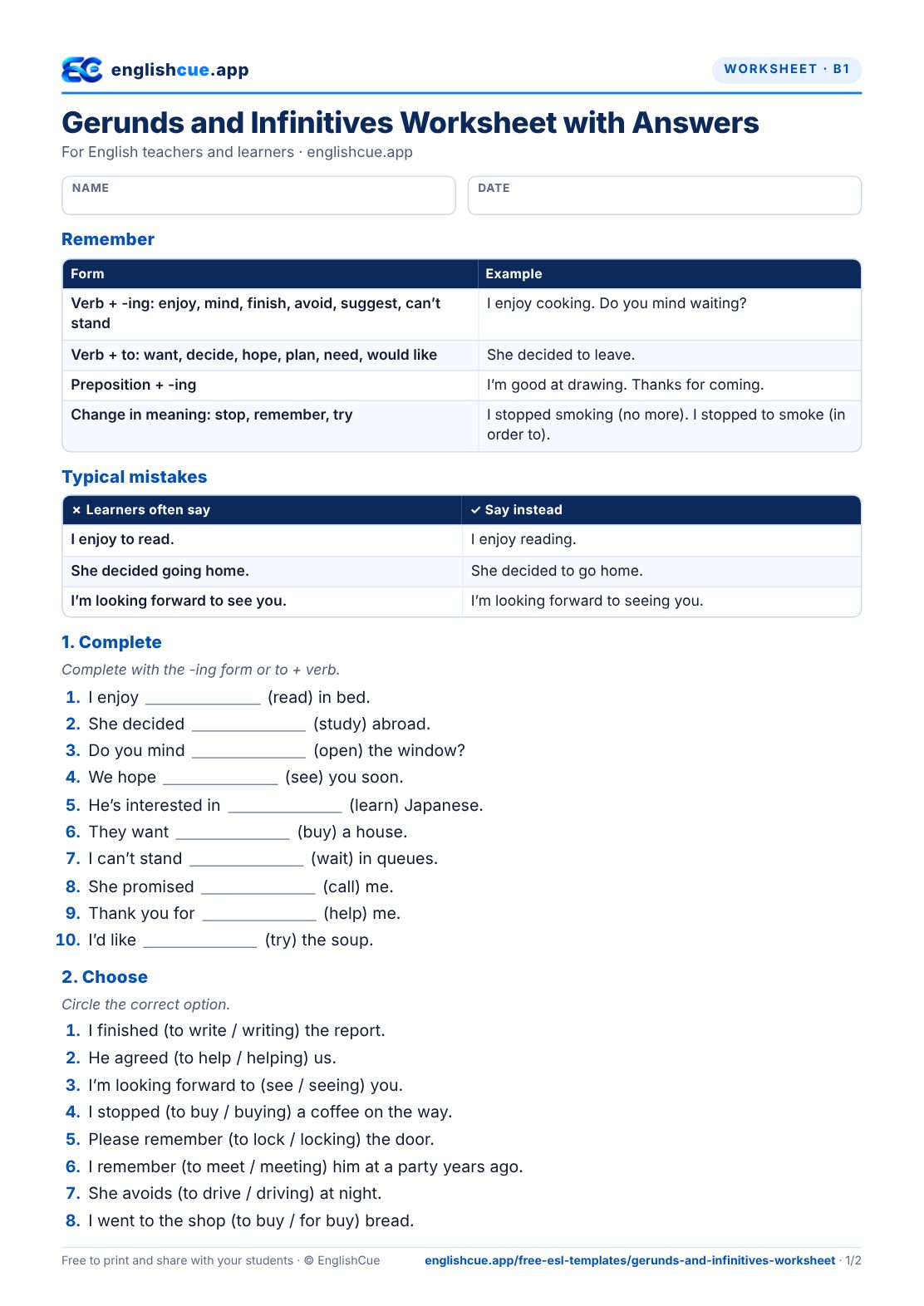
Gerunds and Infinitives Worksheet with Answers previewWorksheet · B1 · PDF with answersGerunds and Infinitives Worksheet with Answers

The grammar at a glance

The forms your learner will use by the end of the lesson.

TO + VERB

to + base form

I went to the bank to get cash.

never for to

FOR + NOUN

for + noun

I went to the market for vegetables.

for a coffee, for dinner

WHY?

Why…? — To…

Why are you here? — To meet a friend.

or: Because…

WHAT FOR?

is for + -ing

A key is for opening doors.

You use it to…

Common mistakes to watch for

The errors students make most often with this structure, and how to explain them.

  • I came to London for study English. → I came to London to study English.Purpose with a verb: to.
  • She saved money for to buy a car. → She saved money to buy a car.Never for to.
  • We went out to a drink. → We went out for a drink.Purpose with a noun: for.
  • A key is for open doors. → A key is for opening doors.Is for + -ing.
  • He went to the doctor for get a check-up. → He went to the doctor to get a check-up. / He went to the doctor for a check-up.To + verb, or for + noun.
  • “Why are you here?” “For meet my friend.” → “Why are you here?” “To meet my friend.”To + base form.

Teaching tips

Never “for to”

Many students say “I came here for to study” or “for study”. In English, a verb of purpose takes only to: “I came here to study.”

Next lesson

Facts and routines: the zero conditional (If you heat ice, it melts).

Quick check: three sample questions

Use them as a warm-up or an exit ticket. Answers are below.

  1. I went to the shop ___ milk.
    • to buy
    • for buy
    • for to buy
  2. Let’s go out ___ a pizza.
    • to
    • for
    • for to
  3. She called me ___ goodbye.
    • to say
    • for saying
    • for say
Show answers
  1. to buy. Purpose with a verb: to.
  2. for. Purpose with a noun: for.
  3. to say. To + verb.

What the full lesson includes

  • A scene that shows the structure in use, with guided discovery questions.
  • Forms and examples on screen, with colour-coded contrasts.
  • Self-correcting practice: choose, fix, build and rewrite, with an explanation for every answer.
  • A recorded listening with transcript, a speaking task with follow-up questions and a short writing task with a model answer.
  • Teacher mode and self-study mode, so students can review after class.

Where this lesson fits in the course

More verb patterns and phrasal verbs lessons

  1. A1Would like and wantOrder, offer and invite politely: I’d like a coffee. Would you like some water? Would you like to come?
  2. A2Verb + to-infinitive or verb + -ing: first patternsI want to learn Italian. I enjoy cooking. I’m good at drawing.
  3. A2Used to: first contactI used to have long hair. We didn’t use to have phones. Did you use to play football?
  4. B1Used to, would, be used to, get used toI used to live in Leeds. I’m used to the cold. I’m getting used to driving on the left.

All verb patterns and phrasal verbs lessons → All A2 grammar lessons →

Teach it and practise it

Teach this lesson with EnglishCue PRO.

Share your screen and teach: everything from the warm-up to the writing task is ready.