ORDER
I’d like + noun, please
I’d like a coffee, please.
polite; want is direct ENGLISHCUE
Until 30 November: try EnglishCue PRO for US$0.99 your first week, then US$19.90/month, cancel anytime. Try PRO · US$0.99 →
A1 English grammar lesson · Verb patterns and phrasal verbs · PRO · 60 min
Order, offer and invite politely: I’d like a coffee. Would you like some water? Would you like to come?
Omar and Bea are at a restaurant. Luca, the waiter, asks: “Would you like a drink?” Bea says: “Yes, please. I’d like a lemonade.” Omar says: “I’d like to see the menu first.” By the end of this lesson you can order, offer and invite politely.
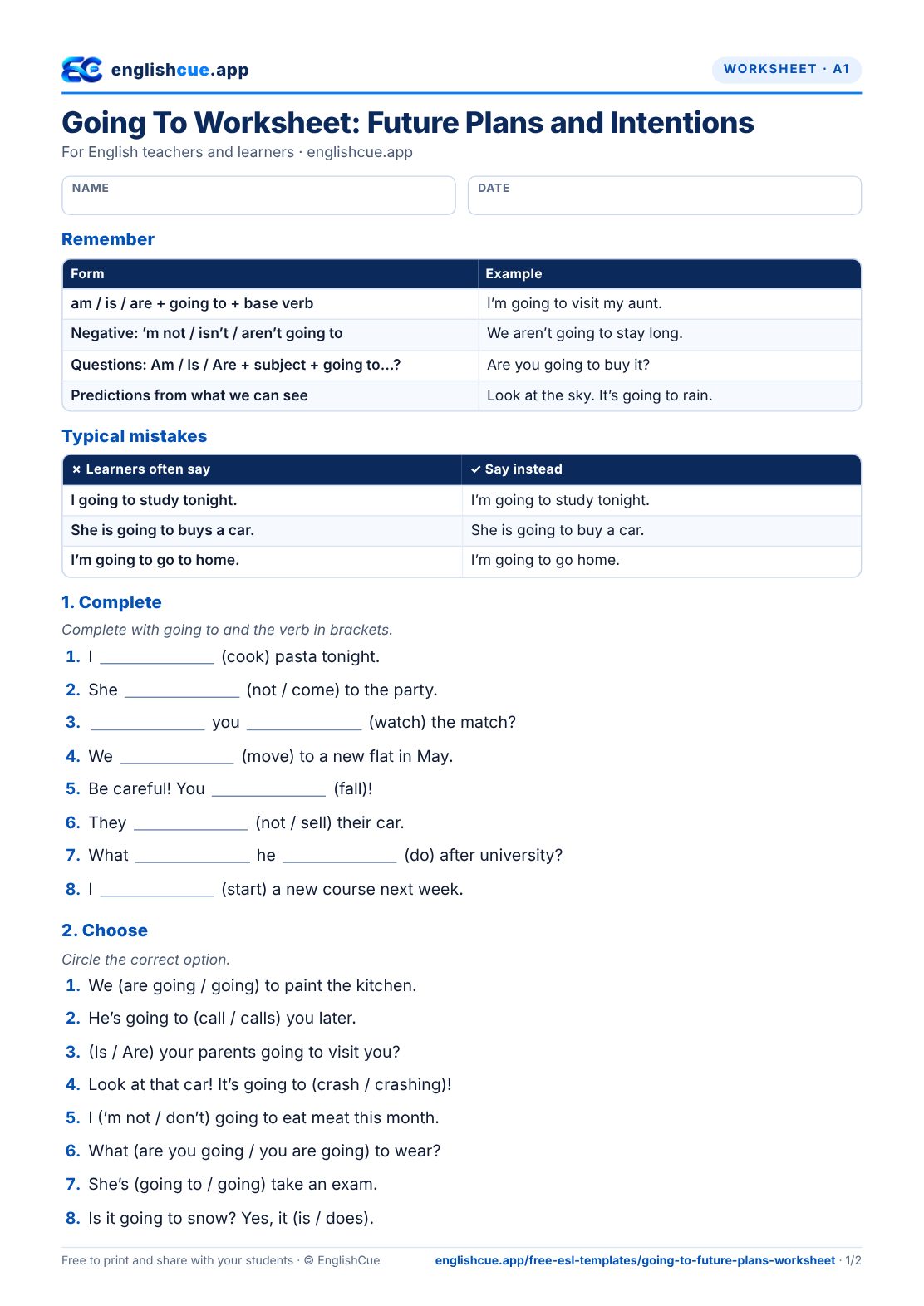 Worksheet · A1 · PDF with answersGoing To Worksheet: Future Plans and Intentions
The forms your learner will use by the end of the lesson.
I’d like + noun, please
I’d like a coffee, please.
polite; want is directI’d like to / I want to + verb
I’d like to book a table.
to before a verbWould you like (to)…?
Would you like to come?
Yes, please. · I’d love to.like = in general · would like = now
I like tea. I’d like a tea.
no -s after would| Pattern | Example |
|---|---|
| want / would like + noun | I’d like a coffee. · We want the bill. |
| want / would like + to + verb | I’d like to book a table. · She wants to go home. |
With a verb, to is necessary: I’d like to order. Not “I’d like order”.
The errors students make most often with this structure, and how to explain them.
In speech we say I’d like, she’d like, we’d like. The full form I would like is more formal. The form is the same for every person: no -s.
No, thank you. for an offer. I’d love to, but I can’t. + a reason for an invitation.
Use them as a warm-up or an exit ticket. Answers are below.
All verb patterns and phrasal verbs lessons → All A1 grammar lessons →
Share your screen and teach: everything from the warm-up to the writing task is ready.