ENGLISHCUE

Until 30 November: try EnglishCue PRO for US$0.99 your first week, then US$19.90/month, cancel anytime. Try PRO · US$0.99 →

A1 English grammar lesson · Verb patterns and phrasal verbs · PRO · 60 min

Like, love, hate + -ing

Talk about what you like doing: I love cooking, I don’t mind cleaning, I hate getting up early.

The situation

Mia looks for a flatmate on an app. Her profile says: “I love cooking and I enjoy reading. I don’t mind cleaning, but I hate getting up early!” By the end of this lesson you can talk about activities you like and don’t like.

Free practice worksheet

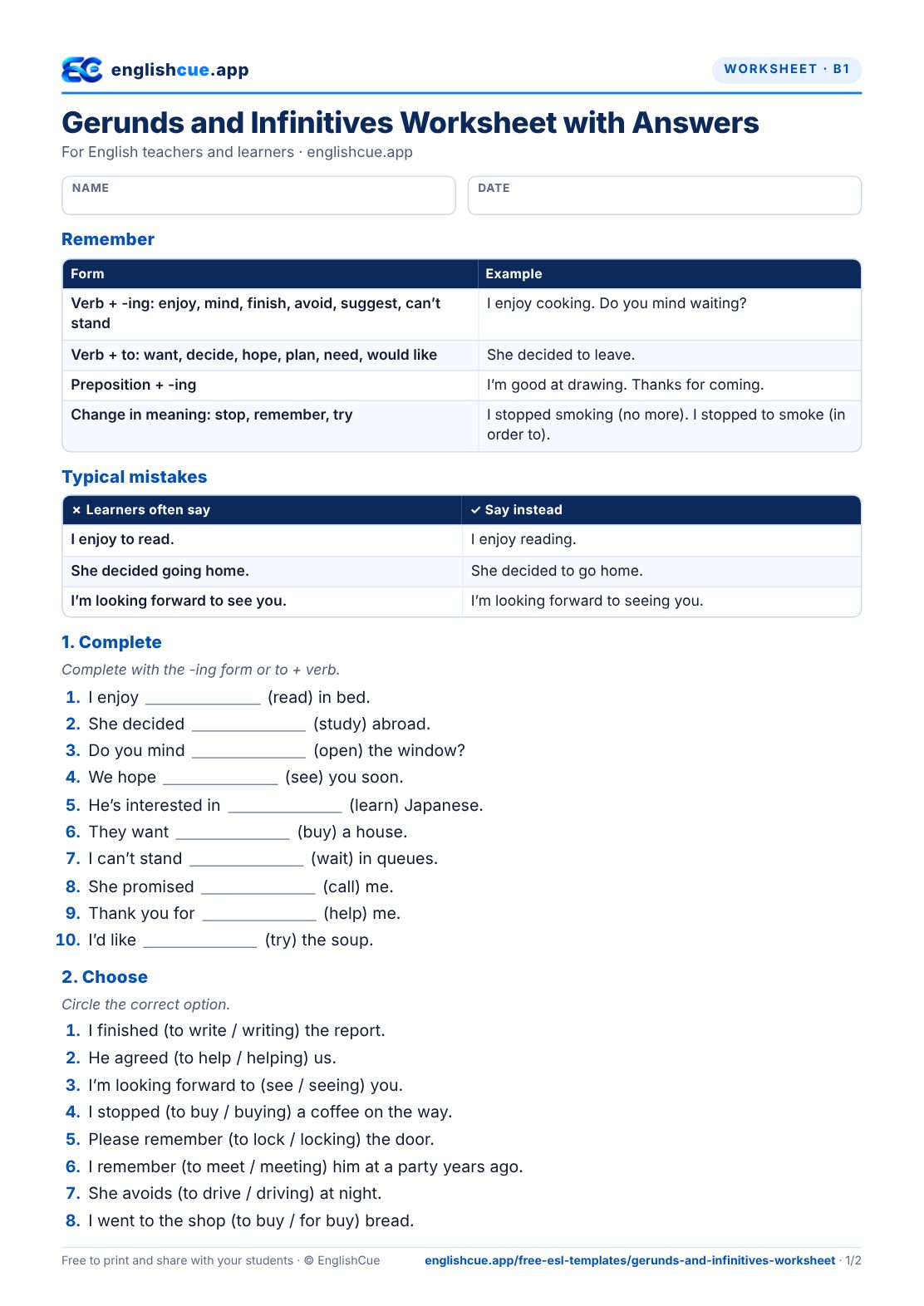
Gerunds and Infinitives Worksheet with Answers previewWorksheet · B1 · PDF with answersGerunds and Infinitives Worksheet with Answers

The grammar at a glance

The forms your learner will use by the end of the lesson.

POSITIVE

love · like · enjoy + -ing

I love cooking.

enjoy never takes to

NEUTRAL

don’t mind + -ing

I don’t mind cleaning.

it’s OK for me

NEGATIVE

don’t like · hate · can’t stand + -ing

I hate getting up early.

like is a normal verb

-ING SPELLING

make → making · swim → swimming

dancing · running · playing

drop e · double · + ing

From love to hate

FeelingVerbExample
😍loveI love cooking.
🙂like · enjoyI like reading. I enjoy walking.
😐don’t mindI don’t mind cleaning.
🙁don’t likeI don’t like ironing.
😖hate · can’t standI hate getting up early.

Don’t mind means *it’s OK for me, no problem*. It is not negative.

Common mistakes to watch for

The errors students make most often with this structure, and how to explain them.

  • I like cook. → I like cooking.After like: -ing.
  • I enjoy to read. → I enjoy reading.Enjoy takes -ing, never to.
  • She love dancing. → She loves dancing.She: loves.
  • I hate geting up early. → I hate getting up early.get → getting.
  • Do you like play tennis? → Do you like playing tennis?After like: -ing.
  • I don’t mind to wash the dishes. → I don’t mind washing the dishes.Don’t mind + -ing.

Teaching tips

After these verbs: -ing

When an activity comes after like, love, enjoy, don’t mind, hate, use the -ing form: I love cooking. You can also use a noun: I love pizza.

Like and would like

I like swimming = in general. I’d like a coffee = I want one now. That second one is in a later lesson.

Quick check: three sample questions

Use them as a warm-up or an exit ticket. Answers are below.

  1. I love ___.
    • cook
    • cooking
    • to cooks
  2. She enjoys ___ in the park.
    • run
    • running
    • runs
  3. My dad ___ watching football.
    • love
    • loves
    • loving
Show answers
  1. cooking. After love: cooking.
  2. running. After enjoy: running.
  3. loves. He: loves.

What the full lesson includes

  • A scene that shows the structure in use, with guided discovery questions.
  • Forms and examples on screen, with colour-coded contrasts.
  • Self-correcting practice: choose, fix, build and rewrite, with an explanation for every answer.
  • A recorded listening with transcript, a speaking task with follow-up questions and a short writing task with a model answer.
  • Teacher mode and self-study mode, so students can review after class.

Where this lesson fits in the course

More verb patterns and phrasal verbs lessons

  1. A1Would like and wantOrder, offer and invite politely: I’d like a coffee. Would you like some water? Would you like to come?
  2. A2Verb + to-infinitive or verb + -ing: first patternsI want to learn Italian. I enjoy cooking. I’m good at drawing.
  3. A2Infinitive of purpose: to and forI went to the bank to get some money. I went to the bakery for some bread.
  4. A2Used to: first contactI used to have long hair. We didn’t use to have phones. Did you use to play football?

All verb patterns and phrasal verbs lessons → All A1 grammar lessons →

Teach it and practise it

Teach this lesson with EnglishCue PRO.

Share your screen and teach: everything from the warm-up to the writing task is ready.