ENGLISHCUE

Until 30 November: try EnglishCue PRO for US$0.99 your first week, then US$19.90/month, cancel anytime. Try PRO · US$0.99 →

A1 English grammar lesson · Modal verbs and the subjunctive · PRO · 60 min

Can and can’t: ability and requests

Say what you can do and ask for help: I can cook, I can’t drive. Can you help me?

The situation

A community centre needs volunteers. Femi, the coordinator, asks: “What can you do?” Rosa says: “I can cook and I can speak Spanish, but I can’t drive.” By the end of this lesson you can talk about abilities, say what is possible, and ask for help or permission.

Free practice worksheet

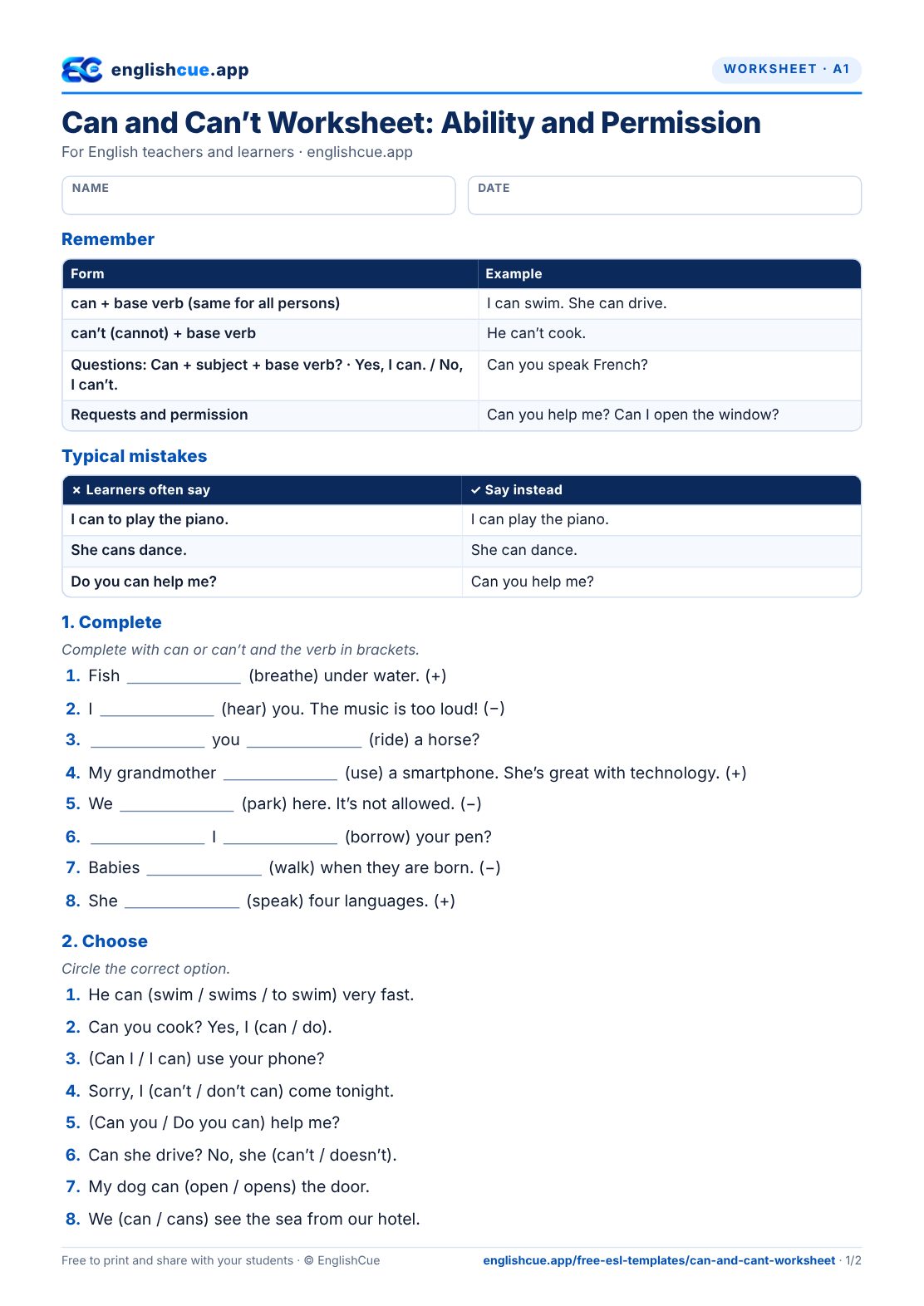
Can and Can’t Worksheet: Ability and Permission previewWorksheet · A1 · PDF with answersCan and Can’t Worksheet: Ability and Permission

The grammar at a glance

The forms your learner will use by the end of the lesson.

CAN

can + base form

She can cook.

ability · possibility

CAN’T

can’t / cannot + base form

You can’t smoke here.

not able · not allowed

QUESTION

Can + subject + verb?

Can you swim? — Yes, I can.

no do

REQUESTS

Can you…? · Can I…?

Can you help me? · Can I sit here?

a favour · permission

Can for every person

Subject+−?
I · you · he · she · it · we · theycan swimcan’t swimCan … swim?

Cannot is one word in the full form. Can’t is the normal short form.

Common mistakes to watch for

The errors students make most often with this structure, and how to explain them.

  • She cans play the piano. → She can play the piano.Can never takes -s.
  • I can to speak English. → I can speak English.No to after can.
  • Do you can help me? → Can you help me?No do with can.
  • He can drives. → He can drive.After can: the base form.
  • I don’t can swim. → I can’t swim.The negative is can’t.
  • “Can you cook?” “Yes, I can cook it.” → “Can you cook?” “Yes, I can.”Short answer: Yes, I can.

Teaching tips

Three “no”s

After can: no -s (she can swim), no to (I can swim, not “can to swim”), and no do in questions (Can you swim?, not “Do you can swim?”).

Hear the difference

In a sentence, can is short and weak: I /kən/ swim. Can’t is long and strong: I /kɑːnt/ swim (British) or /kænt/ (American). Listen for the long vowel, not the t.

Three “no”s

No -s (she can), no to (can swim), no do (Can you…?).

Quick check: three sample questions

Use them as a warm-up or an exit ticket. Answers are below.

  1. Rosa ___ Spanish.
    • can speak
    • cans speak
    • can speaks
  2. I ___ drive. I don’t have a licence.
    • can’t
    • don’t can
    • not can
  3. ___ play the guitar?
    • Do you can
    • Can you
    • You can
Show answers
  1. can speak. Can + base form, no -s.
  2. can’t. Negative: can’t.
  3. Can you. Question: Can + subject + verb?

What the full lesson includes

  • A scene that shows the structure in use, with guided discovery questions.
  • Forms and examples on screen, with colour-coded contrasts.
  • Self-correcting practice: choose, fix, build and rewrite, with an explanation for every answer.
  • A recorded listening with transcript, a speaking task with follow-up questions and a short writing task with a model answer.
  • Teacher mode and self-study mode, so students can review after class.

Where this lesson fits in the course

More modal verbs and the subjunctive lessons

  1. A2Have to, don’t have to, must, mustn’tYou have to wear a uniform. You don’t have to work on Sundays. You mustn’t be late.
  2. A2Should and shouldn’t: adviceYou should take an umbrella. You shouldn’t carry too much cash.
  3. A2Could, couldn’t and was able toI could read when I was four. The road was closed, but we were able to get home.
  4. A2May and might: possibilityIt might rain on Saturday. I may not come. Maybe we’ll go on Sunday.

All modal verbs and the subjunctive lessons → All A1 grammar lessons →

Teach it and practise it

Teach this lesson with EnglishCue PRO.

Share your screen and teach: everything from the warm-up to the writing task is ready.