ENGLISHCUE

Until 30 November: try EnglishCue PRO for US$0.99 your first week, then US$19.90/month, cancel anytime. Try PRO · US$0.99 →

A2 English grammar lesson · Modal verbs and the subjunctive · PRO · 60 min

Should and shouldn’t: advice

You should take an umbrella. You shouldn’t carry too much cash.

The situation

Nina is going to London for the first time. Her friend Josh lived there for two years. Josh: “You should take an umbrella. It rains a lot! And you shouldn’t take taxis: they’re very expensive.” By the end of this lesson you can ask for advice and give advice with should.

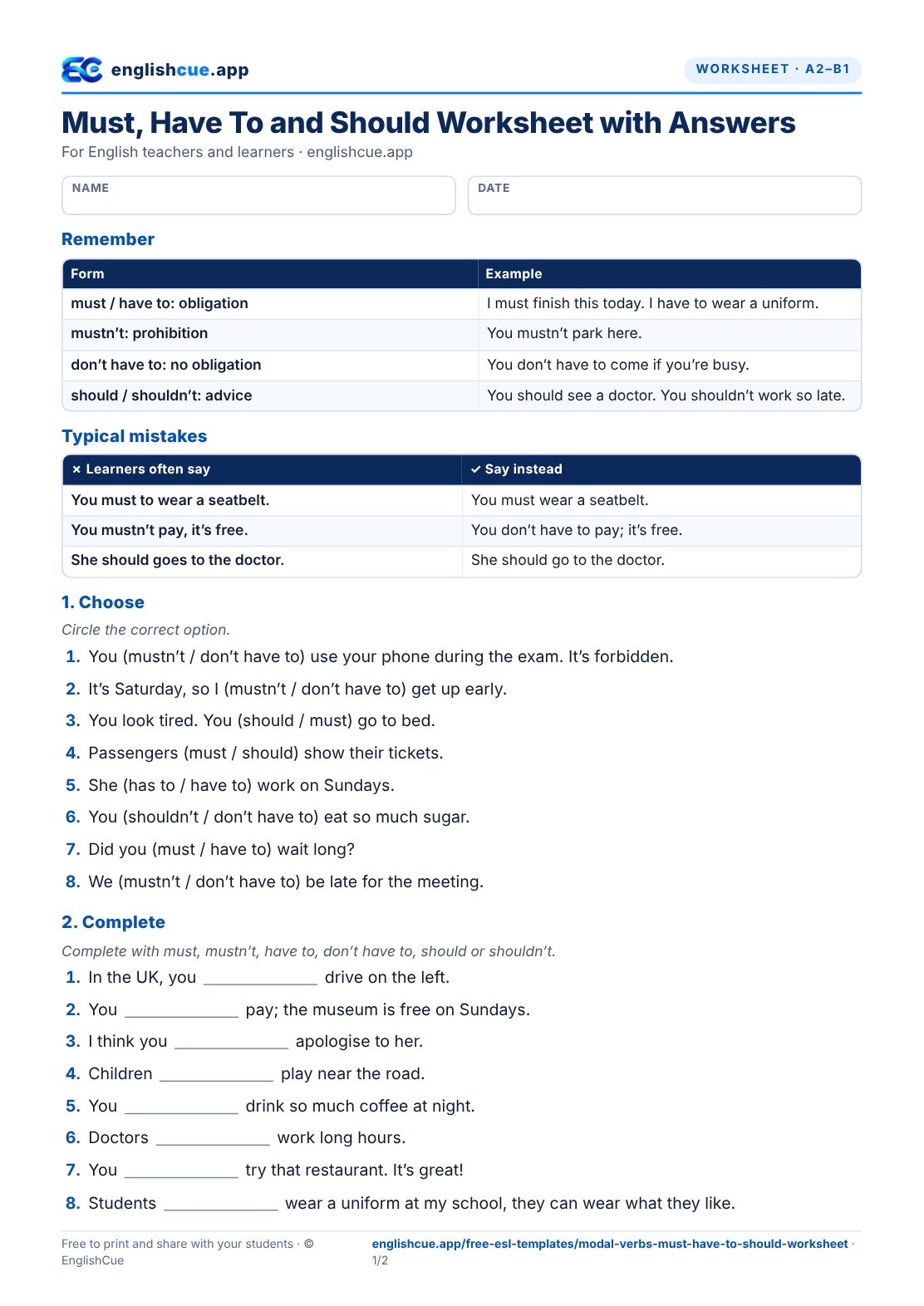
Free practice worksheet

Must, Have To and Should Worksheet with Answers previewWorksheet · A2–B1 · PDF with answersMust, Have To and Should Worksheet with Answers

The grammar at a glance

The forms your learner will use by the end of the lesson.

SHOULD

should + base form

You should take an umbrella.

same for every person

SHOULDN’T

shouldn’t + base form

You shouldn’t take taxis.

a bad idea

ASKING

Should I…? · What should I…?

What should I see first?

I don’t think you should…

SUGGESTIONS

Why don’t you…? · You could…

Why don’t you take the Tube?

friendly ideas

The form

PositiveNegativeQuestion
I / you / he / she should goI / you / he / she shouldn’t goShould I go?
we / they should restwe / they shouldn’t worryWhat should we do?

Like will and must, should is the same for every person: no -s, no to. Short answers: Yes, you should. / No, you shouldn’t.

Common mistakes to watch for

The errors students make most often with this structure, and how to explain them.

  • You should to see a doctor. → You should see a doctor.No to after should.
  • She shoulds study more. → She should study more.Should never changes.
  • Do I should call her? → Should I call her?Questions: Should I…?
  • I think you shouldn’t go. → I don’t think you should go.Natural English puts the negative on think.
  • Why you don’t ask the teacher? → Why don’t you ask the teacher?Why don’t you + base form?
  • You don’t should worry. → You shouldn’t worry.Negative: shouldn’t.

Teaching tips

Next lesson

Ability in the past: could, couldn’t and was able to.

Quick check: three sample questions

Use them as a warm-up or an exit ticket. Answers are below.

  1. You look tired. You ___ go to bed early.
    • should
    • should to
    • shoulds
  2. He ___ eat so much sugar. It’s bad for him.
    • shouldn’t
    • doesn’t should
    • not should
  3. ___ I bring a present?
    • Do
    • Should
    • Am
Show answers
  1. should. Should + base form.
  2. shouldn’t. Shouldn’t: a bad idea.
  3. Should. Should I…?

What the full lesson includes

  • A scene that shows the structure in use, with guided discovery questions.
  • Forms and examples on screen, with colour-coded contrasts.
  • Self-correcting practice: choose, fix, build and rewrite, with an explanation for every answer.
  • A recorded listening with transcript, a speaking task with follow-up questions and a short writing task with a model answer.
  • Teacher mode and self-study mode, so students can review after class.

Where this lesson fits in the course

More modal verbs and the subjunctive lessons

  1. A1Can and can’t: ability and requestsSay what you can do and ask for help: I can cook, I can’t drive. Can you help me?
  2. A2Have to, don’t have to, must, mustn’tYou have to wear a uniform. You don’t have to work on Sundays. You mustn’t be late.
  3. A2Could, couldn’t and was able toI could read when I was four. The road was closed, but we were able to get home.
  4. A2May and might: possibilityIt might rain on Saturday. I may not come. Maybe we’ll go on Sunday.

All modal verbs and the subjunctive lessons → All A2 grammar lessons →

Teach it and practise it

Teach this lesson with EnglishCue PRO.

Share your screen and teach: everything from the warm-up to the writing task is ready.