 ENGLISHCUE
Until 30 November: try EnglishCue PRO for US$0.99 your first week, then US$19.90/month, cancel anytime. Try PRO · US$0.99 →
Worksheet · A2–B1 · For teachers and students · Free PDF, 2 pages
Must, Have To and Should Worksheet with Answers
Must, have to and should are the modals learners use most at work and in daily life, and mustn’t vs don’t have to is one of the most important differences in English: one is a prohibition, the other means there is no obligation. This sheet practises all three, with rules and advice tasks learners can relate to.
Preview
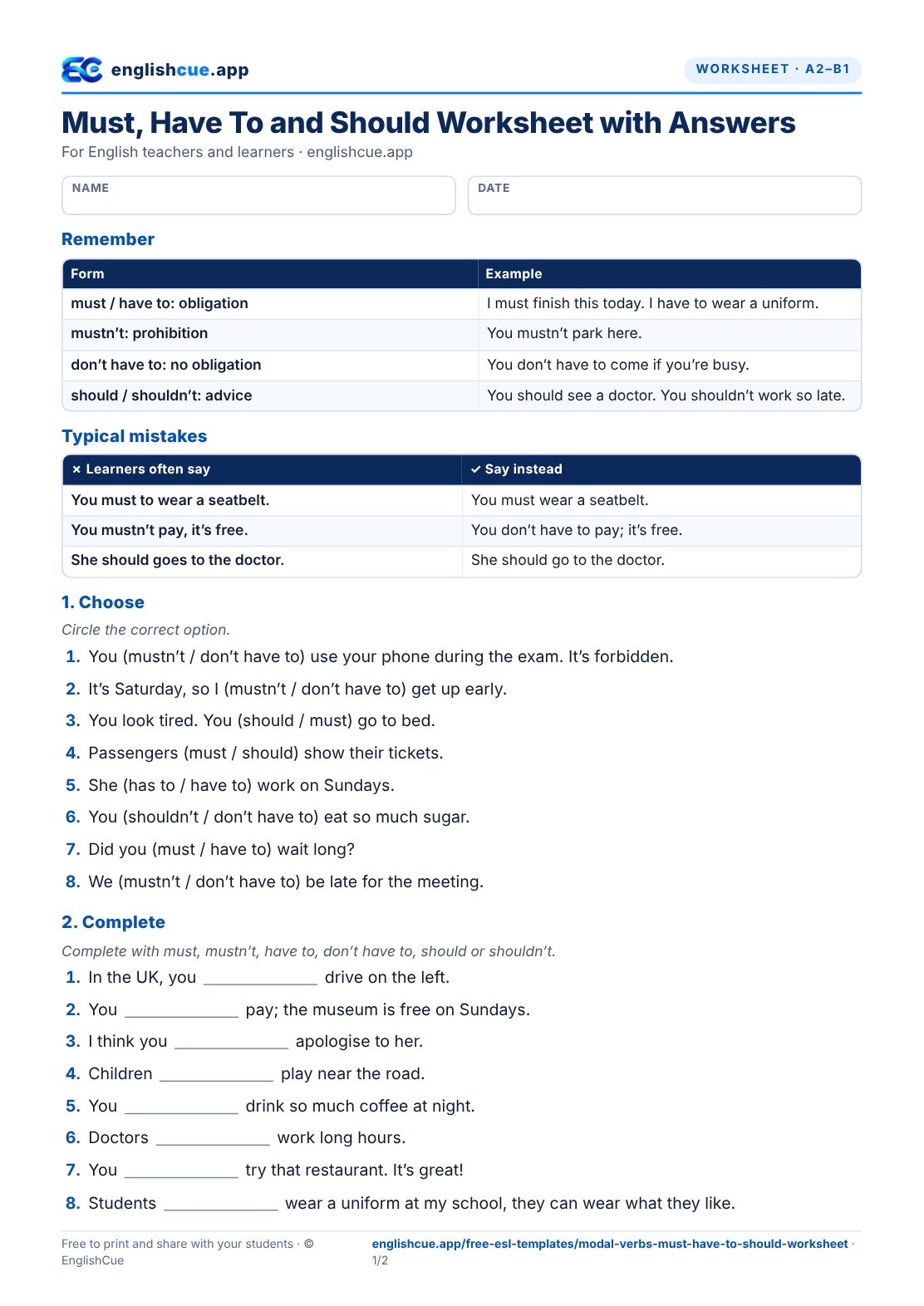
A4, portrait, 2 pages. No sign-up. Free to print, copy and share with your students.
How to use it
- Give a clear pair: ‘You mustn’t smoke here’ (it is forbidden) and ‘You don’t have to wear a tie’ (it is not necessary).
- For advice, ask the learner to bring a real problem a friend has; should sounds more natural with real situations.
- Give the first page in class or share it on screen; the last page ends with a model answer and the answer key, so print it separately or fold it back.
- Do the speaking questions last and spend at least ten minutes on them: the exercises prepare the language, the conversation is where learners own it.
What is on the sheet
The full content, so you can check it before you print or copy an example onto your own slide.
Remember
| Form | Example |
|---|---|
| must / have to: obligation | I must finish this today. I have to wear a uniform. |
| mustn’t: prohibition | You mustn’t park here. |
| don’t have to: no obligation | You don’t have to come if you’re busy. |
| should / shouldn’t: advice | You should see a doctor. You shouldn’t work so late. |
Typical mistakes
| ✗ Learners often say | ✓ Say instead |
|---|---|
| You must to wear a seatbelt. | You must wear a seatbelt. |
| You mustn’t pay, it’s free. | You don’t have to pay; it’s free. |
| She should goes to the doctor. | She should go to the doctor. |
1. Choose
Circle the correct option.
- You (mustn’t / don’t have to) use your phone during the exam. It’s forbidden.
- It’s Saturday, so I (mustn’t / don’t have to) get up early.
- You look tired. You (should / must) go to bed.
- Passengers (must / should) show their tickets.
- She (has to / have to) work on Sundays.
- You (shouldn’t / don’t have to) eat so much sugar.
- Did you (must / have to) wait long?
- We (mustn’t / don’t have to) be late for the meeting.
2. Complete
Complete with must, mustn’t, have to, don’t have to, should or shouldn’t.
- In the UK, you ___ drive on the left.
- You ___ pay; the museum is free on Sundays.
- I think you ___ apologise to her.
- Children ___ play near the road.
- You ___ drink so much coffee at night.
- Doctors ___ work long hours.
- You ___ try that restaurant. It’s great!
- Students ___ wear a uniform at my school, they can wear what they like.
3. Correct the mistakes
Correct the mistake in each sentence.
- You must to wear a helmet.
- She have to leave early.
- You don’t must smoke here.
- I musted work late yesterday.
- You should to see a doctor.
- Do I must bring anything?
Writing
Write 6 rules and tips for a new person in your job, school or house. Use must, mustn’t, have to, don’t have to and should.
Speaking
- What do you have to do at work or school that you don’t enjoy?
- What are three rules in your home or office? What mustn’t people do?
- What don’t you have to do now that you had to do as a child?
- Give advice: a friend wants to learn English fast; a colleague is always stressed.
Show the answer key
1. Choose: 1 mustn’t · 2 don’t have to · 3 should · 4 must · 5 has to · 6 shouldn’t · 7 have to · 8 mustn’t
2. Complete: 1 have to / must · 2 don’t have to · 3 should · 4 mustn’t · 5 shouldn’t · 6 have to · 7 should (or must) · 8 don’t have to
3. Correct the mistakes: 1 You must wear a helmet. · 2 She has to leave early. · 3 You mustn’t smoke here. · 4 I had to work late yesterday. · 5 You should see a doctor. · 6 Do I have to bring anything?
Writing, model answer: Welcome to the office! You have to sign in at reception every morning. You must wear your badge at all times. You mustn’t eat at your desk, but there is a nice kitchen. You don’t have to wear a suit; jeans are fine. You should bring your own mug. And you should ask questions: everyone is happy to help.
Use it with
More free worksheets
All 100 free worksheets by level, with a PDF pack per level →
Found this useful?
EnglishCue also has complete interactive lessons that open on screen, with audio, practice and speaking tasks.