ENGLISHCUE

Until 30 November: try EnglishCue PRO for US$0.99 your first week, then US$19.90/month, cancel anytime. Try PRO · US$0.99 →

B1 English grammar lesson · Modal verbs and the subjunctive · PRO · 60 min

Obligation and permission: allowed to, supposed to, need to

We’re not allowed to use our phones. We’re supposed to start at eight. You don’t need to wear a tie.

The situation

Zara starts a summer job at a hotel. Her manager explains: “You’re allowed to eat in the staff room, but you’re not allowed to use your phone at reception. You’re supposed to start at eight, and you don’t need to wear a tie.” By the end of this lesson you can talk about rules, permission and necessity.

Free practice worksheet

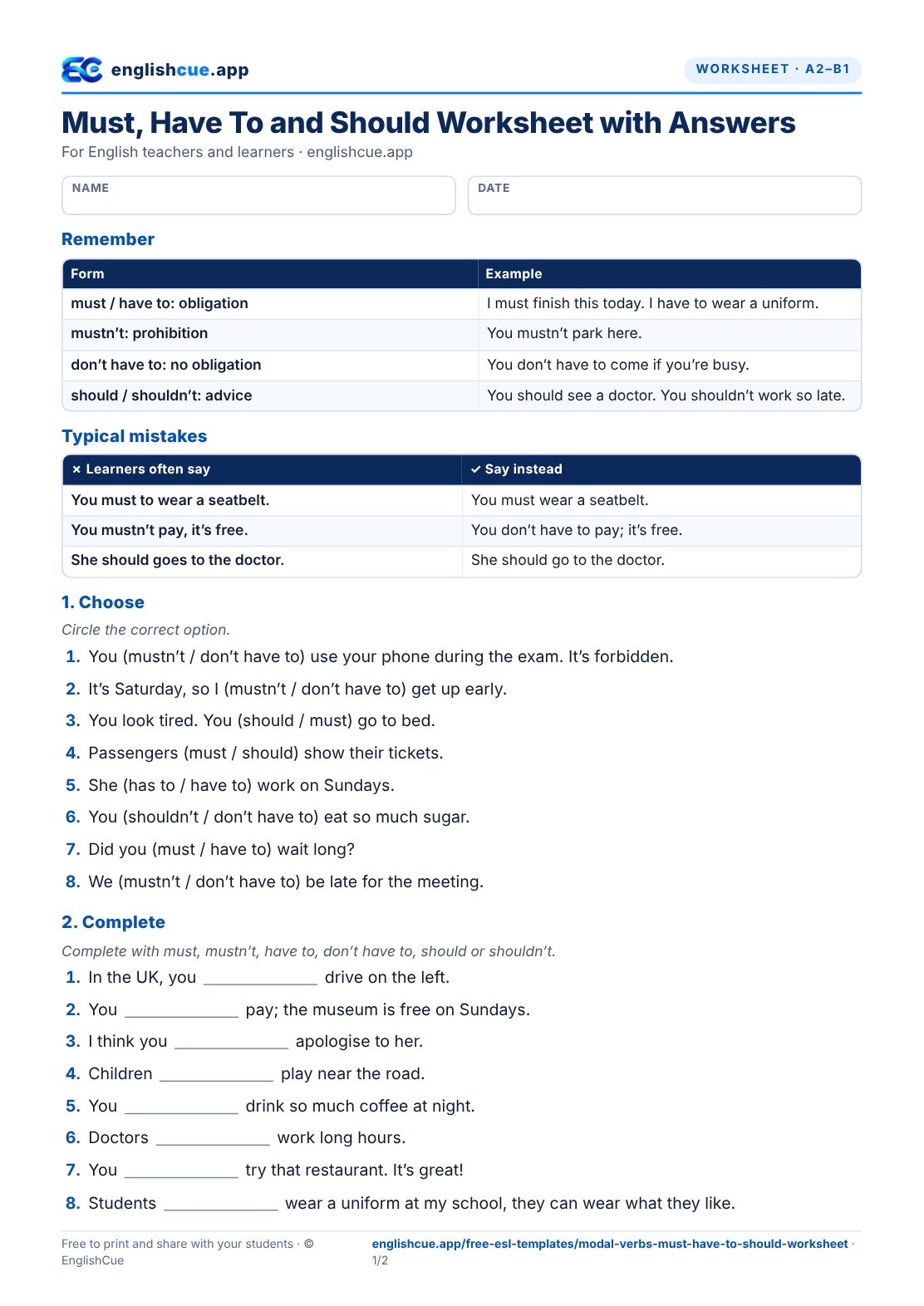
Must, Have To and Should Worksheet with Answers previewWorksheet · A2–B1 · PDF with answersMust, Have To and Should Worksheet with Answers

The grammar at a glance

The forms your learner will use by the end of the lesson.

PERMITTED

be allowed to · can

You’re allowed to eat here.

past: was allowed to

PROHIBITED

not allowed to · can’t · mustn’t

You’re not allowed to smoke.

not “don’t allow to”

EXPECTED

be supposed to

We’re supposed to start at eight.

often: but…

NOT NECESSARY

don’t need to · don’t have to · needn’t

You don’t need to pay.

≠ mustn’t

Four kinds of rule

MeaningStructureExample
permittedbe allowed to / canYou’re allowed to eat in the staff room.
prohibitednot be allowed to / can’t / mustn’tYou’re not allowed to use your phone at reception.
the rule, what people expectbe supposed toYou’re supposed to start at eight.
not necessarydon’t need to / don’t have toYou don’t need to wear a tie.

All of them are followed by the base form: allowed to eat, supposed to start, need to wear.

Common mistakes to watch for

The errors students make most often with this structure, and how to explain them.

  • We don’t allow to use phones here. → We aren’t allowed to use phones here.Passive: be allowed to.
  • You are supposed wear a uniform. → You are supposed to wear a uniform.Supposed to.
  • You don’t need bring anything. → You don’t need to bring anything.Need to + base form.
  • I’m not allowed going out. → I’m not allowed to go out.Allowed to + base form.
  • You mustn’t pay. It’s free. → You don’t need to pay. It’s free.Not necessary ≠ prohibited.
  • We were suppose to meet at six. → We were supposed to meet at six.Supposed (with -d).

Teaching tips

Needn’t

In British English, needn’t + base form also means not necessary: “You needn’t come.” It is a little formal.

Next lesson

Polite requests and offers: could you, would you mind, shall I.

Quick check: three sample questions

Use them as a warm-up or an exit ticket. Answers are below.

  1. Guests ___ smoke in the rooms. It’s prohibited.
    • aren’t allowed to
    • don’t need to
    • are supposed to
  2. You ___ book a table. There’s always space.
    • don’t need to
    • aren’t allowed to
    • are supposed to
  3. We ___ arrive at 8, but the bus is often late.
    • ’re supposed to
    • ’re allowed to
    • don’t need to
Show answers
  1. aren’t allowed to. Prohibited.
  2. don’t need to. Not necessary.
  3. ’re supposed to. The rule, not always followed.

What the full lesson includes

  • A scene that shows the structure in use, with guided discovery questions.
  • Forms and examples on screen, with colour-coded contrasts.
  • Self-correcting practice: choose, fix, build and rewrite, with an explanation for every answer.
  • A recorded listening with transcript, a speaking task with follow-up questions and a short writing task with a model answer.
  • Teacher mode and self-study mode, so students can review after class.

Where this lesson fits in the course

More modal verbs and the subjunctive lessons

  1. A2Could, couldn’t and was able toI could read when I was four. The road was closed, but we were able to get home.
  2. A2May and might: possibilityIt might rain on Saturday. I may not come. Maybe we’ll go on Sunday.
  3. B1Must, might, can’t: deduction in the presentHe must be tired. She might be at the gym. That can’t be true!
  4. B1Polite requests and offers: could you, would you mindCould you send me the file? Would you mind closing the door? Shall I make some coffee?

All modal verbs and the subjunctive lessons → All B1 grammar lessons →

Teach it and practise it

Teach this lesson with EnglishCue PRO.

Share your screen and teach: everything from the warm-up to the writing task is ready.