ENGLISHCUE

Until 30 November: try EnglishCue PRO for US$0.99 your first week, then US$19.90/month, cancel anytime. Try PRO · US$0.99 →

A2 English grammar lesson · Modal verbs and the subjunctive · PRO · 60 min

May and might: possibility

It might rain on Saturday. I may not come. Maybe we’ll go on Sunday.

The situation

Ella and her friends want to go camping. Ella: “The forecast isn’t great. It might rain on Saturday.” Ryan: “I may not come. I might have to work.” By the end of this lesson you can talk about things that are possible but not sure.

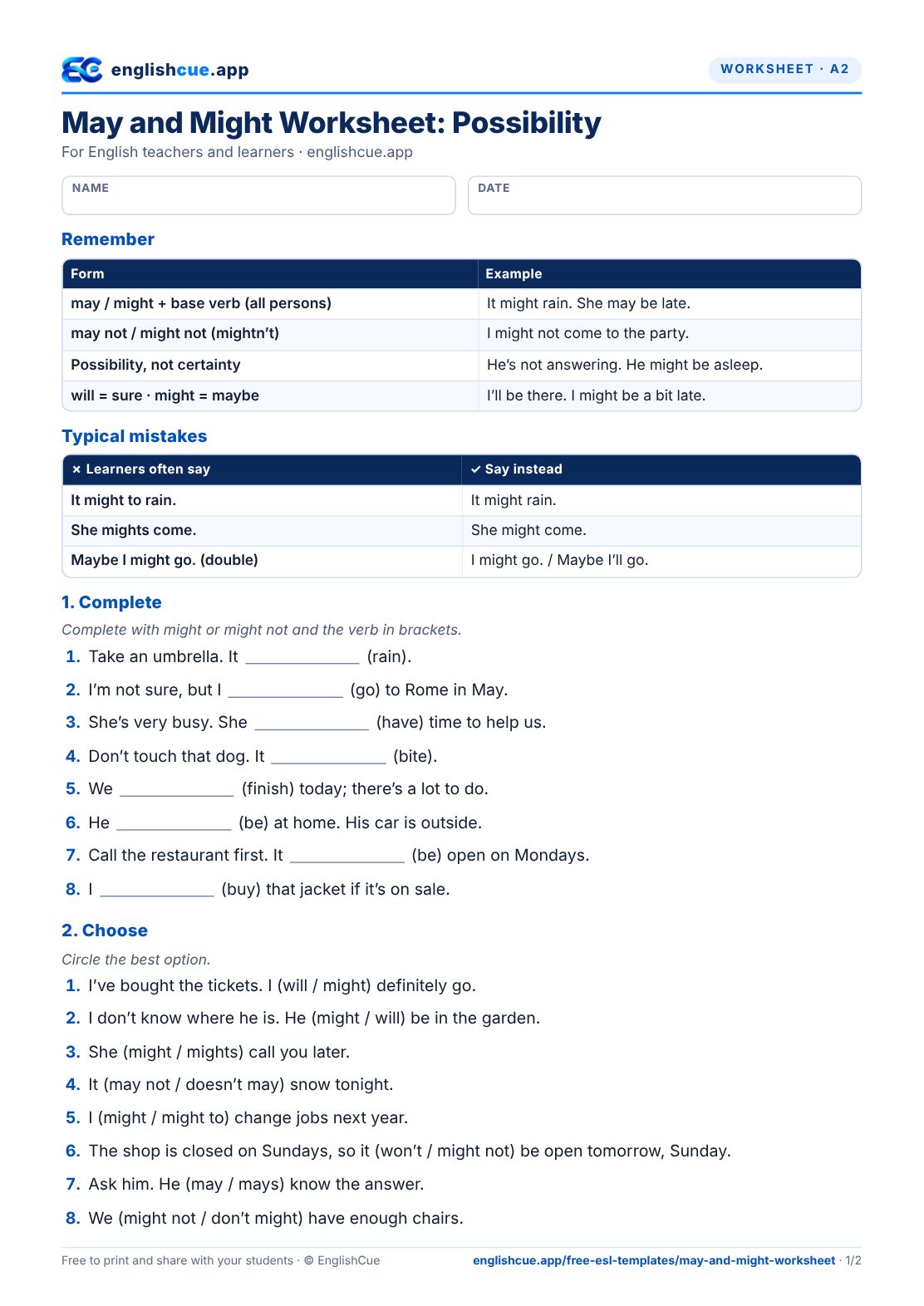
Free practice worksheet

May and Might Worksheet: Possibility previewWorksheet · A2 · PDF with answersMay and Might Worksheet: Possibility

The grammar at a glance

The forms your learner will use by the end of the lesson.

MAY / MIGHT

may / might + base form

It might rain.

about 50%

NEGATIVE

may not / might not

I might not come.

possibly not

MAYBE

Maybe + will

Maybe I’ll call you.

one word = perhaps

QUESTIONS

Do you think … will …?

Do you think it’ll rain? — It might.

not “Might it…?”

The form

PositiveNegative
It might rain.It might not rain.
She may be at home.She may not be at home.
We might go camping.We might not go camping.

May and might mean almost the same. Might is more common in conversation; may is a little more formal. Both are the same for every person: no -s, no to.

Common mistakes to watch for

The errors students make most often with this structure, and how to explain them.

  • It might to snow tomorrow. → It might snow tomorrow.No to after might.
  • She mights be late. → She might be late.Might never changes.
  • I don’t might go. → I might not go.Negative: might not.
  • May be I’ll visit you. → Maybe I’ll visit you.Maybe = perhaps (one word).
  • Might it rain tomorrow? → Do you think it’ll rain tomorrow?Natural questions: Do you think…?
  • Maybe I might go. → Maybe I’ll go. / I might go.Don’t use maybe and might together.

Teaching tips

Next lesson

Verb patterns: verb + to-infinitive or -ing (I want to go, I enjoy going).

Quick check: three sample questions

Use them as a warm-up or an exit ticket. Answers are below.

  1. Take a coat. It ___ be cold tonight.
    • might
    • might to
    • mights
  2. I ___ come to the party. I’m very tired.
    • might not
    • don’t might
    • mightn’t to
  3. “Where’s Tom?” “I don’t know. He ___ be in the garden.”
    • may
    • mays
    • is may
Show answers
  1. might. Might + base form.
  2. might not. Negative: might not.
  3. may. May + base form.

What the full lesson includes

  • A scene that shows the structure in use, with guided discovery questions.
  • Forms and examples on screen, with colour-coded contrasts.
  • Self-correcting practice: choose, fix, build and rewrite, with an explanation for every answer.
  • A recorded listening with transcript, a speaking task with follow-up questions and a short writing task with a model answer.
  • Teacher mode and self-study mode, so students can review after class.

Where this lesson fits in the course

More modal verbs and the subjunctive lessons

  1. A2Have to, don’t have to, must, mustn’tYou have to wear a uniform. You don’t have to work on Sundays. You mustn’t be late.
  2. A2Should and shouldn’t: adviceYou should take an umbrella. You shouldn’t carry too much cash.
  3. A2Could, couldn’t and was able toI could read when I was four. The road was closed, but we were able to get home.
  4. B1Must, might, can’t: deduction in the presentHe must be tired. She might be at the gym. That can’t be true!

All modal verbs and the subjunctive lessons → All A2 grammar lessons →

Teach it and practise it

Teach this lesson with EnglishCue PRO.

Share your screen and teach: everything from the warm-up to the writing task is ready.