MUST
I’m sure it’s true
He must be tired.
strong evidence ENGLISHCUE
Until 30 November: try EnglishCue PRO for US$0.99 your first week, then US$19.90/month, cancel anytime. Try PRO · US$0.99 →
B1 English grammar lesson · Modal verbs and the subjunctive · PRO · 60 min
He must be tired. She might be at the gym. That can’t be true!
Ana comes home and finds an empty pizza box, three plates and a strange jacket in the kitchen. “Somebody must be here. That jacket can’t be Jake’s: it’s too big. It might be his brother’s.” By the end of this lesson you can make deductions about the present.
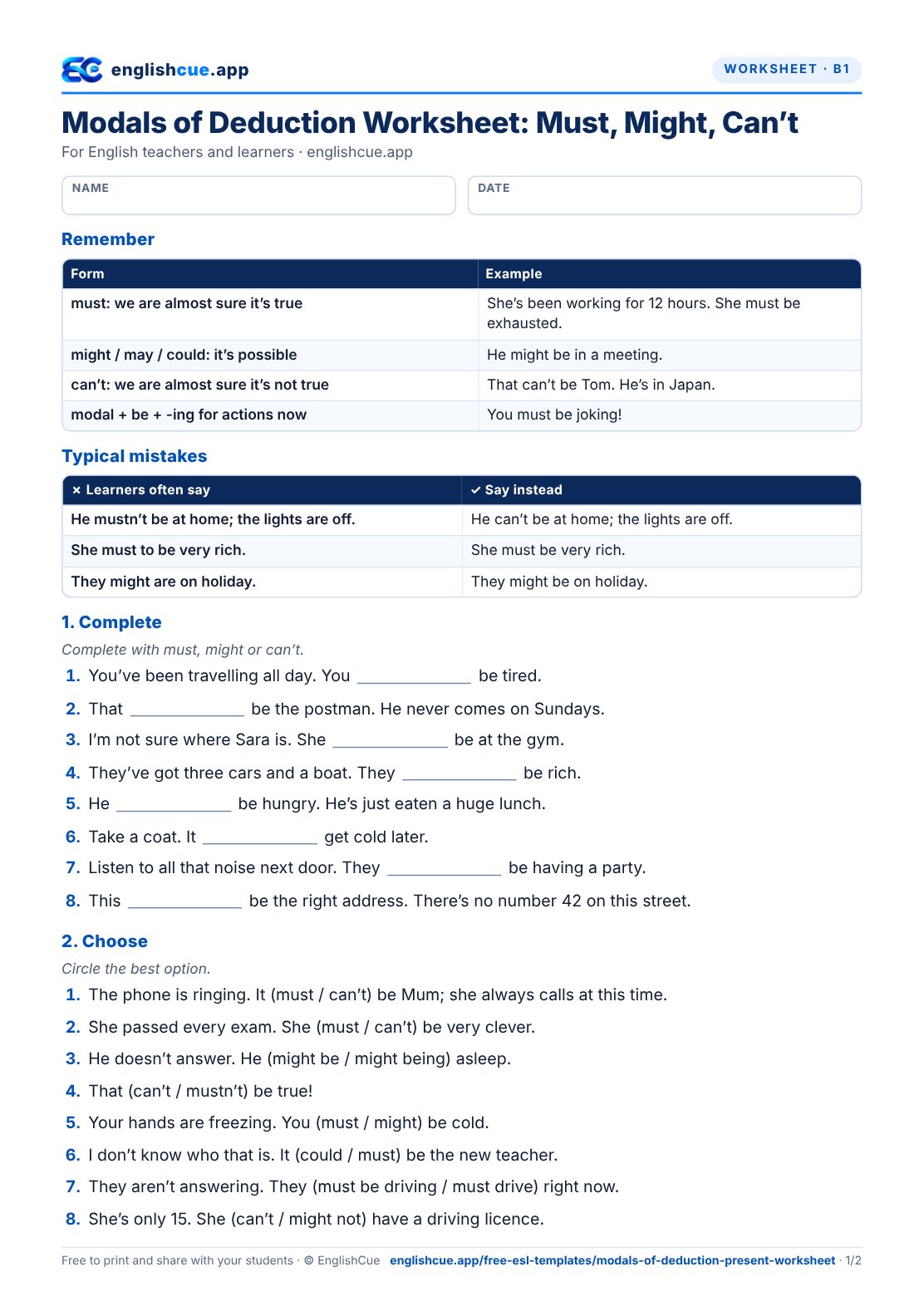 Worksheet · B1 · PDF with answersModals of Deduction Worksheet: Must, Might, Can’t
The forms your learner will use by the end of the lesson.
I’m sure it’s true
He must be tired.
strong evidencepossible
She might be at the gym.
might not = possibly notI’m sure it isn’t true
That can’t be Jake.
not mustn’tactions now
They must be watching the match.
modal + be + -ing| Certainty | Modal | Example |
|---|---|---|
| almost 100% · I’m sure it’s true | must | Somebody must be here. |
| about 50% · possible | might / may / could | It might be his brother’s. |
| about 50% · possibly not | might not / may not | He might not know about it. |
| almost 0% · I’m sure it isn’t true | can’t | It can’t be Jake’s. |
Modal + base form (no to). For actions now: modal + be + -ing (He must be sleeping).
The errors students make most often with this structure, and how to explain them.
In deduction, the opposite of must is can’t: “He must be rich.” → “He can’t be poor.” Mustn’t means prohibited (You mustn’t smoke).
Rules and permission: allowed to, supposed to, need to.
Use them as a warm-up or an exit ticket. Answers are below.
All modal verbs and the subjunctive lessons → All B1 grammar lessons →
Share your screen and teach: everything from the warm-up to the writing task is ready.