COULD
could + base form
I could swim when I was six.
general ability in the past ENGLISHCUE
Until 30 November: try EnglishCue PRO for US$0.99 your first week, then US$19.90/month, cancel anytime. Try PRO · US$0.99 →
A2 English grammar lesson · Modal verbs and the subjunctive · PRO · 60 min
I could read when I was four. The road was closed, but we were able to get home.
Lily, 12, talks to her grandpa Frank. Frank: “When I was your age, I could climb any tree, but I couldn’t use a computer. There weren’t any!” Lily: “I couldn’t ride a bike until I was nine.” By the end of this lesson you can talk about what you could and couldn’t do in the past.
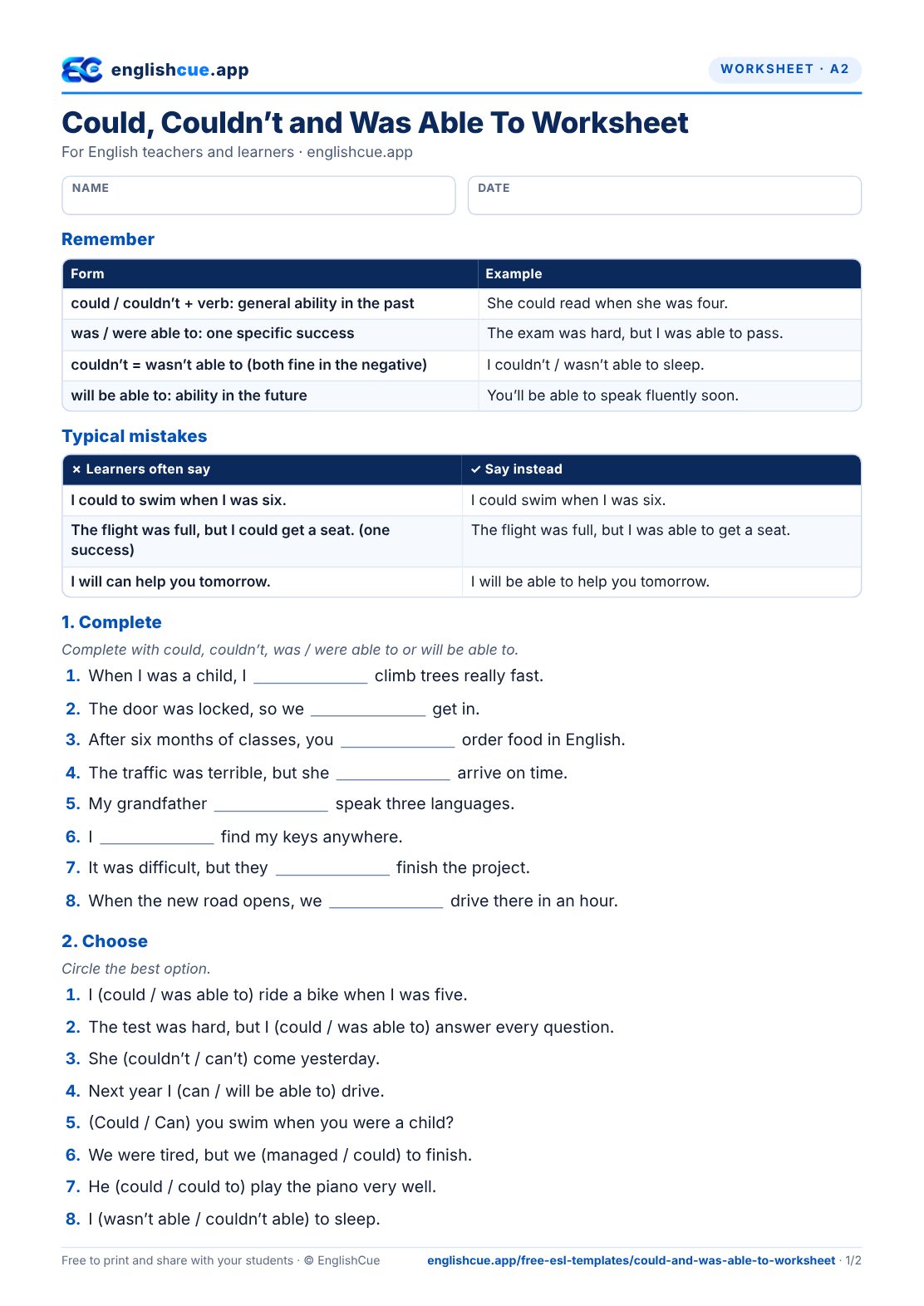 Worksheet · A2 · PDF with answersCould, Couldn’t and Was Able To Worksheet
The forms your learner will use by the end of the lesson.
could + base form
I could swim when I was six.
general ability in the pastcouldn’t + base form
I couldn’t see the path.
general or one situationwas / were able to · managed to
We were able to send a message.
one specific successCould you…?
Could you read at four?
Yes, I could. / No, I couldn’t.| Present | Past |
|---|---|
| I can swim. | I could swim when I was six. |
| She can’t drive. | She couldn’t drive in 2015. |
| Can you read? | Could you read when you were four? |
Could is the past of can. It is the same for every person: no -s, no -ed, no to. Short answers: Yes, I could. / No, I couldn’t.
The errors students make most often with this structure, and how to explain them.
In the negative, couldn’t works for both: “I couldn’t swim as a child.” (general) and “I tried, but I couldn’t open the door.” (one situation).
Possibility: may and might.
Use them as a warm-up or an exit ticket. Answers are below.
All modal verbs and the subjunctive lessons → All A2 grammar lessons →
Share your screen and teach: everything from the warm-up to the writing task is ready.