 ENGLISHCUE
Until 30 November: try EnglishCue PRO for US$0.99 your first week, then US$19.90/month, cancel anytime. Try PRO · US$0.99 →
Worksheet · C2 · For teachers and students · Free PDF, 3 pages
British vs American Grammar Worksheet
Did you eat yet? Have you eaten yet? The team is / are winning. On the weekend / at the weekend. British and American English share almost all their grammar, but the differences matter for teachers, translators and anyone writing for a specific audience. This sheet practises the most frequent ones, so learners can recognise both and choose one consistently.
Preview
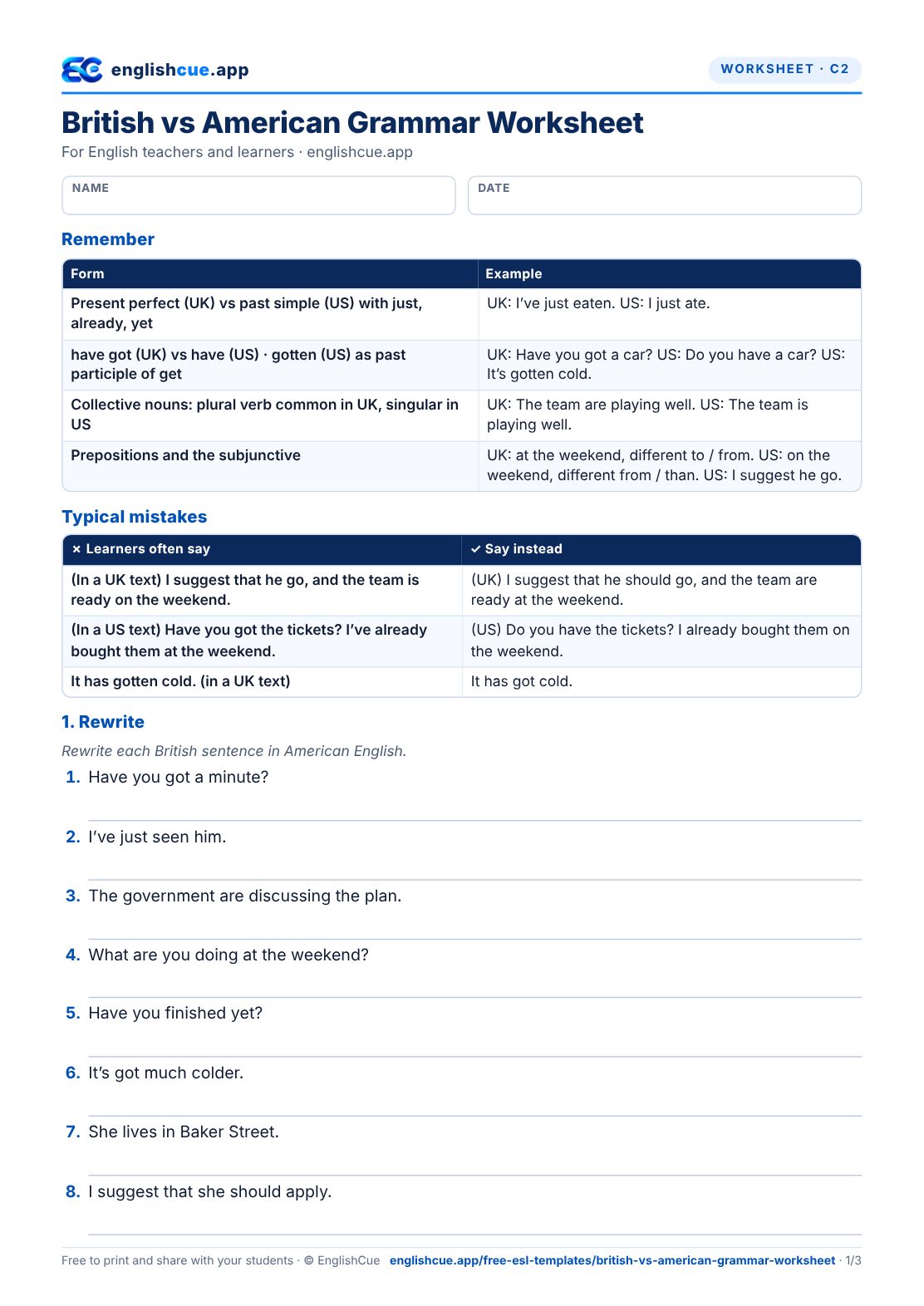
A4, portrait, 3 pages. No sign-up. Free to print, copy and share with your students.
How to use it
- Ask learners which variety they hear most (series, music, work) and which they want to write in. Consistency matters more than the choice.
- Make clear that neither variety is ‘correct’; mixing them in one formal text is the only real problem.
- Give the first page in class or share it on screen; the last page ends with a model answer and the answer key, so print it separately or fold it back.
- Do the speaking questions last and spend at least ten minutes on them: the exercises prepare the language, the conversation is where learners own it.
What is on the sheet
The full content, so you can check it before you print or copy an example onto your own slide.
Remember
| Form | Example |
|---|---|
| Present perfect (UK) vs past simple (US) with just, already, yet | UK: I’ve just eaten. US: I just ate. |
| have got (UK) vs have (US) · gotten (US) as past participle of get | UK: Have you got a car? US: Do you have a car? US: It’s gotten cold. |
| Collective nouns: plural verb common in UK, singular in US | UK: The team are playing well. US: The team is playing well. |
| Prepositions and the subjunctive | UK: at the weekend, different to / from. US: on the weekend, different from / than. US: I suggest he go. |
Typical mistakes
| ✗ Learners often say | ✓ Say instead |
|---|---|
| (In a UK text) I suggest that he go, and the team is ready on the weekend. | (UK) I suggest that he should go, and the team are ready at the weekend. |
| (In a US text) Have you got the tickets? I’ve already bought them at the weekend. | (US) Do you have the tickets? I already bought them on the weekend. |
| It has gotten cold. (in a UK text) | It has got cold. |
1. Rewrite
Rewrite each British sentence in American English.
- Have you got a minute?
- I’ve just seen him.
- The government are discussing the plan.
- What are you doing at the weekend?
- Have you finished yet?
- It’s got much colder.
- She lives in Baker Street.
- I suggest that she should apply.
2. Choose
Which version is typically British (UK) and which American (US)? Circle the British option.
- (at the weekend / on the weekend)
- (Have you got / Do you have) any brothers?
- (The team are / The team is) arriving tomorrow.
- (I’ve already eaten / I already ate).
- (different to / different than)
- (He has got used to it / He has gotten used to it).
- (Monday to Friday / Monday through Friday)
- (I’ll write you / I’ll write to you).
3. Correct the mistakes
Each sentence mixes the two varieties. Make it consistently British.
- Did you finish yet? I’ve got to leave.
- I’ve gotten a new job and I start Monday.
- The committee is meeting at the weekend and they have decided.
- She lives on Oxford Street and works at the weekend.
- I just saw the news and I’ve already called my mum.
- Write me when you arrive.
Writing
Write a short email (6 sentences) to an American colleague about weekend plans, then rewrite the same email for a British colleague, changing every grammar feature that differs.
Speaking
- Which variety of English do you hear most? Where?
- Do you think teachers should teach one variety or both? Why?
- Which British or American expressions do you find strange?
- Does your language have regional grammar differences? Give an example.
Show the answer key
1. Rewrite: 1 Do you have a minute? · 2 I just saw him. · 3 The government is discussing the plan. · 4 What are you doing on the weekend? · 5 Did you finish yet? / Have you finished yet? (both used in US) · 6 It’s gotten much colder. · 7 She lives on Baker Street. · 8 I suggest that she apply.
2. Choose: 1 at the weekend · 2 Have you got · 3 The team are · 4 I’ve already eaten · 5 different to · 6 He has got used to it · 7 Monday to Friday · 8 I’ll write to you
3. Correct the mistakes: 1 Have you finished yet? I’ve got to leave. · 2 I’ve got a new job and I start on Monday. · 3 The committee are meeting at the weekend and they have decided. · 4 She lives in Oxford Street and works at the weekend. · 5 I’ve just seen the news and I’ve already called my mum. · 6 Write to me when you arrive.
Writing, model answer: US: Hi Josh! Did you get my message yet? I just booked the cabin for the weekend. Do you have a sleeping bag? The team is really excited. I suggest that everyone bring warm clothes; it’s gotten cold. UK: Hi Josh! Have you got my message yet? I’ve just booked the cabin for the weekend. Have you got a sleeping bag? The team are really excited. I suggest that everyone brings / should bring warm clothes; it’s got cold.
Use it with
More free worksheets
All 100 free worksheets by level, with a PDF pack per level →
Found this useful?
EnglishCue also has complete interactive lessons that open on screen, with audio, practice and speaking tasks.